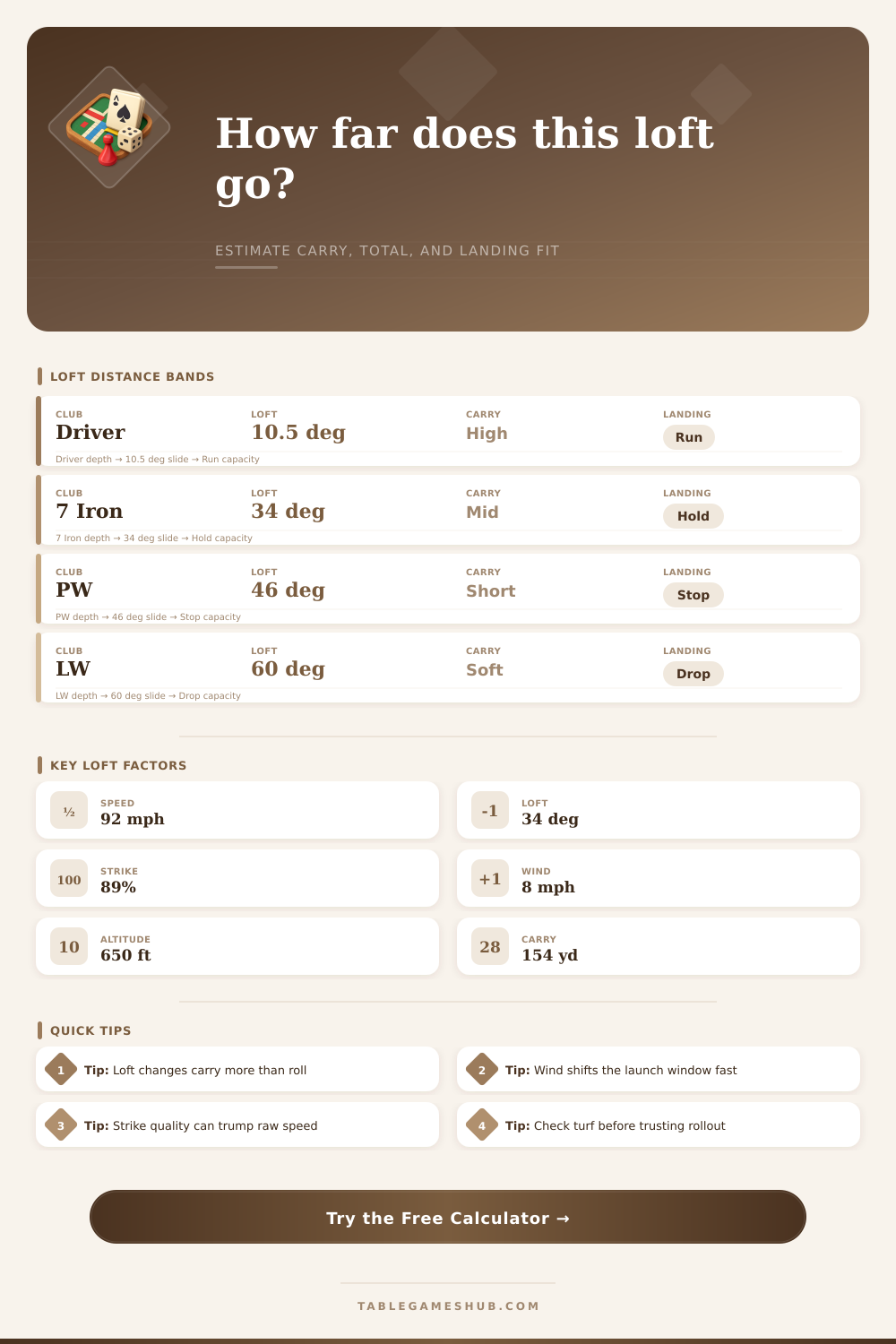
Golf Club Loft Distance Calculator
Map loft, speed, and conditions into a carry window that fits your bag.
Club Loft Bands
| Club Family | Typical Loft | Carry Pattern | Landing Pattern |
|---|---|---|---|
| Driver | 8° to 12° | Longest carry | Shallow run |
| Fairway Wood | 13° to 17° | High launch | Moderate run |
| Mid Iron | 27° to 36° | Balanced carry | Firm hold |
| Wedge | 46° to 60° | Short carry | Soft stop |
Condition Adjustment Matrix
| Condition | Carry Change | Roll Change | Best Fit |
|---|---|---|---|
| Soft turf | Flat | Lower | Green hold |
| Firm turf | Flat | Higher | Chase shots |
| Headwind | Down | Down | More club |
| Altitude | Up | Up | Extra carry |
Strike Quality Bands
| Strike Band | Carry Range | Launch Shape | Stop Notes |
|---|---|---|---|
| Flush | Best window | Stable | Clean drop |
| Toe strike | Slight loss | Lower spin | More run |
| Heel strike | Slight loss | Wobble | Less hold |
| Heavy contact | Big loss | Knocked down | Short finish |
Loft Gapping Rules
| Gap Size | Carry Shift | Total Shift | Use Case |
|---|---|---|---|
| 2 degrees | Tight gap | Small change | Precise fit |
| 4 degrees | Clean split | Clear move | Bag spacing |
| 6 degrees | Large jump | More rollout | Shot change |
| 8 degrees | Big shift | Very different | Special use |
Loft is the measurement of an angle of the club face. The loft of the club determine the launch angle and spin rates of the golf ball. Clubs with a higher loft will launch the ball at a higher angle with more spin on the ball but with a steeper descent angle of the ball.
Clubs with a lower loft will launch the ball at a lower angle with less spin on the ball but will travel more further on the turf after hitting the ground with the ball. Understanding the effect of the loft of clubs will help you to understand how the loft of clubs change the trajectory of the ball through the air. Swing speed is one variable that will change how loft function in clubs.
How Club Loft Affects Ball Flight and Distance
The faster the swing speed with which a person swings the club, the clubs will interact differently with the golf ball. A high swing speed will produce a different result from a club compared to when a person swings with a low swing speed. The strike quality with which a player hits the ball with the club is another variable that affects the loft of clubs.
The location where a person strikes the ball will change the dynamic loft of clubs. For instance, hitting the ball on the toe of the club will produce a decrease in the carry distance of the ball. Hitting the ball on the heel of the club will change the trajectory of the ball.
Environmental factor change the way clubs function. Environmental factors include wind, altitude, and turf firmness. Wind will change the carry distance of the ball.
A headwind will change the carry distance of the ball to a lesser distance. A tailwind will change the carry distance of the ball to a further distance. The higher the altitude the club is hit with the ball, the less dense the air will be.
The less dense the air, the further the ball will travel. Lastly, turf firmness will change the rollout of the ball on the course. On soft turf the ground will absorb the ball.
On firm turf the ball will roll further on the course. When planning a golf bag, a person should consider the carry distance of each club rather than the total distance the ball will travel. Carry distance is the distance the ball will travel through the air before it hits the ground.
Total distance is the carry distance of the ball plus the rollout distance of the ball after it hits the ground. The rollout distance is dependent upon the firmness of the turf. For clubs to have a consistent gap between each club the loft should differ by 4 degrees.
Clubs with a 4-degree loft will create a consistent carry distance. This allows a person to understand which club will travel the ball to a specific distance. Hybrid clubs are clubs in between woods and irons.
The loft of hybrid clubs is between 18 and 22 degrees. Hybrid clubs will launch the ball higher than long irons but have more rollout on firm turf than long irons. Fairway woods have a loft between 13 and 17 degrees.
Fairway woods are easy to hit than drivers. Mid irons have a loft between 27 and 36 degrees. Mid irons allow a player to have a firm flight without too much height.
Wedge clubs have a loft of over 42 degrees. Wedge clubs produce high amounts of spin on the ball and create a steep descent angle for the ball. A person can improve their accuracy in driving golf balls by analyzing the sample size of the swings they take with their clubs.
If a person swings more times with their clubs the laws of probability will create a tighter window in which their ball will travel. The more narrow the window for the golf balls to travel the better they can plan their shots. Using the data from their swings a person can find gaps between their clubs in the golf bag.
These gaps can allow a player to determine if they need to change clubs or the shafts of their clubs. Through understanding the factors mentioned above, when faced with a specific type of shot a player can determine which club to use to hit that shot.