Bocce Ball Pallino Distance Calculator
Check whether the pallino throw is in your valid zone, compare bocce ball measurements to the pallino, apply measurement tolerance, and score the closest balls for one end.
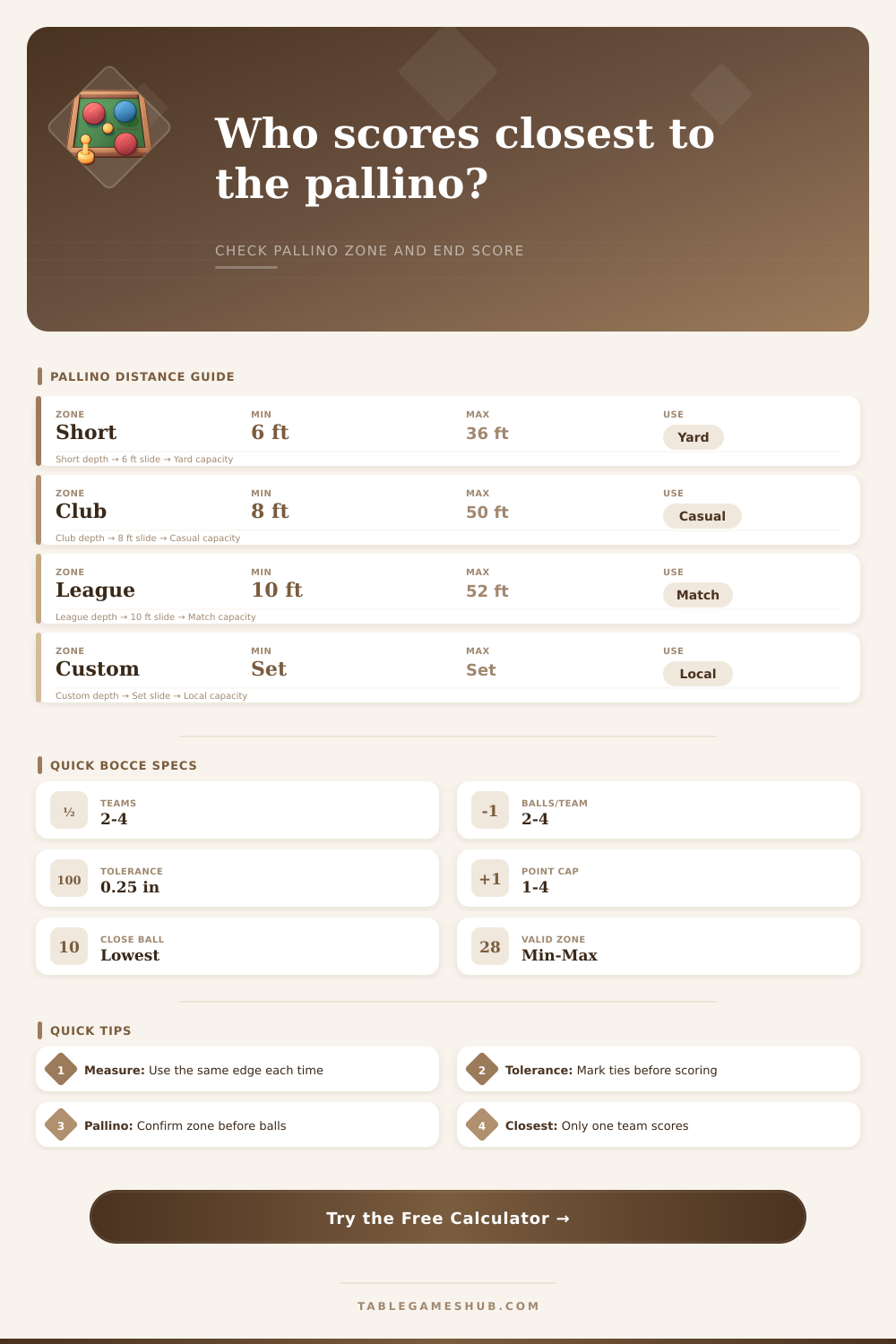
| Court zone | Typical minimum | Typical maximum | Best use |
|---|---|---|---|
| Short-court house zone | 6 ft | 36 ft | Yard or compact social play |
| Club casual zone | 8 ft | 50 ft | Flexible recreational games |
| League match zone | 10 ft | 52 ft | More deliberate pallino placement |
| Tight match zone | 12 ft | 48 ft | Measured competitive calls |
| Custom local zone | User entered | User entered | Use posted court or league rules |
| Team A distances | Team B distances | Winner | Score logic |
|---|---|---|---|
| 3, 7, 11, 20 in | 5, 9, 12, 18 in | Team A, 1 | Only 3 in beats B's 5 in best |
| 2, 4, 8, 14 in | 7, 12, 18, 24 in | Team A, 2 | 2 and 4 in beat B's 7 in best |
| 6, 9, 14, 22 in | 2, 5, 13, 30 in | Team B, 2 | 2 and 5 in beat A's 6 in best |
| 4.1, 10, 20 in | 4.2, 9, 15 in | Review | Closest balls are inside tolerance |
| Bocce gap | Metric gap | Call type | Scoring impact |
|---|---|---|---|
| 0 in | 0 cm | Touching pallino | Always closest unless tied by contact |
| 0.25 in | 0.6 cm | Tolerance band | Useful for disputed close calls |
| 1 in | 2.5 cm | Very close ball | Often wins the end |
| 6 in | 15.2 cm | Moderate measure | Can score if opponent is farther |
| 12 in | 30.5 cm | Loose measure | Usually vulnerable to later balls |
| Game setup | Teams in score | Common balls per team | Calculator setting |
|---|---|---|---|
| Singles | 2 | 2 or 4 | Set measured ball count to match play |
| Doubles | 2 | 4 | Standard head-to-head end scoring |
| Triples rotation | 2 active | 3 or 4 | Use team count note for rotation |
| Multi-team queue | 2 active | 2 to 4 | Score only the two teams in the end |
Bocce is a game that require precision and patience when throwing the balls towards the small white target, known as a pallino. The position of the pallino is crucial in determining the outcome of each round of bocce. The distance of the pallino from the throwing line is important to the players and the court, if the pallino is too close to the throwing line, it can be difficult to play the end, and if it is too far from the line, the throw can be invalid.
A player can use a calculator to enter the distance of the pallino and the limits of each zone to determine if the pallino is in play. In order to play bocce, each team will have four ball, though some format require fewer balls be thrown. The goal is for one’s balls to end up closer to the pallino than the opposing team’s balls.
How to Use a Bocce Distance Calculator
The distance of the first ball to the pallino will be the target distance for the remaining balls for a team. Only the balls that is closer to the pallino than the best ball of the opposing team will earn points for the team. A tolerance distance can be established within the group to determine if a ball is close enough to the pallino that the distance must be reviewed.
In order for the calculator to determine the outcome of bocce with accurately, there are a few different inputs that must be made. Each group will have a unit system in meters or feet that will be entered into the calculator. The valid zone for the pallino must be set.
The number of teams that are playing and the number of balls each team has will need to be entered into the calculator. A tolerance field must be entered into the calculator to reflect the rules of the specific league playing, as well as a point cap to limit the score of a single end of bocce. Each of these settings is important in ensuring the outcome of the bocce game matches with the decisions of each player.
When measuring the balls during bocce, it is important to use the same method for measuring each ball. One reference edge on the pallino should be used to measure each ball. Additionally, the players must decide the distance of each ball to the pallino in advance, whether any ball that touches the pallino is zero distance to the pallino, or if that distance is determined by the tolerance rule.
If a calculator is used to calculate the distance of each ball, any ball that is within the tolerance distance of the pallino will be flagged for review by the players. Using the calculator for distance measurements will avoid the need for the players to argue about the accuracy of the distance measurements. In addition to the calculator, there are some environmental factors that may impact the outcome of bocce.
For instance, if there is wind after the balls are thrown, the balls may move. Additionally, the slope of the bocce court may impact the distance that the balls travel. To account for these variables, players must adjust the speed of their throws and the angle at which they throw their balls.
The calculator will provide a baseline for the score of each team, but the players are responsible for their balls distance from the pallino. It is common for many players to make mistakes when measuring the balls. For example, they may use the wrong edge of the pallino to measure the distance of each ball, or they may not remember that only one team can score points within an end.
If a team has won an end, their additional balls will not earn any additional points. Additionally, players may not use the tolerance distance for any ball that is close to the pallino, instead of treating any ball within a few inches of the pallino as a tie. These types of mistakes between players are problematic because they add to the friction and the slow rate at which the game of bocce can be played.
The reference tables for bocce show the different distance range for various styles of bocce play. Short-courts are used by those who have limited space in which to play bocce, while clubs and leagues use zones for the pallino that provide it with more room to land. Tournament games use the same distance requirements as clubs and leagues.
These distances are not permanent distances for bocce, but they provide the starting distances for players and teams to adjust to there specific court locations. The calculator allows for players to switch between these distances to view how each distance may impact the outcomes of there throws. For three- or four-team games, the rotation of each team is important.
Only two teams play at a time, so the calculated score only applies to those two teams. The calculator keeps a running count of the number of teams playing. With experience with bocce, individuals can develop a feeling for how far a ball has to be from the pallino in order to earn points.
Any ball that is within a few inches of the pallino will earn points, but any ball that is a foot from the pallino may still be outdistanced by a team throw. The calculator is valuable in that it helps to remove friction in the bocce game. By entering the distance of the pallino, the distance of the gaps between the balls, and the tolerance distance for the game, the calculator will show which team earn points for that end of bocce.
As a result of using the calculator, the teams will avoid the friction and arguments that could otherwise develop between themselves regarding the accuracy of the distance measurements of the balls. Thus, the calculator will provide a clear place for the players’ judgments to land, and it will help the bocce game to continue smoothly.