Jaipur Score Calculator
Total goods token stacks, hidden sale bonuses, camel bonus, opponent margin, and seal progress for one Jaipur round.
The formula is identical; the label changes how the margin is interpreted.
Diamonds 7 7 5 5 5
Gold 6 6 5 5 5
Silver 5 5 5 5 5
Cloth 5 3 3 2 2 1 1
Spice 5 3 3 2 2 1 1
Leather 4 3 2 1 1 1 1 1 1
Jaipur Round Result
| Good | Cards in deck | Goods tokens | Token ladder from top |
|---|---|---|---|
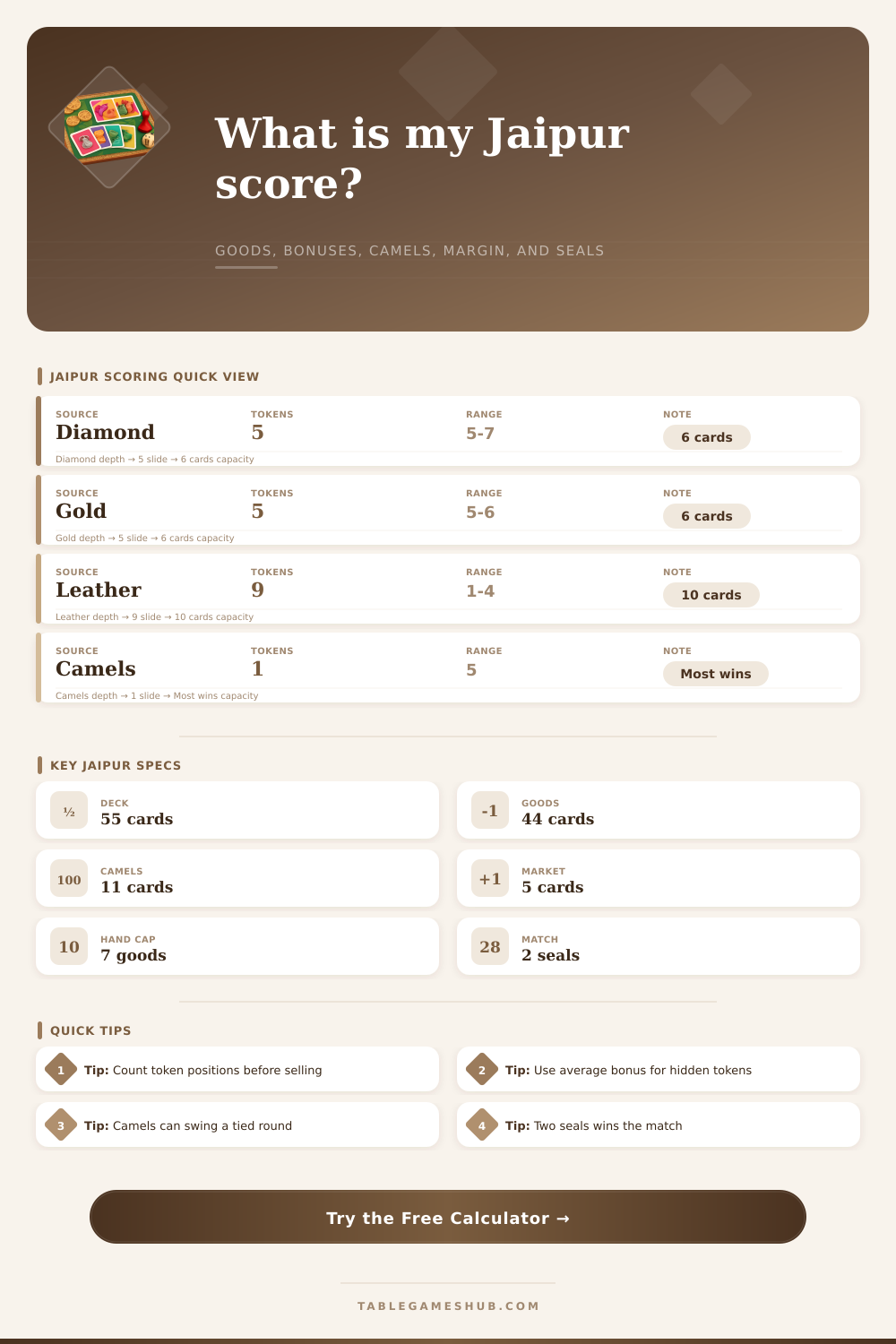
| Diamonds | 6 cards | 5 tokens | 7, 7, 5, 5, 5 |
| Gold | 6 cards | 5 tokens | 6, 6, 5, 5, 5 |
| Silver | 6 cards | 5 tokens | 5, 5, 5, 5, 5 |
| Cloth | 8 cards | 7 tokens | 5, 3, 3, 2, 2, 1, 1 |
| Spice | 8 cards | 7 tokens | 5, 3, 3, 2, 2, 1, 1 |
| Leather | 10 cards | 9 tokens | 4, 3, 2, 1, 1, 1, 1, 1, 1 |
| Sale size | Bonus tokens | Minimum | Average used by calculator |
|---|---|---|---|
| 3 goods cards sold | 1, 1, 2, 2, 2, 3, 3 | 1 rupee | 2 rupees |
| 4 goods cards sold | 4, 4, 5, 5, 6, 6 | 4 rupees | 5 rupees |
| 5 or more goods cards sold | 8, 8, 9, 10, 10 | 8 rupees | 9 rupees |
| Camel majority | Camel token | 5 rupees | 5 rupees |
| Score source | Formula | Included in total | Calculator field |
|---|---|---|---|
| Goods tokens | Sum visible token values after skipped tokens | Yes | Cards sold and tokens already taken |
| Sale bonus | Count of 3, 4, and 5-card tokens times chosen value mode | Yes | Bonus tokens taken |
| Camel token | 5 if your camel count is higher than rival camel count | Yes | Your camels and rival camels |
| Round margin | Your total minus opponent round rupees | No, comparison only | Opponent round rupees |
| Game component | Count | Scoring role | Comparison note |
|---|---|---|---|
| High-value goods | 18 cards | Diamonds, gold, and silver token stacks | Small stacks, high top values |
| Common goods | 26 cards | Cloth, spice, and leather token stacks | Larger stacks, lower tail values |
| Camels | 11 cards | End-round 5 rupee majority token | Can swing a narrow margin |
| Seals of excellence | 3 tokens | Match progress after each round | First player to 2 seals wins |
Jaipur forces you to monitor not just state of market but also what other players are doing. As each player buys and sells token, you’re watching them exit the supply board while attempting to guess what they’re hiding. It adds a sense of tension above and beyond the math. At the end of a round, you’ll tally up wooden discs to see who come out on top. Did I sell three or four diamonds? Did I get any bonus tokens from the facedown pile? The stress builds as you confirm whether you actualy won the round or merely looked like it briefly.
After entering your position in tokens and sales of cards, the calculator above will take over the math. You won’t have to guess about conversion rates or which coefficient to use. It doesn’t eliminate thought, just frees your brain so that you can think about the next hand. To do so, you’ll need to know how those inputs translate into flow of the game.
How to Use the Jaipur Score Calculator
Entering your number of cards sold for each type of good tells the calculator what tokens you recieve from that pile. And it factors in the fact that other people may have scooped up some of high value discs before you. A pile of diamonds starts with seven rupees on top, but the value drop to five as you go down the pile because two are removed. Missing this change in value means you’ll have scored more then is actually possible on the table. That’s a common error that people make. They account for their card sales, but not the state of market they found themselves playing into.
Every sale also has an extra layer of hidden complexity: bonus tokens. At any point when selling three or more item together, you reach over and pick up one face down bonus token rather than showing it right away. Your total remains a mystery until the end. Depending on what you think opponent may earn, you can estimate that based off max, min, or expected average. Want to know if you’re ahead enough that even with their best shot you’ll still win? Use the min to find out. Chasing? Maybe they will throw all they’ve got for a bonus attack, so do you know if that would turn the round around? A nine-ruble bonus versus a three-ruble average can mean the difference between winning and losing. It is a little bit, but it is not nothing.
Camels aren’t sold for rupees; they are cards you keep in-hand throughout the round. At the end of the round, whoever has the most camel receives an additional five bonus points. While it may seem small at first glance, it can mean the difference between winning and losing by two rounds. One player might be focused on leather sales while the other hold onto a few extra humps for the end-game bonus. There’s also field on the calculator where you’ll record how many camels are in each player’s hand. This helps us calculate this swing factor into your overall score. Do you hold onto a few camels in hopes of increasing your chances of winning at the end? Or do you use them to create space in your hands for more goods? The tradeoff is between end-game insurance and immediate liquidity.
In the end, however, it all comes down to seals in a match. It doesn’t matter if you beat someone by 2 in one round and lose by 3 in another. Two seal are required to win a game. That’s why the tool helps track how close you were when you got each of those seals. Did you barely scrape it together? Or did you absolutely crush your opponent? Understanding this will help you know if you won clearly or only by a little. Sometimes, winning a round by a little isn’t as good as losing one on purpose to get a much bigger bag in the next market phase. Experience teaches you when it is better to let your competitor grab the seal this round if you can hold out for a big one next time. The calculator shows you the numbers (your gut tells you what to do with ’em).
The page contains reference tables that describe what each kind of good goes for in tokens. Gold and diamonds yield well early game, then vanish fast. Cloth and leather don’t pay as much per piece but give volume instead. Understanding these curves lets you strategize about how you sell things without having to grab a card yet. If most of the diamond tokens are depleted, there’s no point trying to push further. It is time to focus on spice or cloth where the stack depth still supports steady gains. The tool will include those in its calculations automatically, no need to memorize the ladder at each position.
“Jaipur is all about scoring clearly when it matters most. There’s hand management and tracking opponents, and there’s visibility into some hidden bonuses and tokens. The bottom line: get the math right. To win, you should of had more than that, you have to know how those numbers shift. Test your calculations against one another. Reassess your camels’ strength. Confirm your bonus assumptions. That last number tells a story, and it’s the story of what happened during this round. Know that story, and you can confidently write next chapter.”