Blitz Rating Calculator
Estimate a one-game blitz Elo update from current rating, opponent rating, result, K-factor, game count, provisional status, expected score, and volatility context.
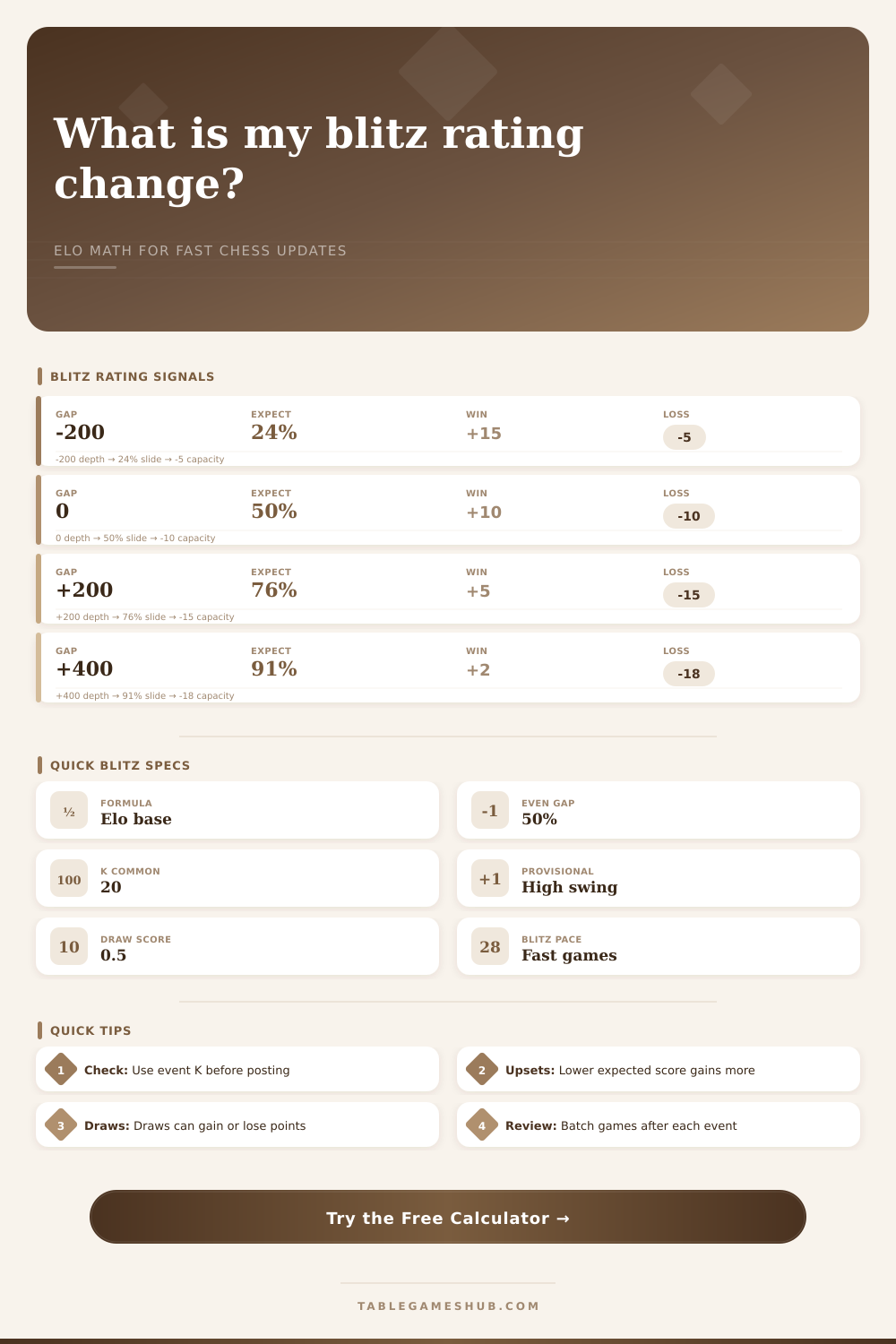
| Player vs opponent gap | Expected score | K20 win change | K20 loss change |
|---|---|---|---|
| Player 400 points lower | 9.1% | +18.2 | -1.8 |
| Player 200 points lower | 24.0% | +15.2 | -4.8 |
| Equal ratings | 50.0% | +10.0 | -10.0 |
| Player 200 points higher | 76.0% | +4.8 | -15.2 |
| Player 400 points higher | 90.9% | +1.8 | -18.2 |
| K-factor | Typical blitz use | One-game ceiling | Best input use |
|---|---|---|---|
| K10 | Very established or master-level pools | About 10 points | Use when the notice lists a low multiplier. |
| K16 | Conservative online or mature club pools | About 16 points | Good for slower-moving blitz ladders. |
| K20 | Common established blitz estimate | About 20 points | Use as the default if your pool confirms it. |
| K32 | Active online pools or lower certainty | About 32 points | Useful for faster rating response. |
| K40 | New, provisional, or returning players | About 40 points | Expect visible movement after each game. |
| Result | Actual score | Rating meaning | Blitz note |
|---|---|---|---|
| Win | 1.0 | Change is K x (1 - expected) | Upset wins create the largest positive movement. |
| Draw | 0.5 | Change is K x (0.5 - expected) | A draw gains points only if expected score was below 0.5. |
| Loss | 0.0 | Change is K x (0 - expected) | Favorite losses create the largest negative movement. |
| Forfeit or bye | Event-defined | May not be rated like a played game | Confirm the published rating rule before entering it. |
| Profile | Game count | Typical rating feel | Calculator note |
|---|---|---|---|
| First blitz session | 0 to 9 games | Very jumpy after each result | Use provisional status and the listed event K. |
| New but active | 10 to 29 games | Still sensitive to short streaks | Check several games, not one result alone. |
| Developing baseline | 30 to 99 games | Settling, but blitz swings remain visible | Recent form can explain sharp movement. |
| Established pool | 100 or more games | Usually steadier unless K is high | One game should be read as a small sample. |
Your heart starts racing as the clock ticks down to just two seconds left. Afraid of hitting the three-minute mark, you blunder a queen and lose game. And now you’re wondering how this will impact your rating.
Until you look at engine powering the math behind it, the change feels arbitrary. Blitz chess may be speedy, but the rating system come with calculated precision. That’s why knowing that precision helps you stop thinking that losing hurts your soul, or that winning is some kind of moral victory. Turns out your rating isn’t so much a reflection of your soul as it is statistical probability engine looking for where you land among all player.
How Chess Ratings Work
It’s a pretty straightforward mechanic: How many points you’ll get depends on the difference between your own rating and your opponent’s rating. The higher the difference, more points you’re “expected” to earn. For instance, if ratings match up, you are expected to earn 0.5 points. If you lose, the system deducts points. If you win, you adds points. And the size of that hit/miss comes down to K-factor.
That’s the number that control how volatile your own rating is. For example, a high-K-factor newbie will see their rating bounce around like crazy with each game. Whereas an old-timer have a low K-factor, so their rating stays more stable over time. Once you enter your current rating and your opponent’s into the calculator above, it crunches the numbers and spits out what it thinks should of occurred, sparing you the need to guess at whether a five-point loss is good/bad/normally expected. You’ll just know what system thinks.
Draws confuse most players. Often in blitz, a draw is some kind of messy scramble in which neither player were able to finish off the other one. But what does the rating system care? The rating system only care about expectation. Underperforming means you lose rating points. So if you are heavy favorite and you draw, it’s like you actualy lost. The system says you should’ve won but you didn’t. You get punished for not doing well enough. If you’re the underdog and you draw, you gain points. You overperformed. A draw is never a neutral event. It’s a data point that either confirms or denies your current standing.
The bare number is not all that matters. When you play online, you play against a pool of players who could be playing at multiple tables. They may also be playing with extra distractions. When you go into a local club with people who are all focused then the reliability of the result will change. The tool acknowledges this by giving you an opportunity to specify what kind of pool you’re playing in and whether or not you are provisional. This means if you’ve been away from the game for a year then your rating is less certain. The system handle this with larger swings to allow you to recalibrate. On the other hand, if you play a thousand games then your rating is a settled matter, and the system resist big changes. You can check out the K-factor guide on the page as well.
It will explain how a loss to a higher-rated opponent only cost you one point while a win over a lower rated opponent only gains you two. And here’s the trick: Batch your calculations. Don’t get hung up on one game. Lag, mouse slip, time trouble, all these things can affects results, sometimes more different than actual skill. Instead, take a look at the total result after a long online session or even just a tournament. That will paint a clearer picture about your true level of performance. The volatility note in the results will help you frame that. Is your rating stabilizing? Or is it still a long way from finding its footing?
The rating of your opponent? It is out of your hands. The time control? It is sometimes out of your hands. But what’s in your hands? It is your interpretation of it all. One game drop following an awful morning? It is not a thing. Ten-game rising trend? That’s a signal. Let it smooth out your momentary anxiety; it turns the rating from a scary number into a way to learn. I am not failing! I am giving you data. Then the data calms down and you look at where you realy are, without panic, because the clock isn’t ticking anymore.