⏰ Chess Game Timer Calculator
Estimate clock pressure, one-game length, and session timing for bullet, blitz, rapid, and classical chess.
♟ Time Control Presets
📊 Timer Inputs
📈 Result Summary
📑 Full Breakdown
⚡ Chess Timer Component Grid
📐 Reference Tables
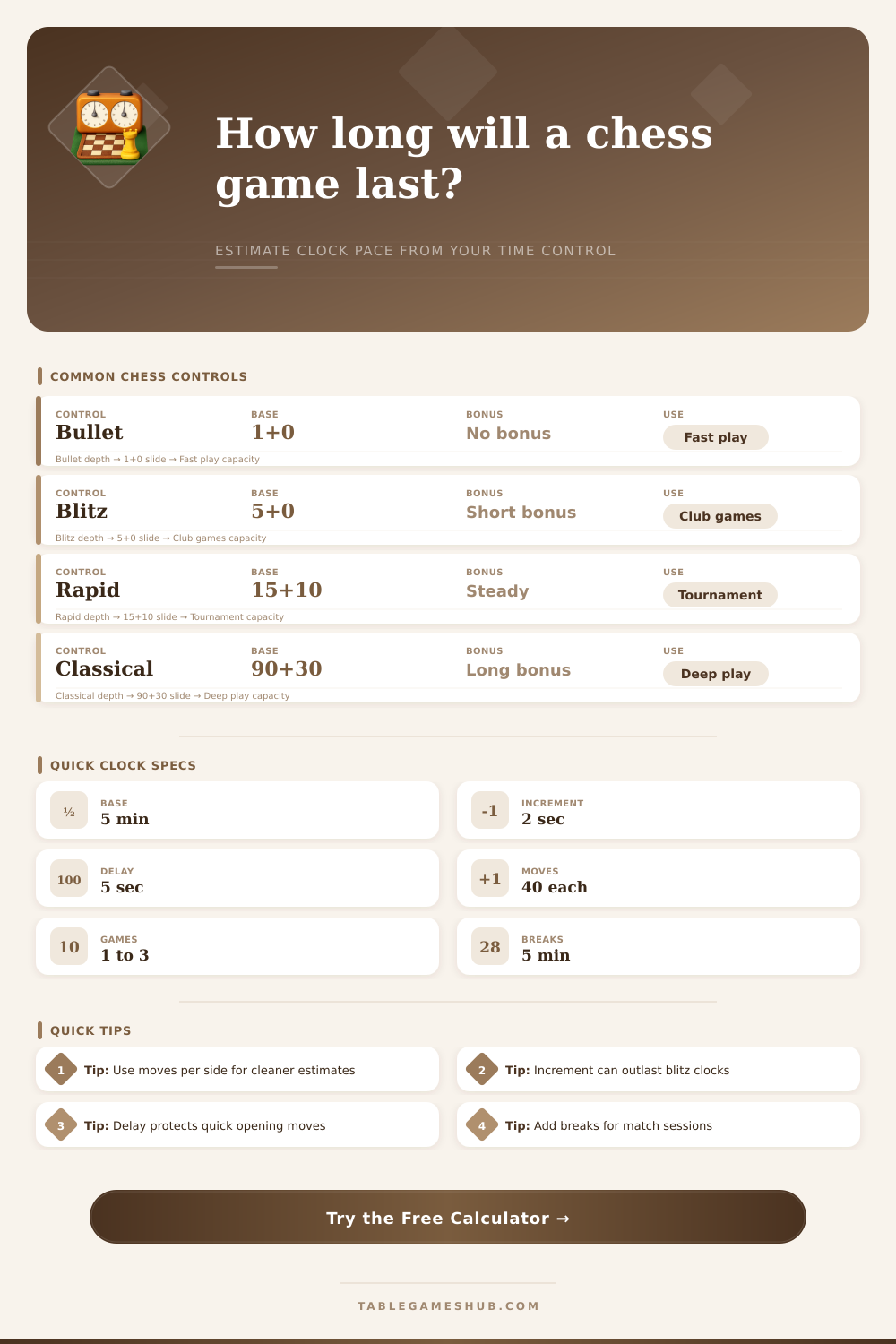
| Control | Base | Bonus | Typical pace |
|---|---|---|---|
| Bullet | 1-2 min | 0-1 sec | 3-8 min |
| Blitz | 3-5 min | 0-3 sec | 5-15 min |
| Rapid | 10-15 min | 5-10 sec | 20-45 min |
| Classical | 30+ min | 15-30 sec | 60-180 min |
| Setup | Clock effect | Best when | Watch for |
|---|---|---|---|
| No bonus | Pure countdown | Sharp tactics | Flags sooner |
| Increment | Adds time after move | Long think lines | Can stretch games |
| Delay | Pauses early seconds | Quick replies | Not extra time |
| Inc plus delay | Flexible pace | Club events | Check rules |
| Moves/side | Avg sec | Game length | Notes |
|---|---|---|---|
| 20 | 15 sec | 10 min | Tactical sprint |
| 30 | 30 sec | 30 min | Casual rapid |
| 40 | 45 sec | 60 min | Club standard |
| 60 | 90 sec | 180 min | Long classical |
| Games | Break | Session total | Use case |
|---|---|---|---|
| 1 | 0 min | Game only | Casual check |
| 3 | 3 min | Short set | Mini match |
| 5 | 5 min | Medium set | League night |
| 9 | 10 min | Long set | Event schedule |
💬 Timing Tips
Tip 1: Track the move rhythm
Use moves per side to match the clock to actual game pace, not just the starting minutes on the dial.
Tip 2: Separate games and breaks
Add break minutes when you schedule a match set so your session total stays realistic from start to finish.
Chess clocks measures time and influence the decision a person makes during a game of chess. A person must understand how time control impact the way that a person allocates their attention to the game. Time controls for chess can be categorized in a number of different ways, such as in the type of time control that each player are to use in their game of chess.
Types of time control include bullet chess, blitz chess, rapid chess, and classical chess. Bullet chess is played with each player having less than two minutes to play all of there move. Blitz chess allow for each player to have three to five minutes to make all of their moves.
Chess Clocks: Types and How to Manage Your Time
Rapid chess games allow for each player to have ten to fifteen minute to make all of their moves. Classical chess games allow each player to have thirty minutes or more to make all of their move. Each of these time controls require a different mindset from the player in order to adapt to how fastly or slow they must play chess.
Beyond the different types of time control, there are also different element of each time control that can impact the length of the game. One such element is the increment, or the amount of time that is added to each player’s time after each of their moves. Another element of time control is the delay, or the amount of time that a player are allowed to begin using their chess clock for the game.
A player might find blitz chess with an increment to be a more comfortabley time control than blitz chess without an increment. Another way that a player can determine how long a game of chess may last is through understanding the number of moves that can occur within a game, and the amount of time that each player can dedicate to thinking about each move. Most games of chess will last for thirty to forty moves, though bullet chess can have fewer move than classical chess, for instance.
By knowing the number of moves that the player is to make within the game, and the amount of time that the player can dedicate to each of those moves, the player can calculate the length of the game. For instance, if a game of rapid chess is to last for forty moves, and if each player can dedicate forty-five seconds to each move, then the player can calculate that the rapid game will last for thirty minutes. This calculation doesnt include any increment or delays.
Beyond the factor that relate to the length and type of chess game that will be played, there are also physical and psychological factor that impact the way in which a player manages their chess clock. For instance, when playing over the board chess, the player is required to hit the chess clock after each of their moves; hitting the chess clock can result in a small addition of time for the player. Additionally, a player’s fatigue after playing a number of games can impact their mental ability to make each move in chess.
Other factor include the playing style of the opponent, the length of time that each player take to make their moves, and the perception of the player of the time controls of the opponent. A player can master their chess clock by keeping track of the length of their previous games, and by adjusting their mental expectation for future games. For instance, bullet chess games will last less than ten minutes.
Additionally, blitz chess games will take approximately fifteen minutes to complete. Rapid chess games can be adjusted so that players focus on ensuring that they have enough time for the endgame of the game. Finally, players can divide classical chess games into segments of time so that players can dedicate appropriate length of time to each stage of the game.
Another way that a player can master their chess clock is by building in a safety margin for their games. A safety margin is an amount of time that is built into a game for players to ensure that they will not run out of time during their turn. Building a safety margin of fifteen percent of the base time for games, for instance, will help players to avoid losing to time constraint during the game.
Creating a positive safety margin allows players to think more creative during their games, while a negative safety margin will make players feel forced to simplify their chess game. Thus, mastering the chess clock allows players to use their time as an advantage in the game rather than a disadvantage.