Indian Rummy Score Calculator
Total a 13-card Indian rummy hand by pure sequence status, second sequence status, unmatched cards, drop penalties, invalid declarations, caps, and running standings.
| Player | Prior total | Hand status | Sequence state | Total hand value | Pure seq value | Unmatched value | Manual +/- |
|---|---|---|---|---|---|---|---|
| Rank | Player | Hand status | Raw points | Round score | New total | Note |
|---|---|---|---|---|---|---|
| Calculate to update the scoreboard. | ||||||
2-10 = face value; A, K, Q, J = 10; joker = 0
raw = total value of all 13 cards in hand
pure only raw = total hand - pure sequence value
round = min(raw + manual adjustment, score cap)
| Card group | Common point value | How to enter | Scoring note |
|---|---|---|---|
| 2 through 10 | Face value | Add printed values | Example: 7 is seven points |
| Jack, queen, king | 10 points each | Count each face card as 10 | High cards raise penalty quickly |
| Ace | 10 points | Count each ace as 10 | Use house rule if your table differs |
| Printed or wild joker | 0 points | Do not add to card totals | Jokers help melds but do not add deadwood points |
| Sequence state | Valid declaration? | Penalty basis | Calculator field to use |
|---|---|---|---|
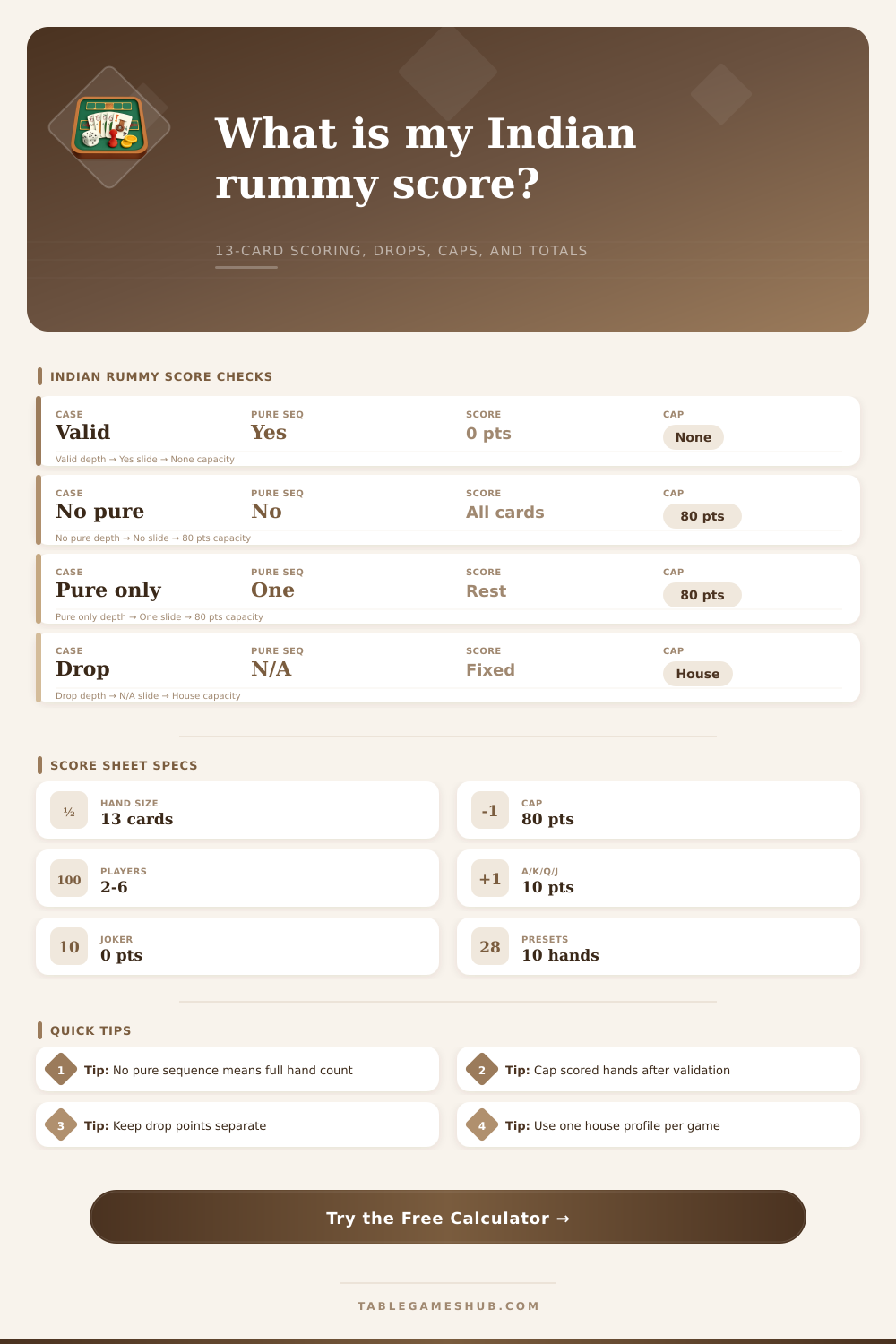
| No pure sequence | No | All cards in hand count | Total hand value |
| One pure sequence only | No | Cards outside the pure sequence count | Total hand minus pure seq value |
| Pure plus second sequence | Can be valid | Only unmatched cards count for a loser | Unmatched value |
| Winner valid declaration | Yes | Winner scores zero points | Hand status: valid declaration |
| Penalty event | Default here | When it applies | Audit note |
|---|---|---|---|
| Initial drop | 20 points | Player leaves before playing a turn | Edit if your table uses 10, 20, or 25 |
| Middle drop | 40 points | Player leaves after taking a turn | Keep separate from card-value scoring |
| Invalid declaration | 80 points | Player declares without valid groups | Usually treated as maximum penalty |
| Full count | 80 points | Quick entry for capped high-card hand | Equivalent to cap when score exceeds max |
| Profile | Target line | Score direction | Best use in calculator |
|---|---|---|---|
| Points rummy | Single hand | Winner scores 0; losers score penalties | Use prior total as zero or ignore standings |
| Pool 101 | 101 points | Lower running total is better | Watch players near the target line |
| Pool 201 | 201 points | Lower running total is better | Longer score tracking with same hand math |
| Deals rummy | Fixed deals | Compare cumulative penalties after each deal | Use target as the table's review line |
You’ve been there before. There’s the table, the cards are down, and the points add up looking good enough to win it all. Heads turn, eyes stare, and you count points against your opponents. It’s crunch time: one wrong addition turns a winning hand into a losing one.
This is what makes folks go for something that’ll do the hard work. A good game of cards depend on keeping the score, and bad math will kill a game quicker then any bluff.
How to Score Points in Indian Rummy
Indian rummy only has one core mechanic that’s easy to grasp but hard to master: 13 cards in valid hands made off sets and sequences. Win the game, and your score is zero. Lose the game, and you pay out points according to what you didn’t manage to turn into a set or sequence.
Here’s where things can get tricky: you must have at least one pure sequence, which is a sequence made only of natural cards without any help from jokers. If you don’t have a pure sequence, then all bets are off. Literally. Every single card in your hand will be counted against you. Ouch.
But this keeps people from floating along by relying only on their wild cards. After plugging in the value of your cards, the calculator above do all the work for you. You no longer have to wonder about conversions and coefficients while trying to calculate your penalty point total in the heat of battle.
Half the battle is understanding how those penalties work. An Ace is worth ten points. Jacks, Queens, and Kings (also known as Face Cards) is also worth ten points. Each numbered card has its numerical value. A Joker? Nothing.
If you have an impure sequence AND a pure sequence in your hand, you can play it out and still lose, but you’ll only be penalized for the unmatched deadwood. That is the normal ruleset. But if you don’t play it that way, if you skip the required pure sequence declaration. Then things get wild. You will be penalized not just for your bad cards, but for all of them.
Usually they cap this at 80 points; otherwise one bad deal could blow the game right out of the water.
Then there are the complications of drops and invalid declarations. A drop before you play a card normally carries a flat penalty (typically 20 points). A drop after you take a turn usually carries a higher penalty (usually 40 points), and these penalties don’t depend on what’s in your hand at all. They’re for dropping out early.
An invalid declaration, showing your cards but not having any combination that matches the rules, normaly gets you the full cap right away. That’s for attempting to cheat the system. This is an automatic penalty and doesn’t involve anything scored by cards.
The tool splits it off from the scoring based on the value of the cards in your hand, so you can’t accidently combine them when updating the leaderboard.
You have to be patient with tracking your running totals from one deal to the next. In the Pool 101 or 201 variants, players builds points until reaching a target line. The first person past that mark is out of the game. You might choose to take a smaller loss early on to stay under the radar rather than gambling for a big win. It’s laid out nicely on the page with the reference table showing how changing profile settings adjust both scoring direction and the target lines. And it will help you know if you’re surviving or going for the win.
A common mistake by many casual players is to add up the hand total first, and then try to work out the sequences. That’s backward. Before adding points to anything, check the sequence status. If it isn’t pure, then the entire hand fails, so what you have left over doesn’t matter at all. It may seem like a little thing, but when people argue over this, it matters a lot. Always check the first sequence for purity. Then see if there are two sequences. After that, count the leftovers.
But here’s why a specific calculator is beautifull: it locks you into this rational sequence. How can you reach the total penalty field if you haven’t defined your hand status yet? That means no more “oh yeah, I forgot to cap my score” mistakes, or worse, applying the wrong drop fee to the wrong hand! It becomes a clear record rather than some confusing oral debate.
And eventually, you’ll start to see trends emerge from your own play. Maybe you’re dropping too soon (and therefore bleeding points you don’t need to bleed). Or maybe you keep risking it all on hands that just don’t have any pure sequences.
In all, rummy comes down to a combination of chance and risk management. Cards gets dealt; how you play them and calculate their impact is up to you. And whether you’re playing a lone hand or a multi-hour tourney round, the math remains what keeps the spirit alive. It’s what assures that if a winner emerges, it’s because they earned it, by the rule set we collectively accepted before we started playing.
Letting the strategy speak means cleaning up after yourself math-wise. That’s where the skillful players split off from the lucky ones. You should of seen how fast the score changes.