Oh Hell Score Calculator
Total an Oh Hell hand from each player's bid, actual tricks, exact contracts, optional bonuses, penalties, running score, target gap, bid balance, and final standings.
Load a realistic hand state, then replace the names, bids, tricks, and previous scores with your table's current hand.
Round score starts from the selected Oh Hell rule, then adds manual bonuses and subtracts penalties. Trick distance is the absolute gap between bid and actual tricks.
| Player | Previous | Bid | Tricks won | Bonus | Penalty | Dealer? |
|---|---|---|---|---|---|---|
| Rank | Player | Bid | Tricks | Contract | Round | Total | Gap to target |
|---|---|---|---|---|---|---|---|
| Calculate to see standings. | |||||||
| Variant | Exact bid | Missed bid | Best use |
|---|---|---|---|
| 10 plus bid | 10 + bid | 0 points | Most casual score sheets |
| 10 plus tricks | 10 + tricks | 0 points | Equivalent when bid equals tricks |
| Exact only | 10 points | 0 points | Fast family games |
| Plus-minus | 10 + bid | Minus miss distance | Sharper penalty races |
| Players | Max full deal | Typical opener | Table note |
|---|---|---|---|
| 3 players | 17 cards each | 10 to 13 cards | Large swings possible |
| 4 players | 13 cards each | 10 cards | Classic family count |
| 5 players | 10 cards each | 8 to 10 cards | Strong bid pressure |
| 6 players | 8 cards each | 7 or 8 cards | Many low contracts |
| 7 players | 7 cards each | 6 or 7 cards | Consider rotating trump |
| Total bids | Compared to tricks | Meaning | Scoring impact |
|---|---|---|---|
| Equal | Same as deal | Every contract can succeed | Often blocked by dealer rule |
| Under | Below deal | Extra tricks are unwanted | Overtricks break exact bids |
| Over | Above deal | Not enough tricks exist | At least one player must miss |
| Far off | 3+ away | Very unstable hand | Expect larger score gaps |
| Scenario | Players | Cards | Why it matters |
|---|---|---|---|
| 10-card opener | 4 | 10 each | High bids and several misses |
| Nil squeeze | 5 | 4 each | Zero bids become fragile |
| Last-card finale | 3 | 1 each | Every trick is a contract swing |
| Party table | 6 | 6 each | Low bids and tight standings |
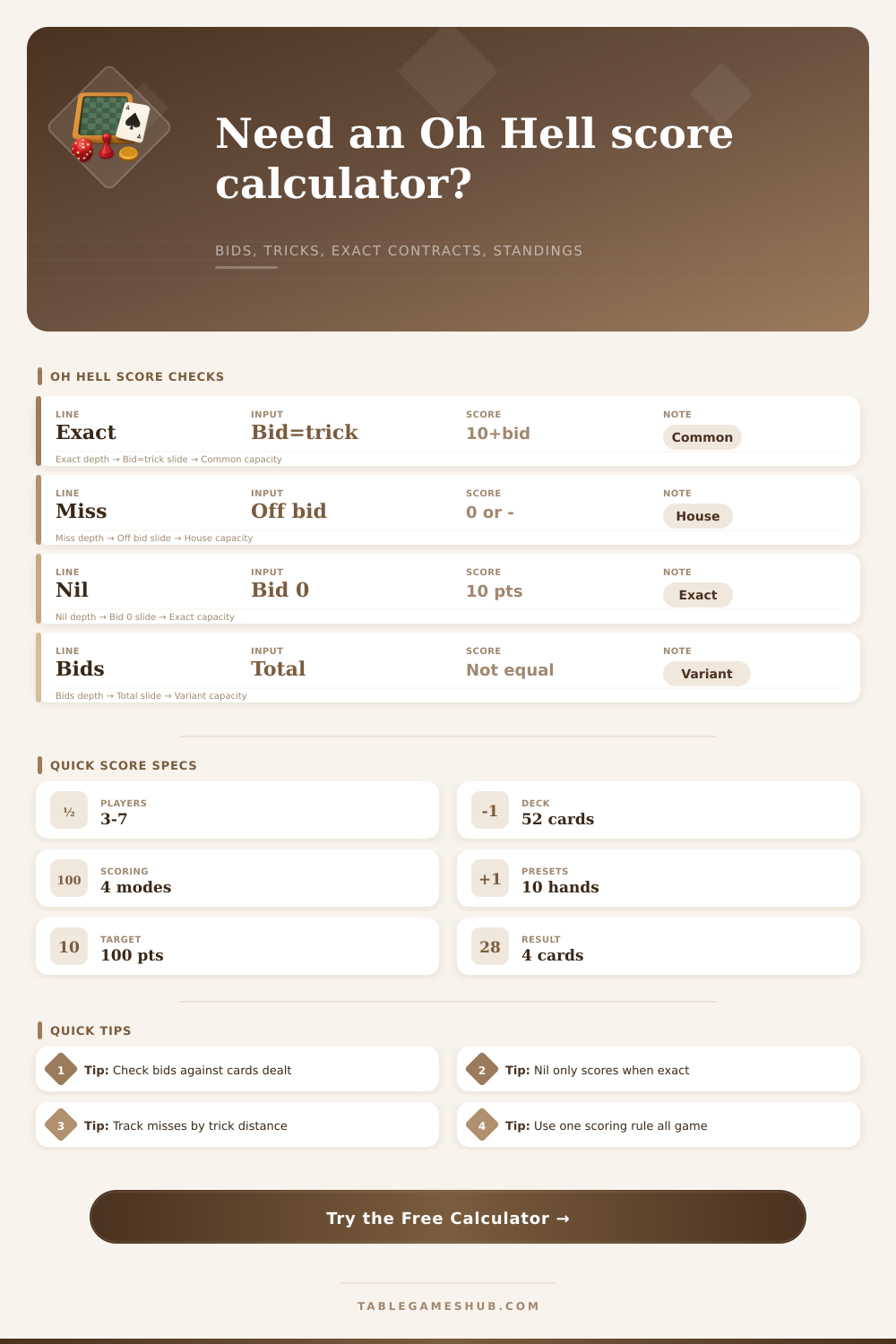
Bid audit: In many Oh Hell groups, the dealer's final bid cannot make total bids equal the number of tricks. Use the bid rule status before play starts.
Variant discipline: Decide whether missed bids score zero or lose points before the first hand. Mixing variants midgame makes standings hard to reconstruct.
But there’s some complex math behind those social smiles, hidden in the quietness of card table. And that’s because Oh Hell is a game about brutally precise mathematics disguised as a social experience. Each deal is a competition of wits rather than blind chance, as one hand plays against another and players try to read each other’s minds.
This means that winning or losing is much less random then just good or bad luck. It seems easy, but it isn’t: How do you bid precisely, knowing that each shuffle rearranges the deck? You can only look at half of the cards and guess the odds. When you have a good suit showing, most people make mistake of assuming other players won’t also, which leads to a bidding war that frequently ends in flames: one player has a bunch of tricks and the other has none.
The Math and Strategy Behind Oh Hell
Once all is said and done and the cards are warm, it’s nice to use this tool (which does the math for you) instead of bickering about who was right or wrong. During the game, it lets you stay focused on playing instead of accounting.
Variations in scoring complicate matters further, splitting tables into camps of lovers and haters. On the side of gentler rules are those who gives 10 points per hit plus the bid amount as a way to reward consistent performance while not penalizing small mistakes to heavily. The other camp goes with more severe penalty if you miss. The farther under you go, the bigger negative points deduction.
This second option tends to make the game a bit sharper; the best strategy then is to be really conservative in bidding. Fair play means picking one system early and playing by those rules all night long. Blending things midway will void any standings and destroy the competitive buzz that builds up towards end.
But the existence of the dealer’s constraint brings a strategy element into play that most casual players do not notice. Under many house rules, the dealer must avoids any bid that would bring total bids up to the number of tricks in play. The effect is to prevent an ideally even balance between all players, each capable of success on paper.
At least one person has to lose, and therefore the game stays unpredictable and dynamic. By shifting the potential failure of the game onto the dealer chair, that position becomes a riskier place to be rather than a privileged one. Often players will take care to rotate this position, for holding it do require a different mindset.
You also keep tabs on how far away you are from some goal, such as a hundred point target. This alters your perspective on every hand. If you’re ahead early, you may gamble to gain an advantage and if you’re behind, you could bet big to try to close the gap. Late in the game, you is neck-and-neck with everyone. You don’t want to risk much because it is too risky; one bad call could erase ten good ones.
That tension builds its own pace beginning relaxed and progressively tightening through the last few hands. The distance someone is falling behind, or how much they need to gain to catch up, are shown clearly. This prevents the stress of trying to do math in the heat of the moment.
One wild card: Nil bidding can turn the table upside down in an instant. Zero tricks represents either an act of desperation or the greatest sign of confidence. If successful, the payoff is large and can alter the balance significanty. If not, then the cost is steep. The variance is high; anyone’s game could of been transformed by a smart nil bid in one round.
That ensures that no one is safe. Being in the top position doesn’t mean you’re cruising. Those chasing are ready for a dramatic reversal if they bet aggressively by going for zero. Oh Hell is ultimately a game of navigating uncertainty while at the same time being punished for overconfidence.
The cards don’t give a hoot if you’re feeling good about yourself or not, just what they are and what suits they fall under. Respecting bid constraints, learning how to score accurately, and reading the flow of tricks can help you understand the game itself. It is less about who has the best cards, and more about who can move through the chaos with precision.
People miss this part. They think it’s about the cards you are dealt, when realy it’s about the game you are playing. Understanding that difference changes a casual evening into a contest of skill, which shows that even within a game of chance, accuracy pays off.