Bergen Dominoes Score Calculator
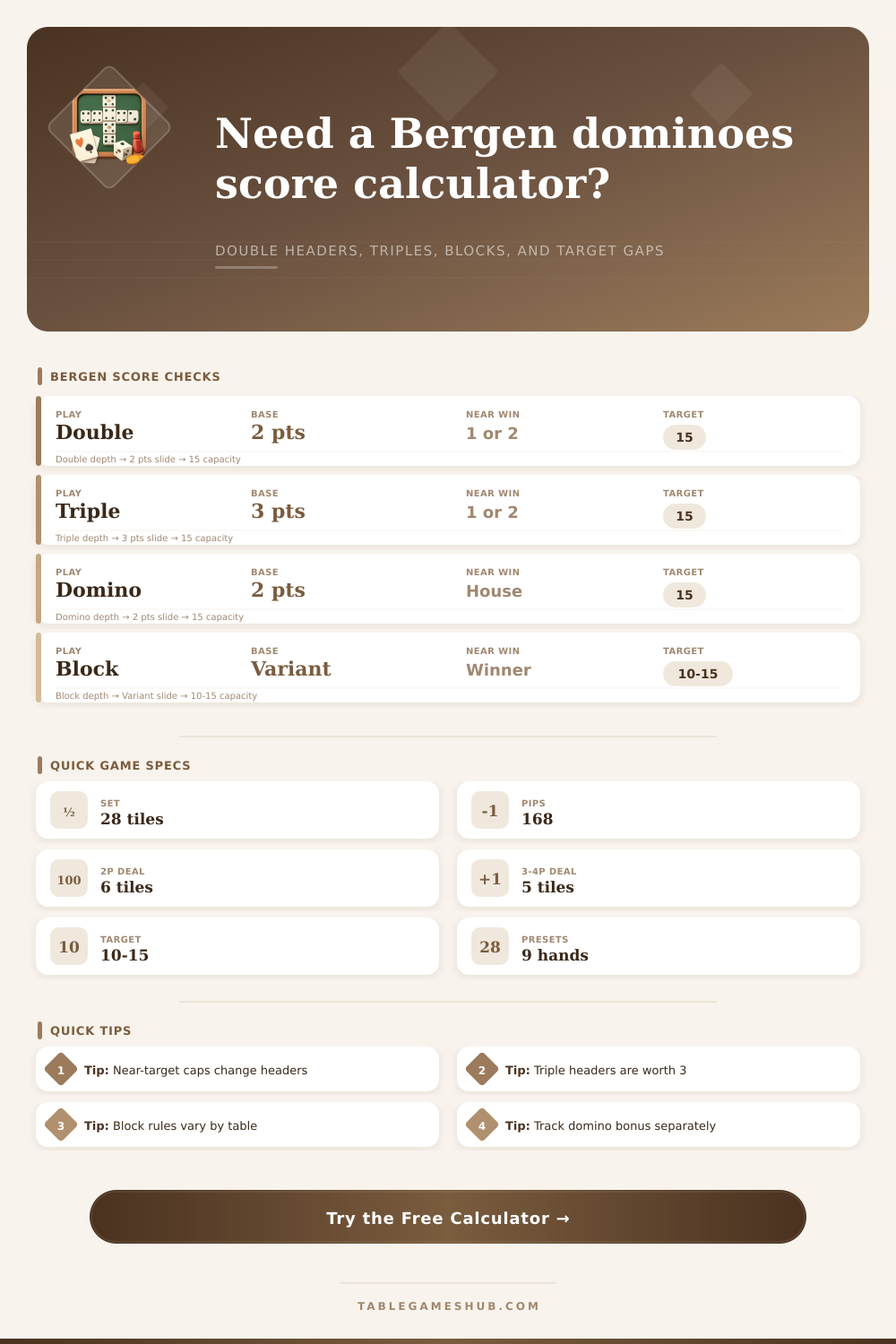
Score Bergen double headers, triple headers, near-target caps, domino finishes, and blocked-round winner checks for two, three, or four-player double-six games.
1Named Bergen Presets
Load a complete Bergen scoring situation, then edit the exposed ends, target gap, block rule, and player hand data.
2Game, Target, and Header Inputs
3Block Rule and Hand Inputs
Remaining Hands at a Block
4Scorekeeping Setup Inputs
5Formula Cards
Double Header Formula
base = 2 when exposed end suits match
If the two open ends show the same suit, the scoring play earns a double header before any near-target cap is applied.
Triple Header Formula
base = 3 when a matching exposed end is a double
After the opening lead, a same-suit open end against a double of that suit creates the higher triple-header award.
Near-Target Cap Formula
gap <= 2 gives 1; gap = 3 gives up to 2
The official Bergen cap reduces header scoring when the scoring player is close to the match target.
Block Winner Formula
winner = rule test, then bonus if scorer matches
Simple, American, and German blocked-hand rules can choose different winners from the same remaining hands.
6Component and Spec Grid
7Reference Tables
| Event | Base Points | Input That Controls It | Calculator Note |
|---|---|---|---|
| Double header | 2 points | Left and right exposed suits match. | Opening double leads are treated as double headers. |
| Triple header | 3 points | Matching suit with a double end after the lead. | The near-target cap may reduce the awarded points. |
| Domino finish | 2 points standard | Round ending set to scoring player dominoed. | The house-rule selector can use 0 or 5 instead. |
| Blocked finish | 2 points standard | Block rule plus remaining hand data. | Bonus is added only when the scoring seat wins the block test. |
| Players | Typical Deal | Common Target | Scorekeeping Fit |
|---|---|---|---|
| 2 players | 6 tiles each | 15 points | Best for a compact two-column score sheet. |
| 3 players | 5 tiles each | 10 points | Three columns keep block checks visible. |
| 4 players | 5 tiles each | 10 points | Four columns help track close target caps. |
| House table | 5 or 6 tiles | 10 or 15 | Use custom target when your table differs. |
| Block Rule | First Test | Tie Break | Best Use |
|---|---|---|---|
| Simple low pips | Lowest pip total wins. | Exact low tie gives no block bonus. | Clear home tables with minimal bookkeeping. |
| American no-double test | Unique player with no doubles wins first. | No doubles uses low pips; double holders use fewest tiles. | Tables that emphasize whether doubles remain in hand. |
| German fewest doubles | Unique no-double hand wins. | Then fewest doubles, then low pips. | Tables that count every remaining double. |
| All players tied | Rule cannot choose one player. | Calculator returns no block bonus. | Prevents accidental points on unresolved blocks. |
| Component Kit | Piece Count | Storage Footprint | Best Bergen Use |
|---|---|---|---|
| Pencil score sheet | 3 pieces | 9 x 6 in | Two-player target 15 scoring. |
| Three-chip Bergen markers | 31 pieces | 8 x 5 in | Visible chip awards for double and triple headers. |
| Club table score tray | 36 pieces | 12 x 8 in | Four-player blocked-hand checks. |
| Tournament score bundle | 42 pieces | 16 x 10 in | Multiple tables using the same cap rule. |
8Calculation Tips
Near target: Apply the target cap after finding the double or triple header. A three-point header can become two or one point near the finish.
Blocked hands: Enter pips, tile counts, and doubles before choosing the block rule. American and German checks can pick different winners.
If you’re doing math in your head while playing, then Dominoes isn’t as fun anymore. You might be trying to decide if Player A gets a blocked round because there was fewer pieces? Or does Player B get it because their tiles has lighter pips? The competition becomes a discussion on house rules and you’re no longer at a social event. Someone reaches for a napkin, and the game stalls.
By keeping track outside of the game, that won’t happen. It’ll allow you to think more strategicly without having to remember how many pips everyone have had so far. With a clearer mind, you’ll notice double headers before they happens and not once you’ve already lost some points.
How to Play Without Arguing About Scores
Bergen dominoes looks deceptively easy at first glance; just line up matching numbers on exposed ends and call out number of points. But then there’s triple headers and caps… and the closer you get to winning, the more complex things become as they cut down the number of points awarded (a three point bonus becomes a one or two point bonus if you’re already almost at win). That part is where this calculator shines.
Type in current game score, your target, and it’ll figure out the rest for you. It tells you whether you should be more aggressive with the tiles you pick. If you think a tile will put you above the cap, you may want to pass it over for something safer. This is especially true if you’re within a few points of win.
It’s a tiny little thing, but when you’re trying to reach an exact number of points, it matters. Where most arguments about blocked rounds happen is based off different regions’ interpretations of “who won”. If you go by the simple rule, it’s the person with the fewest number of pips left over that gets the pot, which sounds like a good rule and feels intuitive. But in Germany, they’re concerned about doubles first and then look at how many pips are left; In America, they don’t even consider doubles.
It is critical to establish the block rule before laying down your first tile; this way, you can have a casual chat instead of an argument after a hand has been disputed. Having the tool set your preference for how blocks work means there’s no arguing; the rules will do it for you. There is nothing unclear to argue about. Just let the rules tell you what happens, and no one’s ego gets involved.
A second wrinkle in the scoring is what they call the domino finish bonus. By default, the player who finishes with last tile gets two extra points. Some house tables bumps that bonus to five points which accelerates the game. When you do that, we adjust total by that amount.
Why? Because the number affects the risk-reward balance of holding onto your tiles longer. For instance, if there’s a large bonus, then you may hold off on playing your own matching tile hoping to domino someone else out even though it leaves more pips on the table. That tension, do I go for the points and finish now vs. Waiting a bit for more points is one of the key strategic choices that makes this an engaging game round after round.
For a couple playing together or with a group of friends, most people think of a fifteen point game for two players or a ten point game for larger groups. That’s because those totals produce games which play out at a comfortabley clip, not too fast but not overly slow either. In a two player game, dealing six-tiles apiece means there should be plenty of meat on every bone to make one think, while dealing five-tiles makes the tempo quite brisk when there are three or four people.
This also gives you an idea of what your chances is of having a double in-hand, and how often you’ll encounter blocking situations. Knowing the beat can help you set reasonable expectations as to how much time you want to plan for an evening of dominoes. Finding the proper sweet spot between speedy and deep is all about ensuring no one falls asleep before final match is over.
There’s no need to scribble numbers on scraps of paper and commit formulas to memory. While it does have its own reference tables at the bottom of the page, referring to these while playing will make the game go more slowely. Rather than look everything up during the game, think of it as an easy way to check your work during contention situations or create new games with alternative rules.
As you get accustomed to the headers and caps interactions in action, you’ll naturaly start noticing the patterns, eventually the math just happens automatically and the points sort themselves out. No longer do you need to pause and compute; you’re back doing what this game’s all about: having fun, tricking your friends, and getting that last point without worrying about arithmetic.