Dominion Deck Ratio Calculator
Measure deck cycling, terminal action pressure, village support, treasure density, draw strength, and victory-card drag for a live Dominion deck.
🎲Real Dominion Presets
🃏Deck Inputs
Ratio Breakdown
⚙Current Deck Ratio Grid
💡Deck Ratio Tips
📊Archetype Comparison Grid
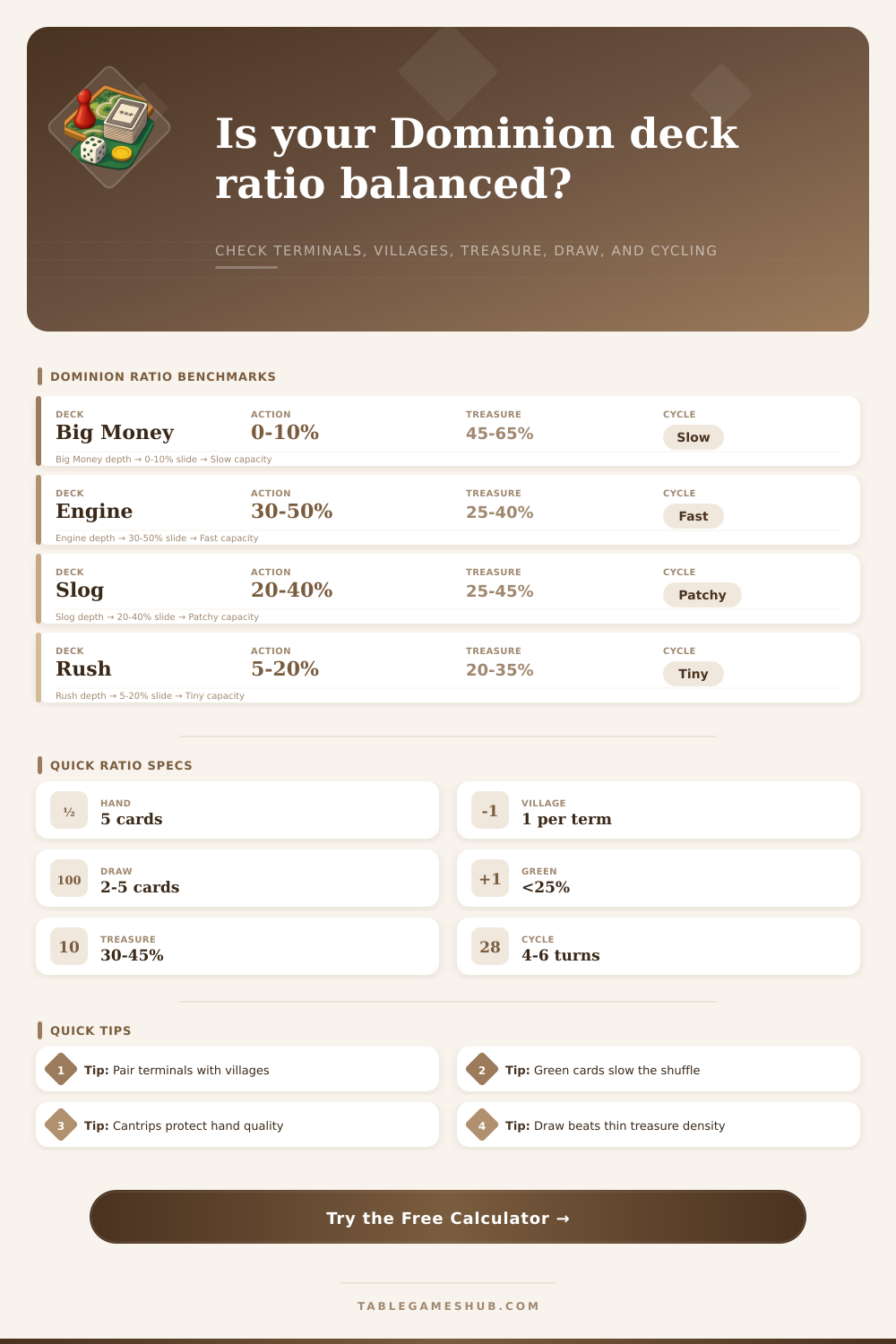
Big Money
Low action share, high treasure density, slower shuffle control, and high tolerance for simple five-card hands.
Engine
Needs village cover, repeatable draw, and enough payload that large hands convert into Provinces or pile pressure.
Slog
Junk and green cards dominate hand quality; draw and trashing become more valuable than raw treasure count.
Rush
Small decks can accept ugly ratios when the game ends before repeated bad shuffles matter.
📘Reference Tables
| Deck plan | Action target | Treasure target | Victory drag target | Cycle target |
|---|---|---|---|---|
| Base Big Money | 0% to 10% | 45% to 65% | Under 30% | 4 to 6 turns |
| Village-draw engine | 30% to 50% | 25% to 40% | Under 22% | 2 to 4 turns |
| Junked slog | 20% to 40% | 25% to 45% | Under 35% | 5 to 8 turns |
| Gardens or pile rush | 5% to 20% | 20% to 35% | Can exceed 35% | Game-end driven |
| Ratio check | Strong range | Warning range | Problem sign | Best fix |
|---|---|---|---|---|
| Village cover | 1.00 or more | 0.60 to 0.99 | Terminals collide | Add village or cut terminals |
| Terminal share | Under 18% | 18% to 28% | Dead action hands | Add draw, village, or cantrips |
| Green and junk | Under 20% | 20% to 35% | Weak five-card turns | Trash, draw, or end game |
| Treasure density | 30% to 45% | Below 25% | Draws do not score | Add payload or +Buy |
| Preset scenario | Typical deck size | Key pressure | Ratio aim | Cycle note |
|---|---|---|---|---|
| Chapel thin deck | 12 to 18 cards | Payload timing | High economy density | Fast shuffle after trashing |
| Village Smithy | 22 to 32 cards | Terminal density | Villages near terminals | Draw must find villages |
| Witch slog | 28 to 45 cards | Curses and dead cards | Draw offsets junk | Shuffle quality varies |
| Gardens rush | 35 to 55 cards | Deck size value | Accepts lower quality | End before engine matters |
| Dominion component | Count in hand math | Ratio effect | Calculator treatment | Practical read |
|---|---|---|---|---|
| Terminal action | May need the one action | Raises collision risk | Compares against villages | Strong but fragile |
| Village action | Adds action capacity | Lowers collision risk | Builds coverage score | Enables engines |
| Cantrip | Replaces card and action | Improves smoothness | Boosts quality modestly | Stabilizes hands |
| Victory or junk | Consumes hand slots | Slows cycling and payload | Creates drag penalty | Buy late or draw more |
A Dominion deck consist of a specific ratio of action cards, treasure cards, and green cards. The ratio of these three types of cards within a Dominion deck will determines whether the deck will function efficient or if it will fail to produce the desired results from the game of Dominion. If there are to many action cards within a Dominion deck that do not produce any additional actions, players can encounter a collision risk.
A collision risk occur when a player draws a single action card for playing another card that does not produce any additional actions. Cards like village provide additional actions for players, but villages alone will not prevent a player from encountering a collision risk unless the player purchase them during the same shuffle window as the terminal cards. The shuffle window is the time during which a player draws certain cards, and the length of those shuffles is determined by the total numbers of cards within a player’s deck.
How to Balance Your Dominion Deck
The treasure density within a Dominion deck is the number of treasure cards within that deck. The treasure density for a players deck must be balanced such that the player can purchase cards yet does not draw too many treasure cards. If there is too little treasure densities, the player will not have enough money to purchase the needed cards.
However, if there is too much treasure density, the player will draw treasure cards instead of the action cards require to play additional cards. The calculator determine the treasure density of a players deck in comparison to the player’s chosen archetype. Additionally, the calculator also determines the treasure density of a player’s deck so that the player is aware whether the player’s deck is constructed as a big-money deck or an engine deck.
An engine deck is a type of deck that requires a fast cycle length to be efficient within the game of Dominion. The cycle length is the number of turns that are required to shuffle the entire deck of Dominion cards and draw the same cards. Within a Dominion deck are green cards and junk cards, which do not provide any actions or treasure cards to the player.
These types of cards will slow the player’s game due to the fact that these cards take up slot within the player’s hand. Thus, it takes longer for a player to reach the next shuffle when green cards and junk cards is held within a player’s hand. The reaching of the next shuffle take longer because the player holds green and junk cards within there hand.
Thinning a player’s deck is the removal of green or junk cards from the deck. Thinning can be used to reduce the cycle length of the Dominion cards within a player’s deck. Removing estates and curses from a player’s deck through thinning will drop the cycle length that is created by that player’s deck.
Thus, dropping the cycle length will allow a player to draw the needed cards. An archetype is a strategy that a player selects for they Dominion deck. Each archetype have different target ranges for the calculator for Dominion.
For instance, a rush strategy for the archetype will allow for more dead cards within a player’s hand than an engine strategy for Dominion. The same type of deck ratio may be acceptable for a rush strategy yet unacceptable for an engine strategy. Thus, a player must adjust the settings for the archetype within the calculator to obtain an accurate determination of the strength of their Dominion deck.
The calculator sends signals to a player that indicate to the player that the ratio of the different types of cards within the deck is incorrect. For instance, if the risk of encountering a terminal card increase yet the number of villages that the player purchases provide little cover for the player, then the calculator will signal to the player that they should purchase more villages. Additionally, if the risk of green drag increases yet the draw rate for the player does not increase according, the player knows that their window to purchase provinces is closing.
A player should use this calculator as a means of continually checking their Dominion deck because the composition of the deck change with every card that a player gains or trashes. A deck that was balanced during turn six of a players game may not be balanced after turn twelve. Therefore, the player should of use the calculator again after making any key purchase within their game.