Two D6 Sum Calculator
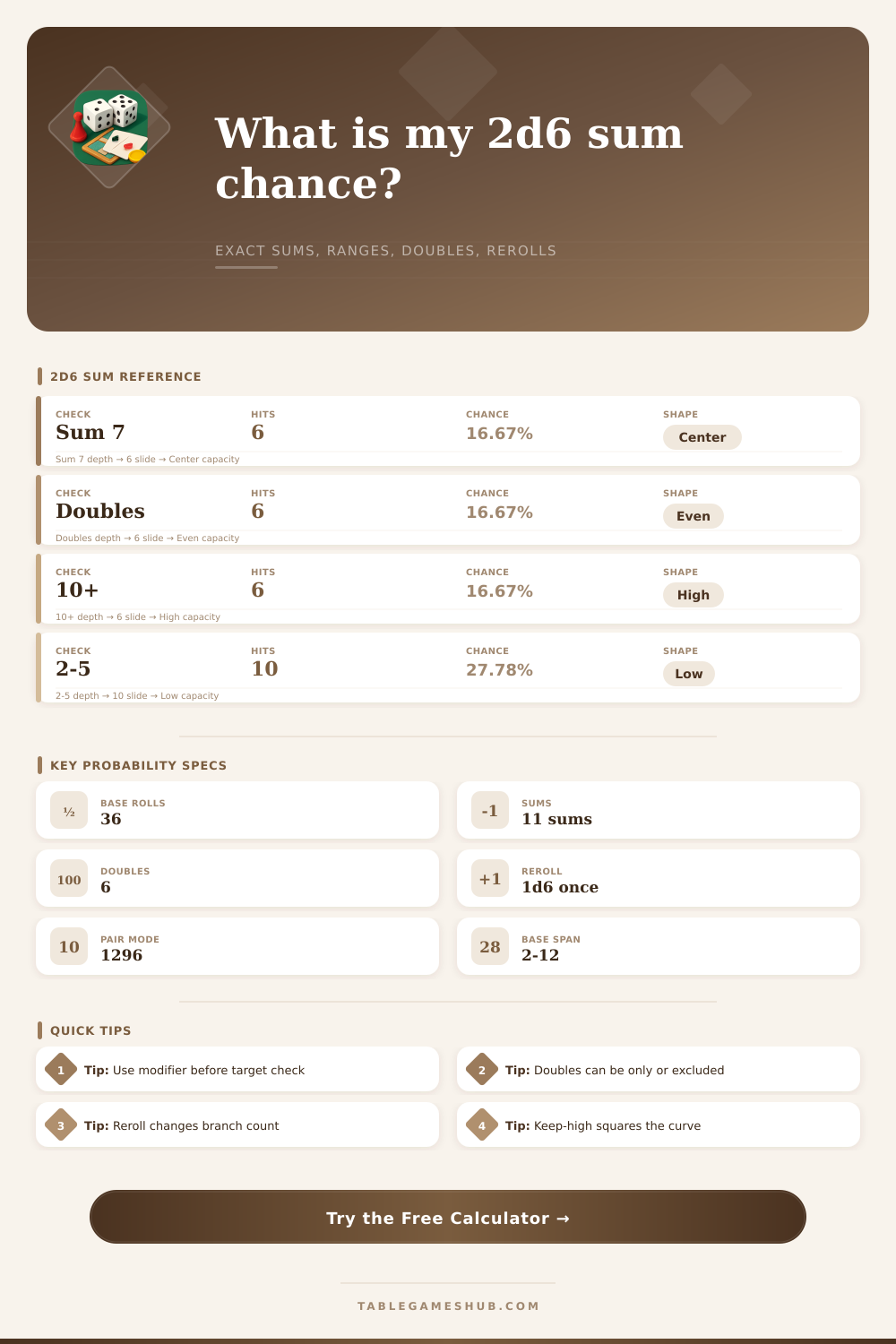
Calculate exact 2d6 sums, at-least and at-most checks, target ranges, doubles filters, modifiers, one-die rerolls, and keep-higher or keep-lower pair rolls from the two six-sided dice probability space.
| Sum | Outcomes | Chance | Example pairs |
|---|---|---|---|
| 2 | 1 of 36 | 2.78% | 1-1 |
| 3 | 2 of 36 | 5.56% | 1-2, 2-1 |
| 4 | 3 of 36 | 8.33% | 1-3 through 3-1 |
| 5 | 4 of 36 | 11.11% | 1-4 through 4-1 |
| 6 | 5 of 36 | 13.89% | 1-5 through 5-1 |
| 7 | 6 of 36 | 16.67% | 1-6 through 6-1 |
| 8 | 5 of 36 | 13.89% | 2-6 through 6-2 |
| 9 | 4 of 36 | 11.11% | 3-6 through 6-3 |
| 10 | 3 of 36 | 8.33% | 4-6, 5-5, 6-4 |
| 11 | 2 of 36 | 5.56% | 5-6, 6-5 |
| 12 | 1 of 36 | 2.78% | 6-6 |
| Target | Hits | Chance | Natural sums |
|---|---|---|---|
| 5+ | 30 of 36 | 83.33% | 5 through 12 |
| 6+ | 26 of 36 | 72.22% | 6 through 12 |
| 7+ | 21 of 36 | 58.33% | 7 through 12 |
| 8+ | 15 of 36 | 41.67% | 8 through 12 |
| 9+ | 10 of 36 | 27.78% | 9 through 12 |
| 10+ | 6 of 36 | 16.67% | 10 through 12 |
| 11+ | 3 of 36 | 8.33% | 11 through 12 |
| 12+ | 1 of 36 | 2.78% | 12 only |
| Double | Natural sum | Single chance | Group note |
|---|---|---|---|
| 1-1 | 2 | 1 of 36 | Lowest double |
| 2-2 | 4 | 1 of 36 | Low even sum |
| 3-3 | 6 | 1 of 36 | Middle even sum |
| 4-4 | 8 | 1 of 36 | Middle high sum |
| 5-5 | 10 | 1 of 36 | High even sum |
| 6-6 | 12 | 1 of 36 | Highest double |
| Any double | 2,4,6,8,10,12 | 6 of 36 | 16.67% total |
| Option set | Branch count | Base idea | Use case |
|---|---|---|---|
| Plain 2d6 | 36 | 6 × 6 | Exact sums and thresholds |
| One-die reroll | 216 | 36 × 6 | Reroll selected die once |
| Keep higher pair | 1296 | 36 × 36 | Compare two 2d6 sums |
| Pair plus reroll | 46656 | 216 × 216 | Compare two rerolled attempts |
Tabletop games often use a mechanic where you roll two six-sided dice. Grab the pair, shake them and drop them where they fall, a chance at success on skill check or an attack roll. It feel like simple math: two to twelve. But inside those thirty-six possibilities is something more. There’s a bell curve here that tugs most outcomes toward its middle but allows extremes to be less frequent. And once you know about that distribution, you’ll start playing differently.
You won’t hope as much; you’ll understand the odds of your luck coming through naturaly. Once you know what you want, plug in your number and let calculator do the math. No need to memorize how often each number adds up. You can experiment with exact scenarios as they occurs at the table. Maybe you need an 8 or higher to punch through a suit of armor? Or maybe you’re trying to stay below five so you don’t trigger a trap? Adjust for modifiers and let tool do its work.
Understanding Dice Odds
A mere +2 bonus doesn’t sound like much, but it nudges your odds closer to victory. It’s pushing the whole curve upward. Suddenly, you hit those higher numbers more frequent because you’ve just bumped your goal down the scale. Strategy also extends to doubles. A pair isn’t simply a matter of taste; often there’s a mechanical advantage as well.
Of the 36 combinations possible, six ways results in a double being rolled out. Regardless of any other number you’re pursuing, that represents a one in six opportunity. Depending on rules, some players don’t want to include doubles or need doubles for certain effects. The tool allow you to filter by these results. You’ll know exactly what that limitation does to the chances of success.
Adding an extra die rerolls breaks the normal bell curve and adds some kind of variable into the mix. By rerolling a one or lower of two dice, you’re not just repeating the experiment; you’re pruning the worst outcomes and replacing them with fresh randomness. By rerolling the lower die or even a one, you’re eliminating the worst case scenario. You are inserting new dice rolls to see what happens. So you eliminate the low numbers from your pool of dice. That means the average will go up.
And that makes it feel like cheating, it feels like bending luck in your favor. But if you consider the new paths that open up, the math works out. Once you include those options in the equation, it all starts to make sense. Those choices change the end result and this little tool illustrates that. One selective reroll could of be far more effective than starting over.
To have greater control, pair two different rolls and use larger of the two. That squares your sample size and pulls the average further from the middle. You end up with a highly uneven spread in favor of high numbers. Some systems calls this advantage; how it works varies between system. What matters here is that you’re sacrificing consistency to gain ceiling height.
You’ll still get some low numbers, but only rarely. If you need moderate results, this is a risky move. But it’s impossible to beat when pursuing a critical success. That understanding will guide your decisions in-game. At the table. At work. In life. Because if you know what kind of distribution the odds represent you make better choices at the table.
When you know the curve, it’s easier to plan. The randomness of the dice isn’t something you can control, but you can learn to read their patterns. Understand how they warp under modifiers and rerolls. And once you do? Every time you hit the button on those dice, it feels less like gambling, and more like taking a calculated step forward.
You won’t wonder why you didn’t get that shot off. You’ll understand when the odds weren’t actualy with you. And that’s worth far more then a handful of lucky breaks.