Balut Score Calculator
Total a full Balut sheet with four entries in each category, automatic line bonuses, score adjustment points, a dice-roll scorer, and a final points audit for tournament or home play.
1Preset Score Sheets
Load a realistic Balut finish, then replace any line with your actual scorecard entries.
2Game and Sheet Settings
3Five-Dice Roll Helper
Enter a roll, choose the line you want to test, then copy the scored value into the next empty scorecard slot.
4Balut Scorecard Entries
Enter each of the four scores for every category. Use zero for scratched entries.
| Category | Entry 1 | Entry 2 | Entry 3 | Entry 4 | Line Check |
|---|---|---|---|---|---|
| FoursScore only dice showing 4 | 52+ earns 2 points | ||||
| FivesScore only dice showing 5 | 65+ earns 2 points | ||||
| SixesScore only dice showing 6 | 78+ earns 2 points | ||||
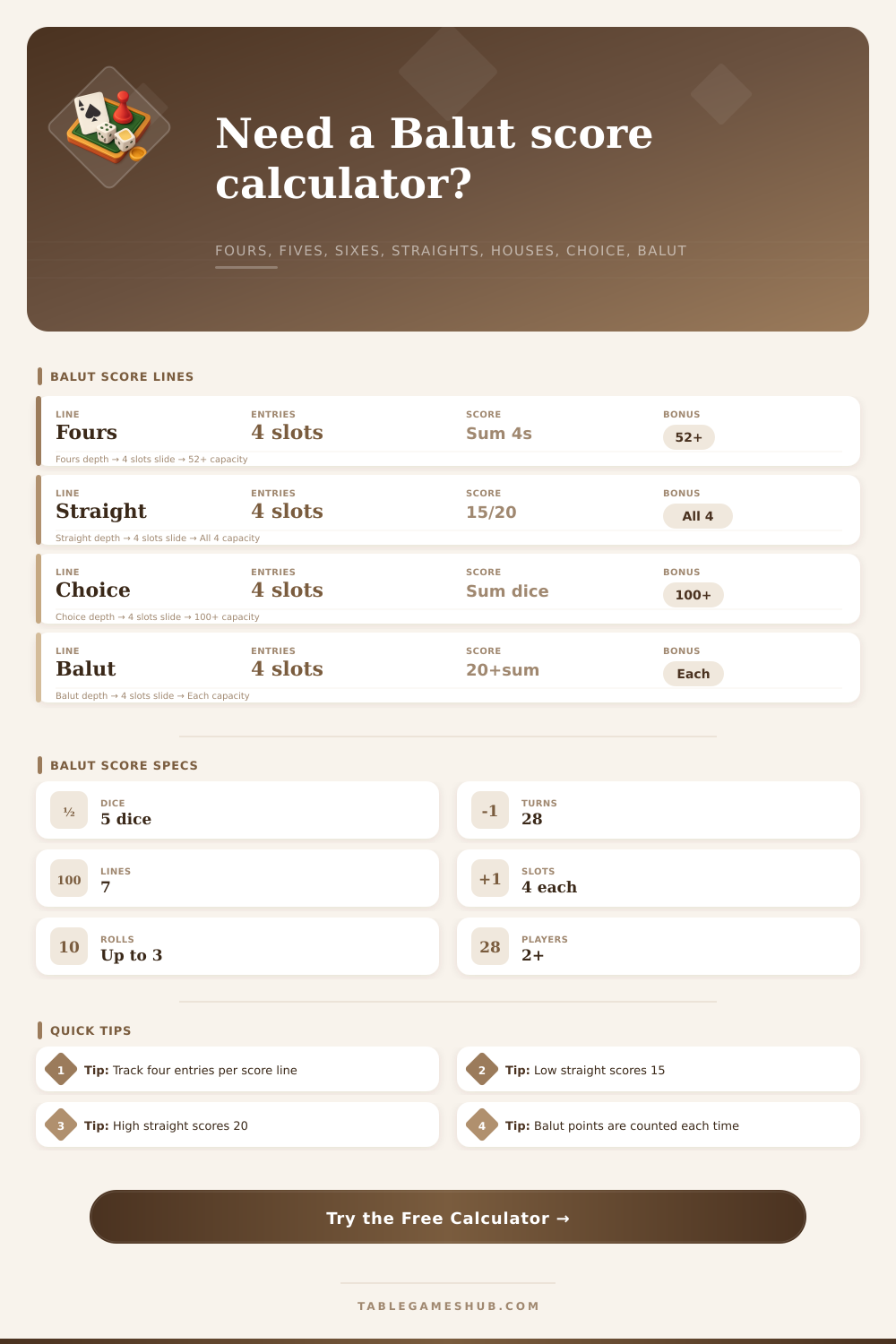
| Straight1-2-3-4-5 = 15, 2-3-4-5-6 = 20 | All four scored earns 4 points | ||||
| Full HouseThree of a kind plus a pair | All four scored earns 3 points | ||||
| ChoiceAny five dice, sum all pips | 100+ earns 2 points | ||||
| BalutFive of a kind | Each scored Balut earns 2 points |
| Line | Total | Rule Check | Points | Status |
|---|
5Balut Component and Score Specs
6Reference Tables
| Category | Roll Requirement | Entry Score | Common Ceiling |
|---|---|---|---|
| Fours | Any dice showing 4 | 4 times count of fours | 20 |
| Fives | Any dice showing 5 | 5 times count of fives | 25 |
| Sixes | Any dice showing 6 | 6 times count of sixes | 30 |
| Straight | 1-2-3-4-5 or 2-3-4-5-6 | 15 or 20 | 20 |
| Full House | Three matching dice and one pair | Sum of all five dice | 28 |
| Choice | Any roll | Sum of all five dice | 30 |
| Balut | Five of a kind | 20 plus dice sum, or fixed club score | 50 or 30 |
| Line Bonus | Requirement | Points | Calculator Check |
|---|---|---|---|
| Fours bonus | Line total 52 or more | 2 | Adds automatically when threshold is met |
| Fives bonus | Line total 65 or more | 2 | Adds automatically when threshold is met |
| Sixes bonus | Line total 78 or more | 2 | Adds automatically when threshold is met |
| Straight bonus | All four straight entries scored | 4 | All four slots must be above zero |
| Full house bonus | All four house entries scored | 3 | All four slots must be above zero |
| Choice bonus | Line total 100 or more | 2 | Adds automatically when threshold is met |
| Balut bonus | Each Balut entry scored | 2 each | Counts positive Balut slots |
| Total Score Band | Adjustment | Use Case | Calculator Output |
|---|---|---|---|
| 20-299 | -2 | Low or scratched card | Subtracts from final points |
| 300-349 | -1 | Below par finish | Subtracts one point |
| 350-399 | 0 | Neutral card | No score-band change |
| 400-449 | 1 | Solid card | Adds one point |
| 450-499 | 2 | Strong card | Adds two points |
| 500-549 | 3 | Excellent card | Adds three points |
| 550-599 | 4 | Table-leading card | Adds four points |
| 600-649 | 5 | Rare high card | Adds five points |
| 650-699 | 6 | Elite card | Adds six points |
| Roll Example | Best Score Line | Score | Why It Matters |
|---|---|---|---|
| 4-4-4-5-6 | Fours | 12 | Builds toward the 52-point fours bonus |
| 2-3-4-5-6 | Straight | 20 | Completes one high straight slot |
| 6-6-6-5-5 | Full House | 28 | Highest common house entry |
| 6-6-6-6-2 | Choice | 26 | Strong flexible total when line pressure is high |
| 5-5-5-5-5 | Balut | 45 | Standard sheet scores 20 plus dice sum |
7Scorekeeping Tips
Line bonus check: Fours, fives, sixes, and choice can look healthy but still miss their threshold. Audit those four totals before final standings are called.
Scratch control: A zero in straight or full house blocks the all-four bonus, so the calculator separates raw score from line points to make that damage visible.
When you are down to your last three rolls and have nowhere left to put them. That’s when the panic sets in. You look at your score card, stare at a matrix of blank squares, and feel restricted. Needing straights, rolling twos and fours. You need fives, but the dice won’t give them to you.
Here is where the good guys separates from everyone else around the table. And it ain’t luck. That happens way back when the dice gets into your hand. It’s about understanding what those dice are worth even before results are recorded. After that, it’s crunching the numbers. This is where calculator will come into play by relieving you from having to keep up with bonuses. That way, you can focus on keeping cool under fire.
How to Win by Using Math
It’s a game of limited optimization with five die. There are twenty-eight decisions before the round ends. You must fill seven categories with four spots each. A choice must be made with every roll. Should you take safe points now (Fours), or wait for a Straight that might never come? Hoarding is risky. Everyone holds back, hoping to collect big ones: Baluts, Full Houses. But a Balut on hand doesn’t count as anything (zero points), until the player use it. And zero points won’t survive consistent accumulators who are happily filling out their Sixes and Choice lines.
By breaking up raw score from line bonuses in calculator, you can see whether going after that large number really costs you something. Newcomers tend to forget that scoring is layered too. It is more than just total of all those dice pips. Bonus points exist, depending on what threshold you cross. If you score fifty-two points with Fours, you get an additional two points. Sounds simple enough, but it alters how you assess a bad roll. If your target are high numbers, one four can seem worthless. But if you’re close to that bonus line, it’s crucial.
This is where you need to see the board holistically, because the tool on this page will automatically check these thresholds, but it also means knowing where you’ll be in 20 turns, rather than simply which box is currently open. Low scores are made interesting with penalty bands. The idea is that if your raw number lands within specific ranges, then points will be subtracted from your total score. In other words a bad game is penalized more different than a good game versus a horrible game. It encourages aggression. There’s no point in parking dice wherever you can and hoping things work out. You need to gather enough mass to escape the penalty zone. Points are taken off according to standard tournament rules, although simply knowing that a score of three hundred minus two is actualy weaker than it sounds helps you judge your position correctly.
That’s why I’m especially intrigued by idea of Choice. It’s simultaneously both a weapon and a vault. Players will feed it whatever roll they don’t feel like using on something else. In that way, Choice becomes a dumpster for subpar rolls. However, anyone who manages to accumulate more than one-hundred points on their Choice gets a bonus that is close to the value of certain category-based accomplishments. Suddenly, the most versatile line has become high-risk opportunity. For many players, Choice is a place to dump the rest. Wrong move. Strategy surrounding Choice are where close games are won and lost.
At its heart, though, Balut is about taking control over a long-term risk horizon. Random dice rolls aren’t random; what you do with them needn’t be either. By validating your bonus as it happens and keeping track of each entry, you remove the uncertainty around who said what in the heat of battle. You know exactly what happened and where you faltered, or didn’t. That transforms the chaos of dice rolls into an orderly audit trail of decision making. You should of seen the patterns earlier. And when you begin to see the twenty-eight slots less as responsibilities and more as potential opportunities, that’s when the panic subsides. You’ll no longer fear the blank card; instead, you’ll respect the mathematics behind it.