Troyes Dice Cost Calculator
Model the denier cost of 1-, 2-, and 3-die Troyes action groups, including opponent dice, neutral dice, activity dividers, and remaining coin pressure.
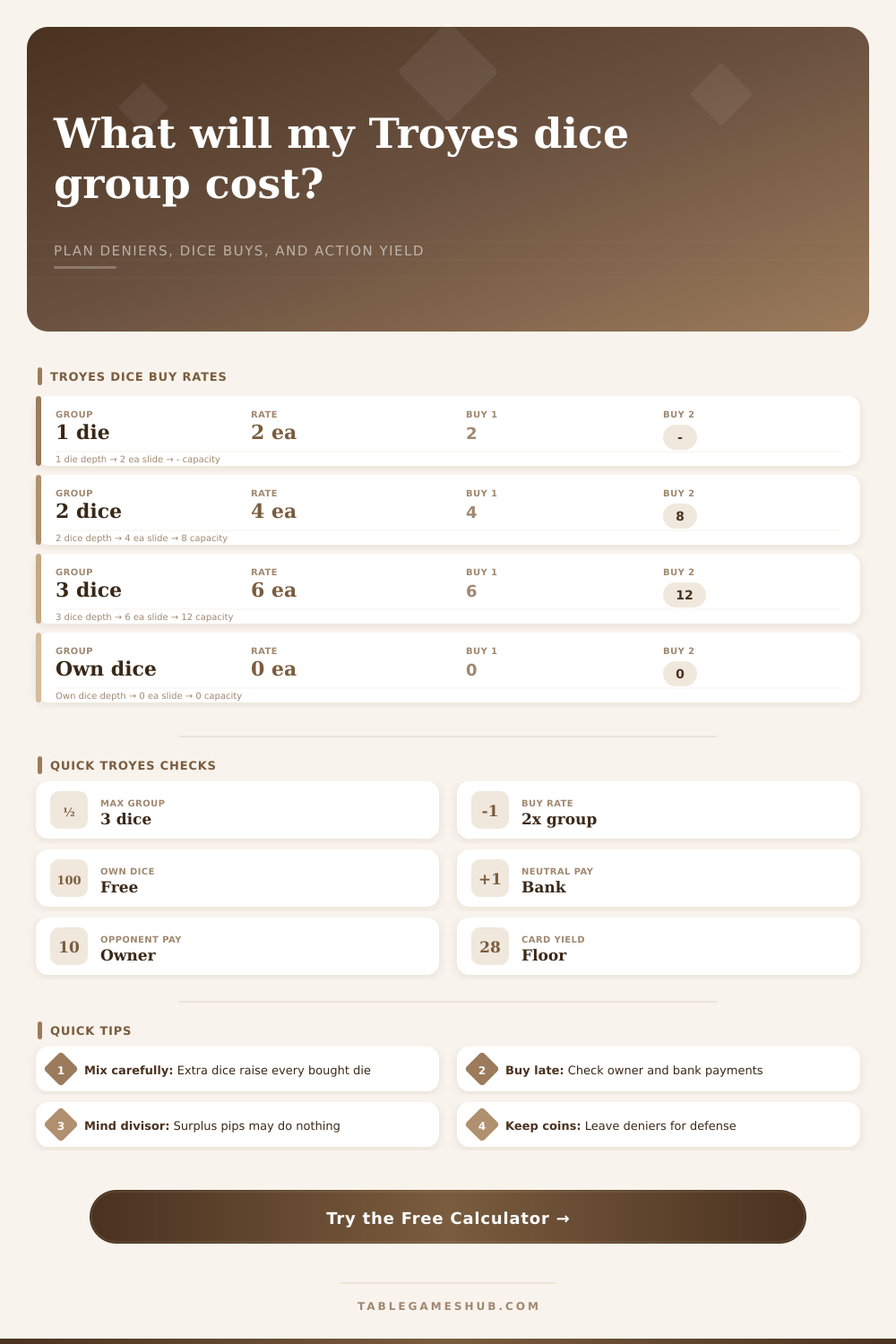
| Total dice in group | Cost per purchased die | One bought die | Two bought dice | Three bought dice |
|---|---|---|---|---|
| 1 die | 2 deniers | 2 deniers | Not possible | Not possible |
| 2 dice | 4 deniers | 4 deniers | 8 deniers | Not possible |
| 3 dice | 6 deniers | 6 deniers | 12 deniers | 18 deniers |
| Your own dice only | 0 deniers | 0 deniers | 0 deniers | 0 deniers |
| Die source | Purchase payment | Cost math | Planning note |
|---|---|---|---|
| Your district | No payment | 0 deniers | Best when pips already meet the divisor cleanly. |
| Opponent district | Pay that player | 2 x group size | The receiver can use those deniers immediately later in the round. |
| Neutral player | Pay the bank | 2 x group size | Useful when you need pips without funding an opponent. |
| Mixed ownership | Split by source | Same rate for each bought die | The third die increases the rate for every purchased die in the group. |
| Divisor | What it models | Result formula | Waste check |
|---|---|---|---|
| 1 | Point-for-pip effects | Adjusted pips | Almost no surplus loss. |
| 2 | Light activity conversion | Floor pips / 2 | Odd totals lose one pip. |
| 3 | Common card threshold | Floor pips / 3 | Totals 3, 6, 9, 12, 15, 18 are clean. |
| 4-6 | Demanding activity or placement | Floor pips / divisor | Buying extra pips is strongest near the next multiple. |
| Action group | Bought dice | Purchase spend | Entry spend | Table feel |
|---|---|---|---|---|
| One borrowed 6 | 1 of 1 | 2 deniers | 0-2 deniers | Efficient single-die pivot. |
| Own die plus borrowed 5 | 1 of 2 | 4 deniers | 0-4 deniers | Good when it reaches a clean divisor. |
| Two bought dice with own 3 | 2 of 3 | 12 deniers | 0-6 deniers | Strong, but can empty the purse. |
| All three dice bought | 3 of 3 | 18 deniers | 0-6 deniers | Only sensible for a decisive payoff. |
In Troyes, you are sitting at the table looking at a yellow civil action card. It’s the type of merchant chain you require. Your district has a good die, one with a four on it. To advance to the next multiple to gain the cards yield, you must roll a six. In an opponent’s district there’s a six. Should you just go for it? Take it? Roll the dice? It’s tempting. But that one die cost a lot. And the bigger the group the higher cost grows.
Troyes’ core mechanic is deceptively simple but merciless: For every action you take, you may combine up to three dice and use them freely. If someone else’s die is in the mix, it’ll cost you two deniers per die borrowed from another player (including the neutral). However, there’s a catch: The more dice in your combo, the higher the cost for all the dice. So if you add another die to your group, that one will also cost you extra because of the other two. A lot of people overlook that fact. They only notice how many pips are added to their action but not how much their cost went up.
How to Play Troyes
For example: Each borrowed die is four deniers if you intend to include it in a two-die action. That same borrowed die becomes six deniers when part of a three-dice action. How about a calculator running the numbers immediately? No need for you to do the mental multiplication as you watch your competitors. Simply enter number of dice you own, how many dice you’re borrowing from other players, and how many neutral dice you’re using for this action. Enter the sum of the dice pips and divide it by divisor for your chosen action card. Instantly, you know whether you can make the play or go bust.
Now let’s talk about understanding the dice and their divisor. To do anything with most action cards, you have to divide your number of pips (for example) by some other number such as four or three. Based off the result, you will gain some number of points or actions. Anything left over is a waste. It doesn’t go towards scoring. So if you have five more than a multiple of three, then so what? It’s like having two less. It is a little thing, but it matters when managing resource. For example, maybe you can buy two dice with twelve deniers. And then remember that three of them don’t even matter for the final score. Ouch.
There is also a strategy angle regarding where you are paying it. If you’re purchasing dice from an opponent, they immediately go straight to their purse. This means you’re funding your competitor’s turn. They’ll be able to buy more dice for themselves or even make actions during the current round. By contrast, neutral dice get paid out to the bank. That means the money dissapears from players’ hands and leaves the player economy. If you’d like to strengthen yourself while keeping your competitors down, this is a good way to do it. The separation of payment allow you to know exactly which of your opponents is getting richer based on your choice.
This ties into timing. Sometimes there are lots of deniers early on in the round. Nobody has taken any good actions and you need to jump the queue. Buying dice is a decent method for jumping the queue. Later on in the round, the economy constricts. Your options narrow and prices stays the same. You’ll be holding onto coins so that you can join in the last couple of action. Use the calculator to estimate how many coins you will end up with after buying dice. If it indicates that you’ll only have two deniers left, consider whether or not this is sufficient to react to somebody else’s move.
It’s not about the pips; that’s what the best players in Troyes understand. It’s about the price. It’s about calculating how efficiently your money can be spent in terms of deniers. If a burst of three dice will yield one more activation, but cost eighteen deniers, then they aren’t worth it. But what if it gives you the one victory point you need to tie with a rival? Then by all means, go for it! That’s where the planning comes into it. You can no longer afford to guess. Know the precise cost beforehand and make your commitment. Don’t do it with your eyes closed!
So don’t go grabbin at dice cups until you’ve made sure the following: How many people? What’s the divisor? Where does it pay out? Test your theory with the tool. Turn chaos into a plan. Stop reacting to the board. Start controlling the board. Save the deniers now so they could of bought you the winning move later. Make the plan. Get the action. Keep your purse safe. That’s how you win in Troyes.