Scrabble Blank Tile Value Calculator
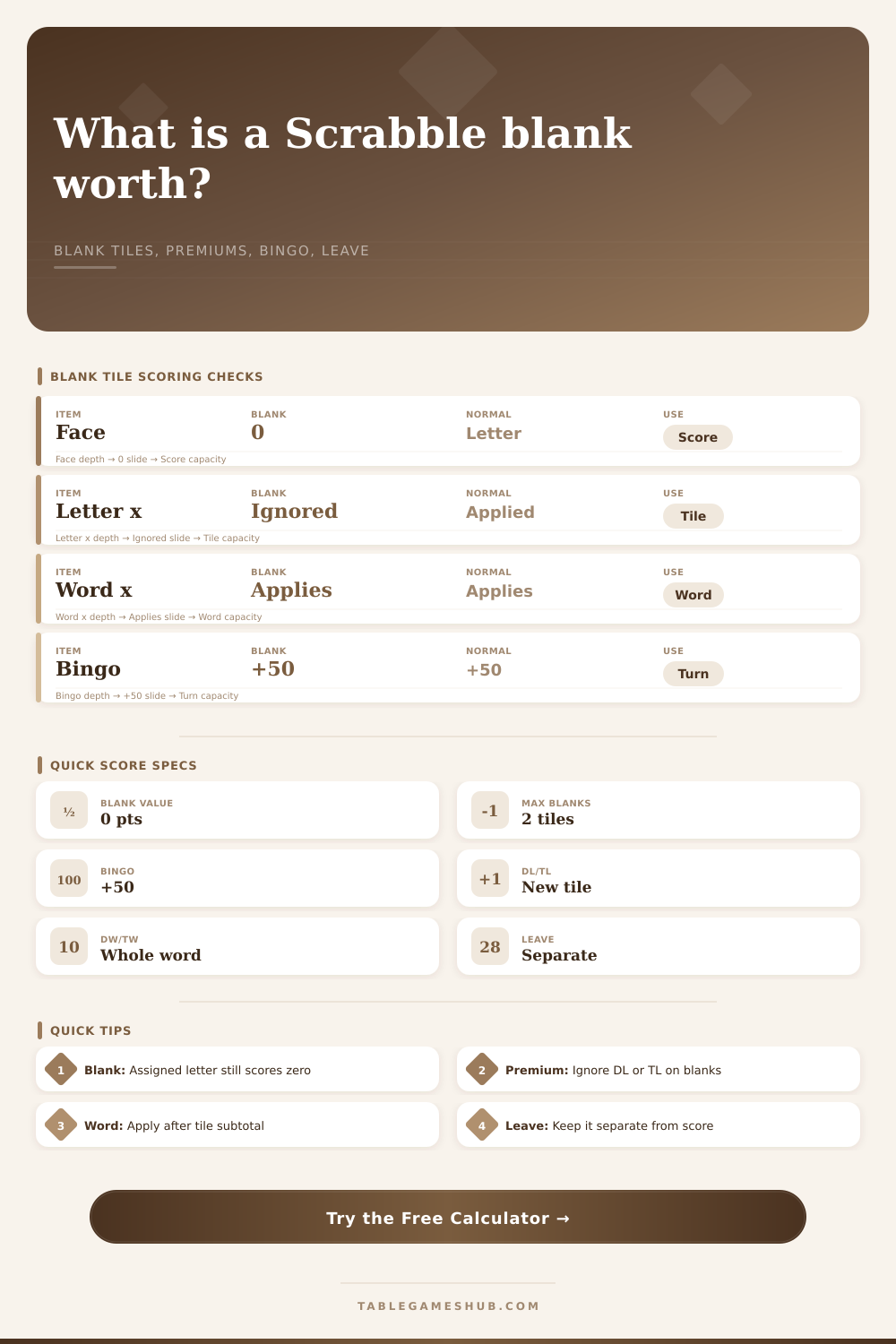
Calculate a Scrabble word score when one or two blanks are assigned letters, including letter premiums, word multipliers, bingo bonus, rack leave, and the final word score.
| Points | Letters | Blank Face Loss | Blank Note |
|---|---|---|---|
| 0 | Blank | 0 | Assigned letter, zero score |
| 1 | A E I O U L N S T R | 1 per blank | Most low-value assignments |
| 2 | D G | 2 per blank | Face value removed before premiums |
| 3 | B C M P | 3 per blank | Letter premium still gives zero |
| 4 | F H V W Y | 4 per blank | Word multiplier magnifies the loss |
| 5 | K | 5 per blank | Single mid-value assignment |
| 8 | J X | 8 per blank | Big difference on word premiums |
| 10 | Q Z | 10 per blank | Largest face value removed |
| Square | Normal Tile | Blank Tile | Calculator Entry |
|---|---|---|---|
| Double letter | Letter x2 | 0 x2 = 0 | position=2 |
| Triple letter | Letter x3 | 0 x3 = 0 | position=3 |
| Double word | Whole word x2 | Applies to word | word x2 |
| Triple word | Whole word x3 | Applies to word | word x3 |
| Multiple word squares | Multipliers combine | Applies after blanks score zero | x4, x6, or x9 |
| Assigned Letter | Normal Face Value | Blank Score | Lost on x3 Word |
|---|---|---|---|
| E | 1 | 0 | 3 points |
| H | 4 | 0 | 12 points |
| X | 8 | 0 | 24 points |
| Q | 10 | 0 | 30 points |
| Component | Included In Official Score | Input Used | Calculation Order |
|---|---|---|---|
| Nonblank tile values | Yes | Played word | Start subtotal |
| Blank face values | No | Blank positions and letters | Remove before premiums |
| Letter multipliers | Yes, nonblank only | Letter multipliers | Add before word multiplier |
| Word multipliers | Yes | Word multiplier | Multiply tile subtotal |
| Bingo bonus | Yes | Bingo bonus | Add after word multiplier |
| Rack leave value | No | Rack leave value | Separate evaluation line |
Wooden tiles gets shuffled, and the game begins. You reach in and pluck out a blank. It feels cool against your fingers. It’s smooth. And then you see the letters: They would make a big score. But there’s no guarantee it will come up. No points if it doesn’t. So how do you proceed? How can you possibly trust yourself to do the right thing when you’re playing a tile that could earn you nothing?
This creates the anxiety inherent in the Scrabble blank. It officially scores zero; it require a degree of strategic discipline. It’s one thing to use the blank as part of an L or a D or even a Z or a Q. But according to the rules, it adds absolutely nothing to the score. A hidden cost exist here. Casual players tend to ignore this hidden cost until they have already lost the advantage.
How to Use the Blank Tile
But this price goes beyond the instant satisfaction of the play. Every time you place a high-value letter on that blank, you’re taking one of those strong tiles out of play. Once you describe the word, and the bonuses or penalties, the calculator does the number crunching for you (and it spares you the guesswork of what price you’re paying). But all the calculator can provide is the score of this single action. It doesn’t advise you whether it’s worth taking a hit on weak vowels later because of what you might score now. That’s a decision based off the tiles at hand and how they are spread across the board. It is not math alone.
Let’s look at the logic behind this one. First of all, the blank is faceless, there’s no “double” or “triple” letter square that will ever benefit it. Putting a blank in a triple letter spot doesn’t give you anything. Many players think it does, as if the letter recieve the bonus. But the rules are clear: it is the tile itself. The multiplier goes toward the overall word score, not the single-tile value. And that makes a difference; it alters how you should read the board. A blank on a double-word square is a powerful thing, since it multiplies the whole amount. A blank on a triple-letter square? Often a wasted square. It is better for the blank to increase the word multiplier than try to boost the letter multiplier.
But here’s the trick: What do you sacrifice? When you use a blank to save yourself that Q, you’re giving up the possibility of playing that Q for ten points in the future. Is that a good trade if this game is going to be a short one? Maybe. But if this game is going to drag out, you just removed a high-value tile from your arsenal for the rest of the game. High-point consonants are a premium and pros frequently will hang on to blanks to save them for these letters in situations where there might be a better way to score those points down the road.
The reasons here stem from rack balance. If you make a good play, it will leave you with tiles that you can use to create words using whatever tile you draw on the following turn. If you make a play that uses up one or both blanks for rare consonants, you may end up with nothing but vowels in your rack that won’t help you create anything worthwhile. Your current turn’s score may look great, but then what about your next turn? Are you stuck making a low-value play or are you compelled to pass? That’s why the quality of your rack leaves is so important. Although they don’t count toward your official score, they do determine how well your next turns is going to go.
You’re sacrificing some points now for potential freedom later. What are those trades worth? Why is this a good or bad trade? When should you accept or avoid that offer? These are questions the top players understand. The bottom line is that the blank tests both your foresight and your patience. Not only do you need to think about what’s coming next, but you must think about the whole game. What’s the long term value of holding onto those strongest tiles? How much is it worth different than the immediate gratification of a great score?
While the math is simple, the strategy isn’t. When you reach into the bag for a blank, you’re placing a bet on the future. Are you betting on something you’re willing to lose? Make sure you are betting on something you can actualy afford to lose.
The tiles shuffle randomly, but your decision of what to do with them doesn’t. Respect the blank. Play the board. Zero points today could of cost you ten points forever.