Archery FOC Calculator
Balance front stack, total arrow mass, and tuning offset
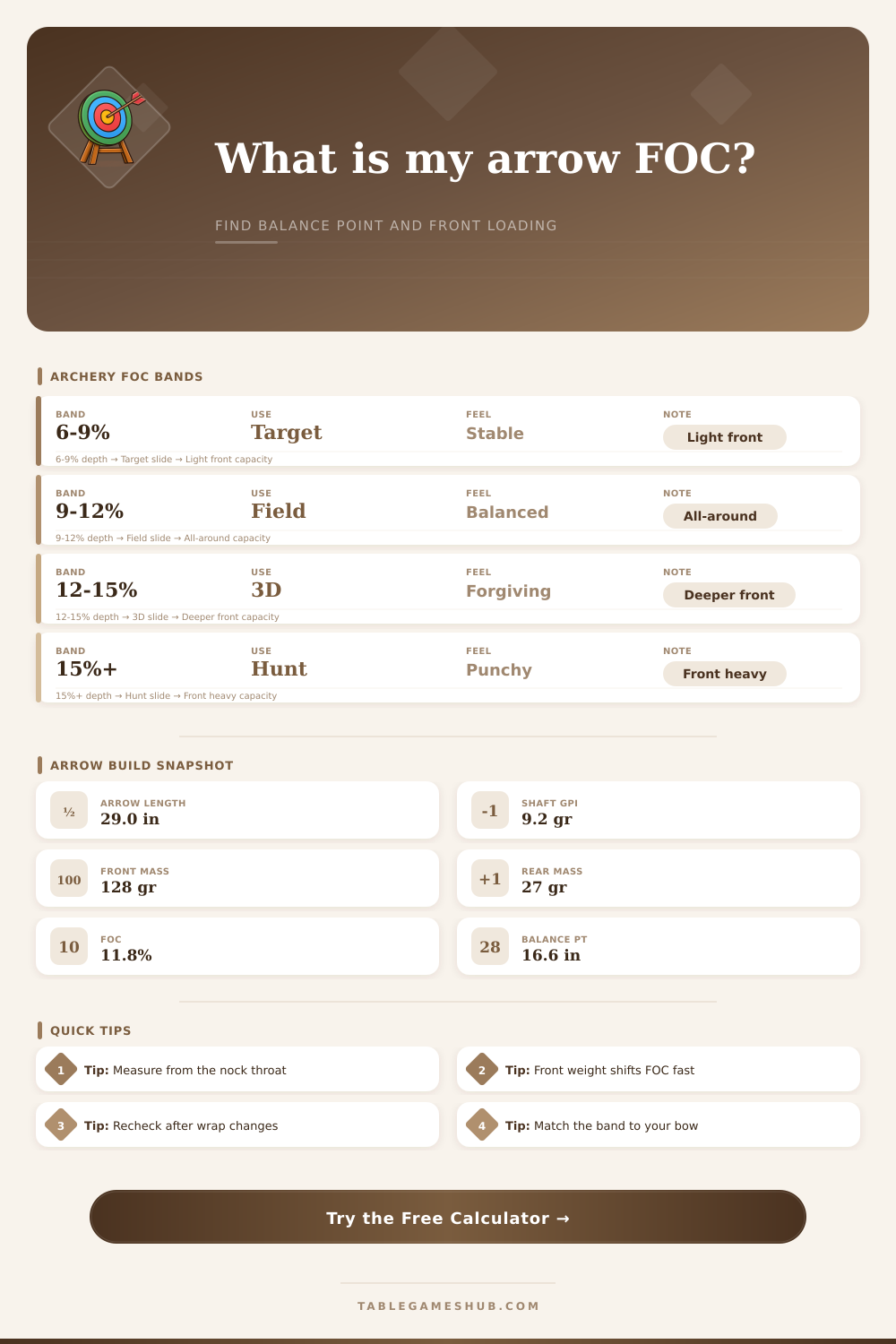
| Band | Use | Feel | Note |
|---|---|---|---|
| 6-9% | Target | Stable | Light front |
| 9-12% | Field | Balanced | All-around |
| 12-15% | 3D | Forgiving | Deeper front |
| 15%+ | Hunt | Punchy | Front heavy |
| Part | Typical | Effect | Tip |
|---|---|---|---|
| Point | 100-200 gr | Raises FOC | Step in 10s |
| Insert | 10-25 gr | Adds front | Small effect |
| Wrap | 5-15 gr | Moves rear | Use sparing |
| Fletch | 6-18 gr | Rear mass | Keep light |
| Style | Target | Bias | Note |
|---|---|---|---|
| Compound | 10-14% | High | Front stack |
| Recurve | 8-11% | Mid | Clean release |
| Barebow | 7-10% | Low | Middle band |
| Hunting | 12-16% | High | Deep front |
| Check | Range | Read | Action |
|---|---|---|---|
| Low FOC | < 8% | Speed-led | Add front |
| Mid FOC | 8-12% | Balanced | Hold tune |
| High FOC | 12-15% | Front-heavy | Verify gap |
| Very high | 15%+ | Deep front | Trim nose |
Front of Center
Front of center (FOC) is the measurement of amount of mass that is located in the front of the arrow that is in front of it’s physical midpoint. FOC is represented as a percentage. The percentage value represents the amount of weight that is located towards the front of the shafts compared to the rear of the shaft of the arrow.
Higher percentages of FOC indicate that the arrow has more of its weight towards the front of the arrow, while lower percentages of FOC indicate that an arrow has more of its weight towards the rear of the arrow. FOC is a value that impacts the flight of the arrow. Arrows with a higher percentage of FOC tend to remain in a straight flight path, but high FOC can reduce the speed of the arrows.
What is Front of Center (FOC)?
Changing the components of the arrow can change FOC. Arrows have a shaft, point, insert, fletching, and nock as their components. The shaft is the basic weight of the arrow.
The point and the insert is located at the front of the arrow. The fletching and the nock are located at the rear of the arrow. Adding a heavier point will increase the FOC.
Adding more heavy fletching will decrease the FOC of the arrow. Bows have different requirements for the FOC of the arrows that they shoot. Compound bows require arrows with an FOC between 10 and 14 percent.
Recurve bows require arrows with an FOC between 8 and 11 percent. Barebow arrows require an FOC between 7 and 10 percent. Hunting arrows has an FOC of 15 percent or more.
Consistency in the method to measure the FOC of the arrow is necessary for obtaining accurate measurements of the FOC. The archer should measure the FOC of the arrow from the nock throat, not the string groove. Any measurements taken from the string groove will result in incorrect measurements of the FOC.
All components of the arrow need to be accounted for in the measurement of the FOC. The wraps and collars of the arrow add to the weight of the arrow. The fletching of the arrow also adds to the total weight of the arrow.
If the weight of the fletching or the wraps isnt accounted for in the calculation of the FOC of the arrow, the calculated FOC will not match the actual FOC of the arrow. Arrows with different FOC percentages exhibit different flight characteristics. Arrows with an FOC between 6 and 9 percent are stable when used for target shooting.
Arrows with an FOC between 6 and 9 percent can travel at higher speeds compared to arrows with higher FOC percentages. Arrows with an FOC between 9 and 12 percent are the most versatile and are often used for field rounds. Arrows with an FOC between 12 and 15 percent are the best for 3D archery targets as they will maintain their flight path when the arrow is not flown in a straight path.
Arrows with an FOC above 15 percent exhibit good performance when hunting game as they will penetrate through the targets. However, arrows with an FOC above 15 percent will move at a slower speed. An FOC that is too low will make the arrow appear to be twitchy when shot.
An FOC that is too high will make the arrow stall before it can fly through the air. The archer can tune the arrows to achieve the desired FOC percentage. Paper tests and bareshaft flights allow the archer to see the flight of the arrow with the current FOC of the arrow.
If the FOC percentage is too low, weight can be added to the front of the arrow. If the FOC percentage is too high, the archer can remove weight from the front of the arrow, or weight can be added to the rear of the arrow. The archer should of measure the FOC of the arrow again after adding fletching or wraps to the shaft of the arrow.
Following these steps will allow the archer to ensure the FOC of the arrow matches the specification of the bow that is being used.