🧱 Upwords Score Calculator
Total an Upwords turn from flat word scoring, stack depth, extra formed words, Qu bonus, seven-tile bonus, endgame penalty, and running score context.
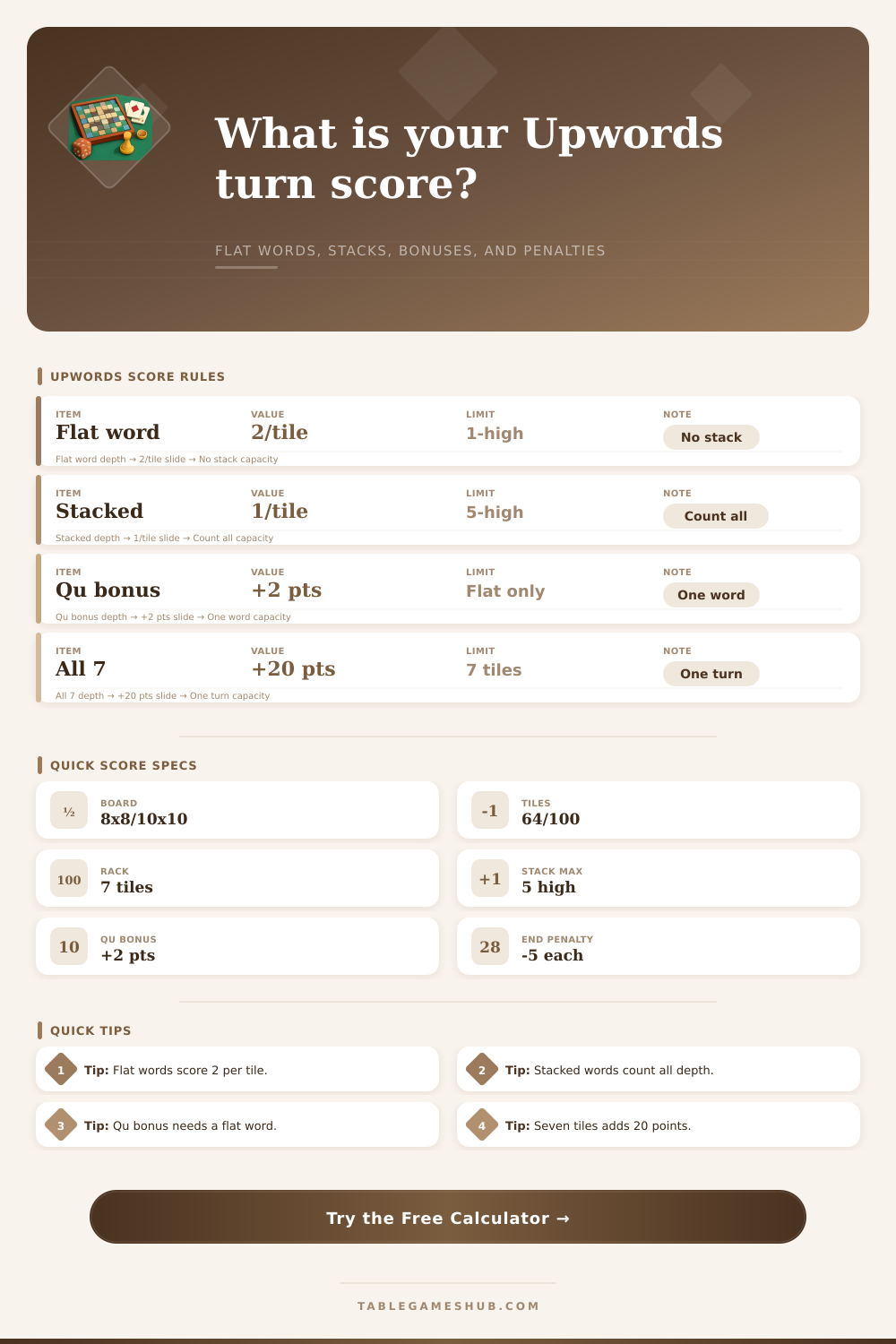
If every letter in a formed word is one tile high, score two points for each letter tile.
If any letter is stacked, score one point for every tile in every stack of that word.
Add two for eligible Qu use and twenty for playing all seven rack tiles in one turn.
At final scoring, subtract five points for each unplayed letter tile left on a rack.
| Scoring item | Value | When to use it | Calculator field |
|---|---|---|---|
| All-one-level word | 2 points per letter | Every letter in that formed word is exactly one tile high. | Main word stack heights all 1 |
| Stacked word | 1 point per tile counted | At least one letter in the word sits on top of another tile. | Main word stack heights |
| Extra formed words | Score each word | Multiple words formed on the same turn are each scored separately. | Extra letters and stacked count |
| Qu bonus | +2 points | Qu tile is used in a word whose letters are all one tile high. | Qu tile bonus |
| Seven-tile bonus | +20 points | All seven rack tiles are used in one turn. | Seven-tile bonus |
| Endgame penalty | -5 per tile | Final score adjustment for each unplayed letter tile. | Unplayed endgame tiles |
| Example turn | Main heights | Extra score | Total before current score |
|---|---|---|---|
| Fresh four-tile word | 1,1,1,1 | 0 | 8 points |
| Change one letter on a stack | 2,1,1,1 | 0 | 5 points |
| Flat Qu word | 1,1 | +2 Qu | 6 points |
| Seven flat letters | 1,1,1,1,1,1,1 | +20 bonus | 34 points |
| Main stack plus cross word | 3,1,1,2 | 6 | 13 points |
| Component or rule spec | Classic value | Modern value | Score relevance |
|---|---|---|---|
| Gameboard grid | 8x8 | 10x10 in some sets | Controls board space, not point value. |
| Letter tiles | 64 tiles | 100 tiles | Affects tile availability and game length. |
| Tile racks | 4 racks | 4 racks | Supports the two-to-four player range. |
| Rack draw | 7 tiles | 7 tiles | Determines seven-tile bonus eligibility. |
| Maximum stack | 5 high | 5 high | Caps accepted stack heights in the calculator. |
| Reference | Used for | Quality note | Link |
|---|---|---|---|
| Winning Moves official rules PDF | Classic scoring, stack cap, bonuses, endgame penalty | Primary rule sheet for the 8x8 / 64-tile edition. | Rules PDF |
| Hasbro US instructions page | Modern product specs and component count | Official product instruction page for a 100-tile edition. | Hasbro US |
| Hasbro GB instructions page | Player range and 10x10 / 100-tile context | Official instruction listing for another modern edition. | Hasbro GB |
Score each word formed on the turn by its own condition: all one-level words use two points per letter, while any stacked word counts every tile in its stacks.
Add Qu and seven-tile bonuses after the formed words are scored, then apply endgame tile penalties only when checking the final score.
By turn three, you know: Upwords isn’t just like Scrabble. Someone plays CAR or TEA (a flat word), and another player puts a letter atop the A. Now that word’s twice as valuable. The game changes from spelling to spatial reasoning, specifically three-dimensional geometry. It catches people off-guard who don’t understand how important it is to stack.
In Upwords, most people wants to get really big words (that’s what they’re used to in other word games). But they miss out on importance of height over width. A four-letter word stacked up two tiles tall earns eight points; a six-letter flat word gets twelve, true, but it also take up board space for doing so. Upwords rewards vertical thinking, and casual opponents rarely notice this at first glance.
How to Score Points in Upwords
While a calculator does all the math for you, understanding the input will help you play better without it. Before laying down any tile, you have to understand whether they is flat or stacked words. Flat words count each letter as two points, which is quite good compared to stacked words that only counts one point per tile.
But there’s more: Stacked words count each tile in their column (even the ones below the stack). If you’re modifying someone else’s stack, adding depth rather then width can pay big rewards. Understanding what you’re measuring matters. What are you counting? Not just tops of the letters; it’s the whole column from the board upwards.
The Qu Tile is confusing for most people. If you use a Qu in a flat word, you will earn a two-point bonus. If that Qu is used in a stack word, no bonus! Most believe that if they ever play that letter, it’s worth a bonus, and technicly in the rules that isn’t true. It has to be on one level to earn additional credit. That makes a difference as you’re fighting for that win in the late game.
Once you indicate what shape of word is being played, the calculator understand the difference. All you have to do is remember what formula to use based off how you played.
Playing all seven tiles is a major way to boost your score. A seven-tile play will always give you an extra 20 points, no matter what words you make from them. So a seven tile play can be very powerful; sometimes even more helpful than finding rare words (like XU or QI). You build several word off a large number of letters in a single move.
Cross-words add bonus points, as well as whatever their main word is worth. You get a separate point for each cross-word word. The points realy start to add up fast if you have a lot of those types of plays. Because that’s not usually your main emphasis, cross-words can easily gets missed. But they still count toward your total score.
A penalty ends the game. Unused tiles cost five points at game’s end. If you don’t use a tile by the time you run out of turns (or at least use it to get rid of another one), you lose five points. This is what keeps you honest. It forces you to empty your rack, even if it means taking a lower scoring play.
Even in the last few minutes, you need to prioritize efficiency over pure aggression. Don’t hang onto good tiles waiting for a better moment. Spend ’em or pay the price. A lot of players do this; they hold back and the penalty takes away some of their advantage.
On the page, the score components are broken down in reference tables that show where points go and where they came from. Whether playing with the classic sixty-four tile set or its hundred-tile expansion, the underlying math remain the same. While available space changes as the board sizes do, a single stack maintains its value.
At its heart, Upwords is a game of resource management. You must manage your letters, their position on the board, and height of stacks all at once. This need to think several moves ahead causes some players trouble. To score big, think of stacks not as obstacles but as assets. Aim your columns where you can build height, because every tile increase your score while using no more board space.
That’s not about expansion, but intensification. It’s not about covering the board so much as deepening it. That’s what distinguishes high scorers from others. High scorers gets that depth pays off in ways that width never will.
The tool will let you check turns, which will help you internalize those values. Don’t feel like you have to check it on every turn. If you practice checking with it, you’ll be able to see if an extra flat word is worth modifying the stack. Or in other words, you begin to train yourself to not only see what’s there, but what could of been made by it.
You are building a board to not only produce good moves now, but also reward good moves to come. Long term set up versus short term gain is where the game realy lies. In Upwords, it’s as much about having spatial awareness as it is word knowledge. It’s all about building a tower of letters, where every element matters. There are no set patterns; you can place flat letters on top of a base to create words, or stack them into vertical columns. Flat words score two points per tile, while stacked words scores one point per tile in the stack. Efficiency earns bonuses, while indecisiveness causes penalties. Get past the temptation of elongated expressions, and the rules become self-evident. The best players consider the pieces in terms of columns and stacks, with height being everything.