Blokus Score Calculator
Total remaining unit squares, completion bonuses, partner colors, and winning margin for basic or advanced Blokus scoring.
▣Named scoring presets
🔢Score inputs
Enter the unplayed pieces for one color. For two-player or team scoring, add the partner or second color score in the aggregate field.
🧮Formula cards
▦Blokus component/spec grid
📋Scoring reference tables
| Score item | Official count | Calculator field | Score effect |
|---|---|---|---|
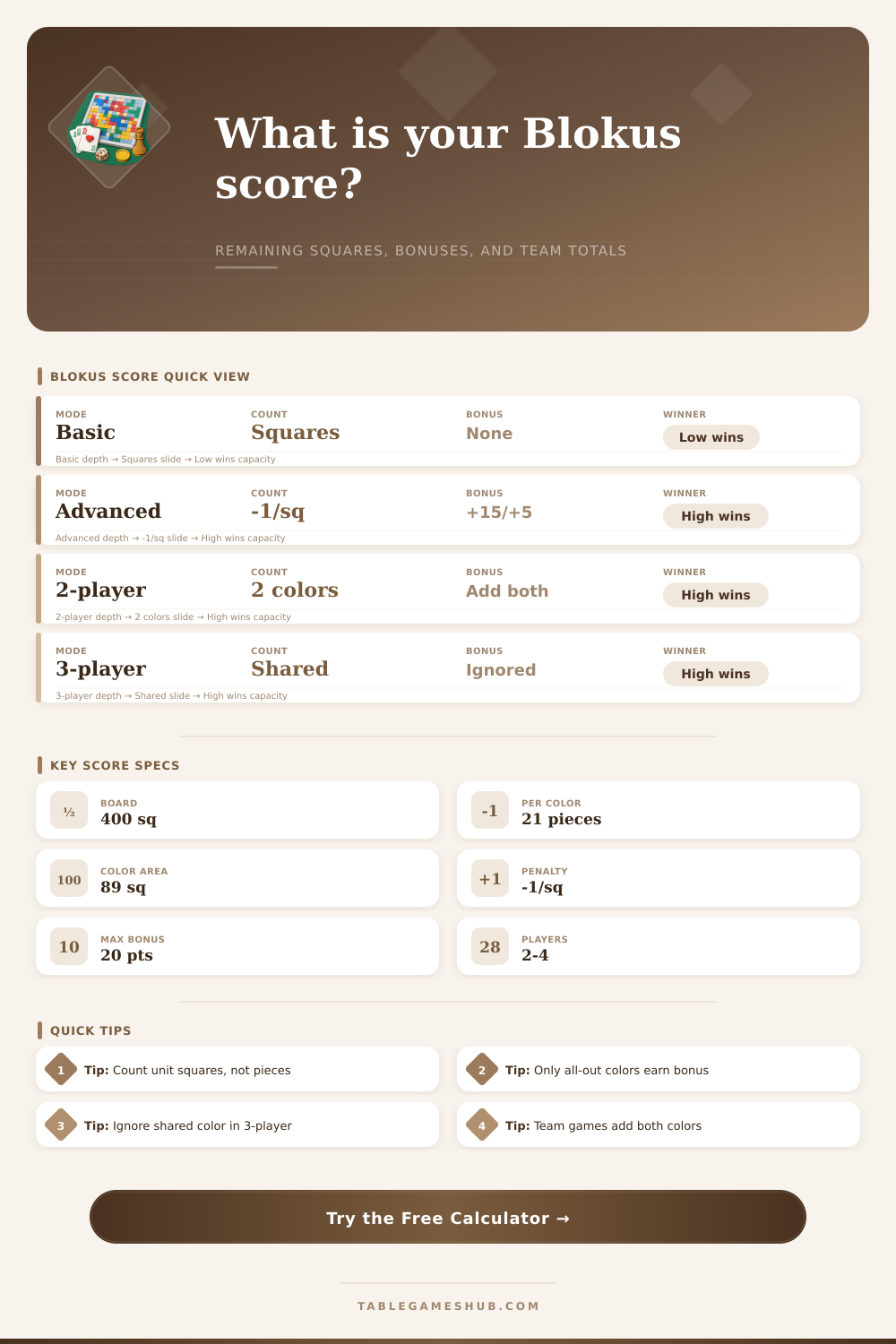
| Unplayed unit square | Count every square in remaining pieces | Piece-size inputs | -1 advanced point per square |
| All pieces placed | No unplayed pieces remain in that color | All 21 pieces placed | +15 advanced points |
| Smallest piece last | The 1-square piece was the final piece placed | 1-square piece was placed last | +5 more advanced points |
| Basic comparison | Compare remaining squares only | Scoring mode: basic | Lowest square total wins |
| Piece size | Pieces per color | Squares per piece | Max leftover squares |
|---|---|---|---|
| Monomino | 1 | 1 | 1 |
| Domino | 1 | 2 | 2 |
| Triomino | 2 | 3 | 6 |
| Tetromino | 5 | 4 | 20 |
| Pentomino | 12 | 5 | 60 |
| Format | Colors scored | Shared color treatment | Calculator approach |
|---|---|---|---|
| 4 players | One color per player | None | Score one color and compare all players |
| 2 teams | Two colors per team | None | Add partner color score to final total |
| 2 players | Two colors per player | None | Add the second controlled color |
| 3 players | One personal color each | Ignored | Leave shared color out of the total |
| Example line | Remaining pieces | Remaining squares | Advanced score |
|---|---|---|---|
| All pieces, single last | None | 0 | +20 |
| All pieces, not single last | None | 0 | +15 |
| Two 4-square pieces | 2 tetrominoes | 8 | -8 |
| One 3, four 4s, one 5 | Mixed leftovers | 24 | -24 |
💡Score audit tips
In most games of Blokus, the endgame can become a frantic struggle to fill in all the gaps. Your board is packed full. There’s one turn left. You need that wonky pentomino to fit in a spot where it no longer can. As the last piece drops into place, everyone holds their breath.
That’s usually when things break down with casual players because now there’s contention over who realy should of won. How does Blokus get scored? It’s more than just counting which player has more leftover plastic. You need to understand the bonus system and how many points each square represent. You also need to decide if you are playing for points or just to survive.
How to Score in Blokus
The calculator up top will crunch the numbers for you, but having some idea of what they represent alters way you play out the last few minutes. The general rules say: the more units of each type you can fit into that grid, the better. And the fewer squares leftover, the better.
The clever part of the advanced scoring make this more concrete. Players is penalized for unused unit squares, which gives them a negative number depending on how much space remains unfilled. Three pentominoes on the table? Fifteen points against you. Sounds harsh, but it encourages efficiency!
Then there’s where the kicker lands… The finish line bonuses. Get all twenty-one pieces placed in your color and get a fifteen-point bonus. Suddenly the goal isn’t just avoiding leaving too many empty spaces. You must expand quickly as the game counts down toward the moment you are forced to lock down. Now you’re racing to achieve a perfect zero and unlock those precious points.
There is another commonly misapplied bonus. While we’re at it: People frequently miss this second bonus, which is worth five more points if you’re able to fit the single-square monomino as your final piece. Because you have to save that smallest possible tile until last turn, it limits your options on preceding moves. What if you needed that little guy somewhere in the middle of the puzzle to fill in a hole? If you left yourself with no way out later, you probably shouldn’t have taken the risk, unless the calculator tells you otherwise.
Did you follow the exact conditions for each of these bonuses? And did you include them properly in your starting total? You won’t have to fight over whether that tiny square was actualy the last one. That’s one more level of complexity.
If it’s a normal four player game, then it’s just about your color. Two players each get two colors. So now it’s about combining your score from both of those colors into one final position overall. Then there are team games where you and your partner add up your results together. There are even wacky variations like three-player games where you ignore any colors you share with someone else. It lets you enter scores for yourself and partners if it’s a team, or change how it totals them based on whatever rule set you’re following.
So instead of having to do this in your head (which always ends up wrong when the pressure comes), it works out the right way according to the rules. This also explains how some endings are “tighter” than others. A few of these shapes (the tetris- and pentominoes) is big enough that they will take up a lot of room on the board. Additionally, every shape has an allotted amount of each color, ranging from the versatile dominoes to the bulky pentominoes.
If you fail to place them all, the penalty is measured by area covered rather than by number of objects placed. For instance, placing two tetrominoes cost much more then placing two triominoes, they are only one piece different. When faced with a decision between placing a big piece or several small ones, this becomes important. It may be worth giving up a large piece for a key spot by using several smaller pieces, since losing points is less important than getting a good position.
These connections are spelled out concisely in the reference table on the page. This illustrates the relationship between the size of a piece and its maximum possible penalty. That is, not all leftover pieces is created equal. Sometimes only two or three points separate victory from defeat, accuracy matters.
In addition to adding up values, the calculator puts your score into context relative to the best possible score. You’ll know exactly how many squares you missed to reach perfection, and if you had enough bonus qualifiers to catch your competitor.
At its core then, Blokis is a spatial constraint optimization game. It’s one where using all of the space given to you has a direct impact on how well you do. That’s reflected in the points system: it rewards players who use as many unit squares as possible. And knowing how well you did (with confidence!) brings that extra level of fulfillment to an otherwise fun game.
You might have played it for fun with friends and family. Or maybe it was for a high score. Either way, seeing the number at the bottom after the match can’t be disputed, the math speaks for itself. There’s no quibbling over whether or not you deserve the completion bonus. You see it there, recognize how efficient your arrangement is, and move onto the next round. The scrum for square inches might have died down, but the clarity of the scoreboard hasn’t.