Stone Age Score Calculator
Total final Stone Age scoring from the score marker, huts, civilization card multipliers, green symbol sets, agriculture, tools, people, resources, starvation penalties, and tie-break data.
Pick a common end-state, then adjust every field to match the player's board and card stack.
Sand-background cards score by multiplying the card count by the final board value.
Enter each green-background symbol count. Duplicate symbols become second, third, or later sets; each set scores number of different symbols squared.
End Resources
Enter resources left on the player board after any final feeding choices. Food is tracked below for starvation only and does not score as a resource.
Feeding Check
Manual Adjustment
| Category | Formula | Input | VP |
|---|
| Layer | Different Symbols | Formula | VP |
|---|
| Score Item | Calculator Field | Formula Used | Common Check |
|---|---|---|---|
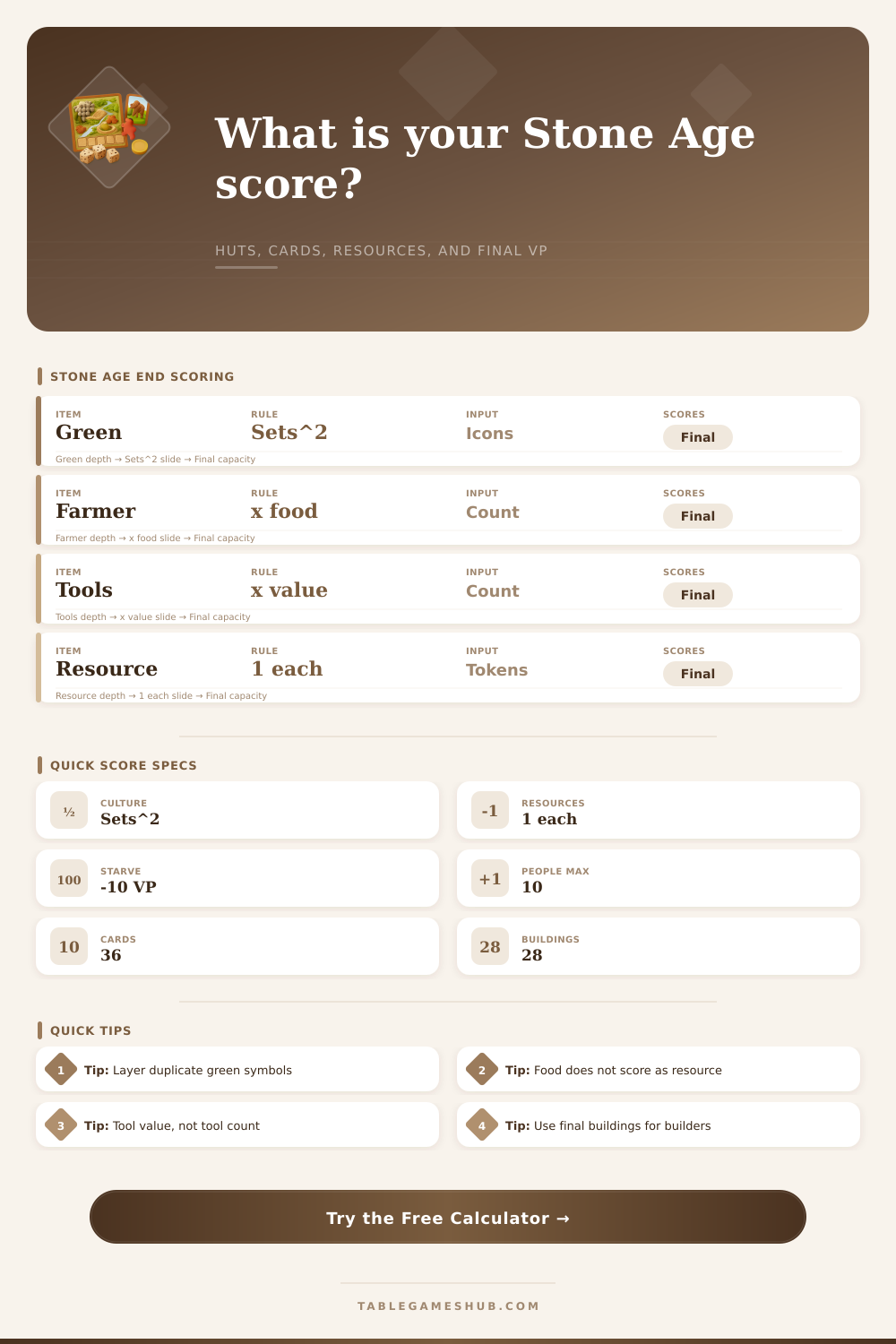
| Green culture cards | Eight symbol count fields | Each different-symbol layer squared | Duplicates make extra layers |
| Farmer cards | Farmer cards and agriculture | Farmers x food production level | Use final track position |
| Tool maker cards | Tool maker cards and tool value | Tool makers x total reusable tool value | Use value, not tile count |
| Hut builder cards | Hut builders and buildings owned | Hut builders x building tile count | Include all owned building tiles |
| Shaman cards | Shamans and people | Shamans x people in tribe | Use final people count |
| Resources | Wood, brick, stone, gold | 1 VP per resource token | Food is not counted here |
| Different Symbols in Layer | Score | Example | Duplicate Handling |
|---|---|---|---|
| 1 symbol | 1 VP | Only pottery | Starts a small layer |
| 4 symbols | 16 VP | Pottery, writing, art, music | One of each in layer |
| 6 symbols | 36 VP | Six different icons | High-value broad set |
| 8 symbols | 64 VP | All green icon types | Maximum single layer |
| Check | Rule Used | Calculator Treatment | Why It Matters |
|---|---|---|---|
| Food required | 1 food per person | People count is the demand | Final round still feeds before scoring |
| Food production | Agriculture adds food first | Food before production plus agriculture | Often avoids a late penalty |
| Resource substitution | Resources may cover missing food | Entered as available for feed check | Prevents starvation when paid |
| Starvation | Move score back 10 points | Subtracts one 10 VP penalty if unfed | Large enough to swing close games |
| Tie breaker | Food production plus tools plus people | Shown in breakdown | Use among tied high scores |
Culture layers: Count one of each green symbol in the first set, then repeat with duplicates for second and later layers.
Multiplier cards: Farmers, tool makers, hut builders, and shamans use final board values after the last round is complete.
Resources: Wood, brick, stone, and gold score 1 VP each at the end; food is only useful for feeding checks.
Starvation: If the final feed fails, subtract 10 VP unless that penalty is already included on the score marker.
Stone Age separates the good from the great, and it reveals your bad habits in final round. It’s time to play out all the cards and fill the board. Now comes the part where you have to score everything and face reality. Scoring isn’t as simple as tabulating points based off buildings you constructed; it’s a multi-layered system that both rewards consistency and penalize overlooking something.
Sure, you’ve got plenty of huts compared to everyone else. You think you’re winning this thing! Then the guy next to you build his own multiplier engine while hoarding culture symbols. Time to get your head screwed on straight and double-check your scoresheet without debating rules for twenty minutes. It’s doing the math for you, yes, but it also makes you consider things that matter when the game ends.
How to Score in Stone Age
Your baseline should be the obvious stuff, which includes your score marker plus any points from huts you forgot to record. Next, what is your agriculture level and tribe size? Those go into your civilization card multipliers. A high agriculture level isn’t just nice for feeding people; it are multiplied to increase your score if you’re playing as farmers.
Tool makers gets their tool value added together and plugged in to the tool, not the tiles. That one throws off new players constantly. How many individual cards do I have in my hand doesn’t matter (you don’t care), only combined value of them. The true difference lie in the green culture symbols, since each distinct symbol scores by the square of its number. One of every single symbol gets you (eight times eight) = 64 points, while doubles creates additional layers. Four separate symbols add another 16 points (and so on), and it sounds easy but trying to do this by hand will drive you crazy. The calculator does this layering for you, letting you know exactly how much your duplicate art or pottery icons is worth. In many cases, it is a lot less than folks realize until they look at all those numbers squared.
Keep in mind: Food doesn’t give points directly, while wood, stone, brick, and gold each count for one point. That’s easy to overlook. You may have a big amount of food that looks impressive, but it won’t mean anything in the last round if you haven’t fed it to your tribe. Feeding everyone is essential; otherwise, you’ll incur a 10-point penalty. Though that sounds minor, when the game could hinge on five points, this is something to watch out for. The calculator will show how many people you’ve got versus how much food you’re producing, and alert you if you’ve just suffered that loss. It can then break ties based on total people count, food produced, and number of tools.
Players also tend to spend all their time optimizing actions immediately by building huts for points now or grabbing resources for points now. But the goal at the end of the game isn’t points, it’s sets and multipliers. A couple more shaman may not look like much in the middle rounds, but once it comes down to it each shaman multiplies your tribe size into victory points. That is three shamans times ten people. That’s thirty points from doing nothing but card synergy.
This way you can tell whether your plan really panned out or not… Did you gather up all those pieces without putting them together proper? The tool flags that for you. Stone Age scoring can be very complicated if you try to remember all the rules, but it’s really not that hard once you understand how total score is calculated, what adds up linearly and what multiplies. After that, it’s simple addition and subtraction, and the calculator takes away the friction of trying to add a bunch of numbers as everyone sits there bored. You’ll learn pretty quick how well you played rather than just getting lucky drawing a couple good cards.
The goal is to have the right stuff, in the right combination. Your multipliers need to be up, your sets must be complete. Sometimes, first place is only a point away from last and it depends on who counts their points right. You should of checked your math more carefuly!