Tug of War Team Weight Calculator
Compare two rosters by total weight, class limit, average puller weight, anchor share, and the smallest roster adjustment needed for a balanced pull.
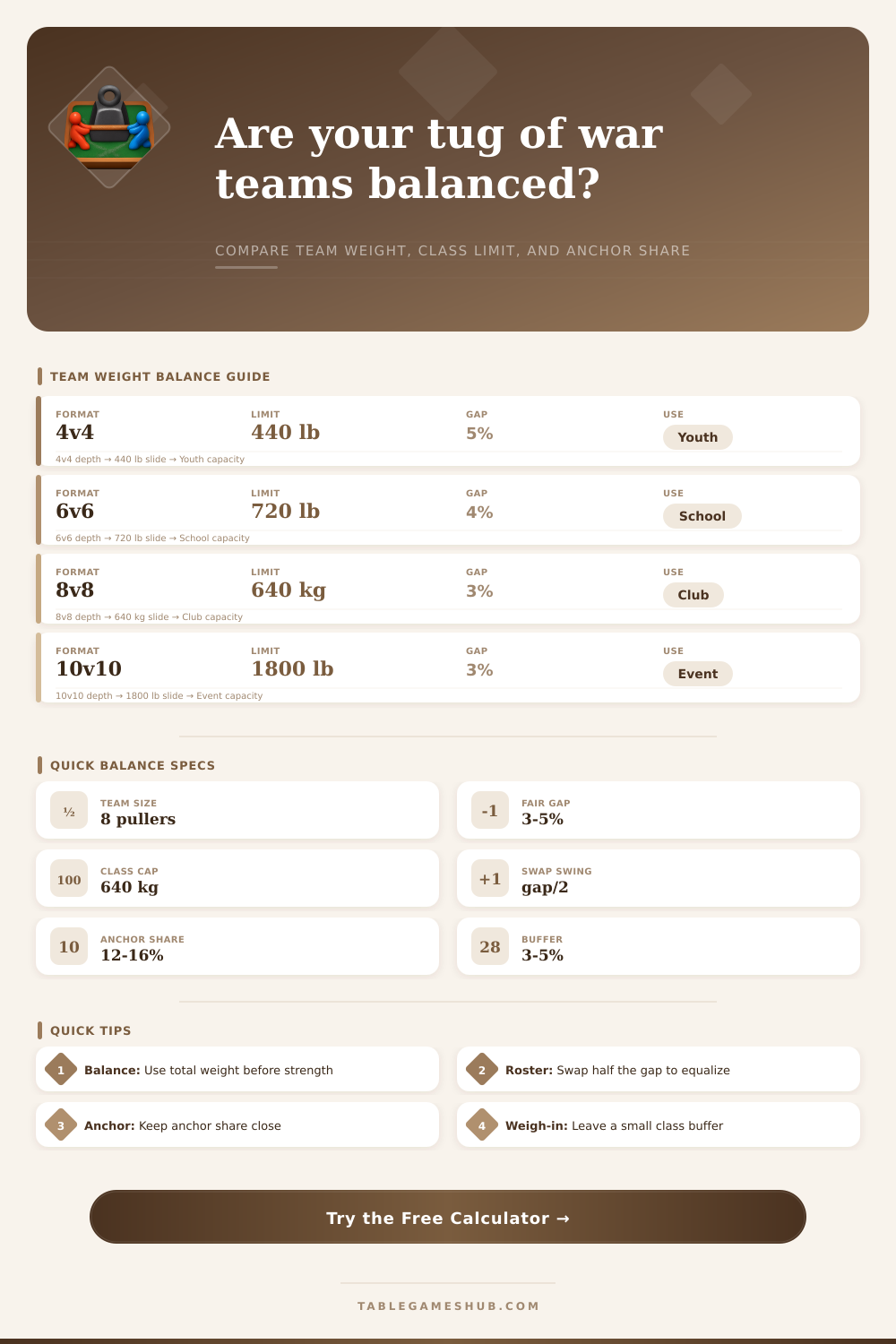
| Format | Typical Use | Common Team Cap | Fair Gap Target |
|---|---|---|---|
| 4 vs 4 | Youth, school, compact indoor lanes | 400 to 520 lb | 5% or less |
| 6 vs 6 | Field day, beach, training rounds | 720 to 1050 lb | 4% or less |
| 8 vs 8 | Club and class-based tug of war | 500 to 720 kg | 3% or less |
| 10 vs 10 | Community events and open teams | 1500 to 1900 lb | 3% to 5% |
| Gap Percent | Balance Rating | Roster Action | Use Case |
|---|---|---|---|
| 0% to 2% | Excellent | Keep teams as drafted | Finals, league, weighted bracket |
| 2% to 4% | Good | Check anchor share and class cap | Club match or school event |
| 4% to 7% | Playable | Swap one medium puller if possible | Casual or mixed-experience pull |
| Over 7% | Uneven | Add weight to lighter side or redraft | Practice only unless intentional |
| Adjustment Type | Calculator Formula | Best When | Example |
|---|---|---|---|
| Add to lighter team | Full gap | You can add a reserve puller | 40 lb gap needs 40 lb added |
| Pair swap | Gap divided by 2 | Both teams have alternates | 40 lb gap needs 20 lb net swap |
| Class trim | Team total minus class limit | A side is over weigh-in limit | 1288 lb in 1280 lb class trims 8 lb |
| Anchor rebalance | Anchor share difference | Totals are close but ends are uneven | 15% anchor vs 12% anchor |
| Preset | Pullers | Class Limit | Balance Goal |
|---|---|---|---|
| Youth school pull | 4 per side | 440 lb | Keep teams within 5% |
| Club 640 kg class | 8 per side | 640 kg | Leave 3% weigh-in buffer |
| Corporate event | 10 per side | 1800 lb | Use gap per puller |
| Practice rotation | 8 per side | No hard cap | Pair-swap until near even |
Tug of war is a sport that require physical strength from the participants. However, the outcome of a tug-of-war contest is based on the total weight of the participating teams. The team with the most total weight will have a physical advantage over the other competing team.
The team with a greater total weight will have to overcome the weight of the opposing team. Therefore, organizers has to weigh each of the competing teams to make sure that the total weight for each team is approximately equal. Several specific weight measurements must be considered for each of the competing teams.
How to Balance Team Weight in Tug of War
These include the total weight of the team, the average weight of each team member, the weight of the anchor person on the team, the class limit for the teams, and the weight gap between the teams. The total weight is the sum of all of the weights of the team member. Dividing the total weight of the team by the total number of team members can calculate the average weight of each team member.
The anchor person for a team is the person at the back of the team. The anchor person for a team contribute to the total weight of the team. The class limits are the maximum weight allowed for each team.
The weight gap is the difference between the total weight of each team. A tug-of-war weight calculator will allow the organizer of a tug-of-war contest to mathematically calculate the total weight of each team, the percentage weight difference between the teams, how much weight must be moved to even out the teams within the allowed weight tolerance, whether the heavier team exceed the class limits for that competition, and whether the anchor share of the anchor person for a team is within the allowable limits. A tug-of-war weight calculator doesnt replace a human’s judgement in a tug-of-war contest, but it will remove the guesswork from a coach that is trying to even out the weight of each team based off a list of the participants names.
The weight limits for tug-of-war matches can differ for various events. Youth tug-of-war contests may allow a five percent weight gap between teams because youth participants are still growing, whereas club and competition tug-of-war contests may require a three percent or less weight difference between teams because the skill levels of club participants are high and small differences in weight are often winning differences in club competitions. Corporate or festival tug-of-war contests may have more lenient weight limits for ease of scheduling participants.
The specific weight limit must be set for each event so that the organizers can adjust the tug-of-war match competitors before the start of the contest. One of the most common errors in tug-of-war is treating the anchor person as if they are a standard team member. The anchor person for a team doesnt typically enter the contest as a standard team member because the anchor person plant their feet on the ground first and remains planted on the ground for a longer period of time than the other members of the team.
The anchor person for a team may be heavy so that their weight provides an advantage to the team over the total weight of the members of the team that calculates to the total team weight. A very light anchor person for a team may be a weak spot that the opposing team can take advantage of. Using the tug-of-war contest weight calculator can calculate the anchor share to assess whether an anchor person is contributing a large portion of the total team weight.
If the calculator determines such a situation, then one solution may be to swap a medium swing team member with a light team member. Another error is failing to allow for a buffer between the actual weight of a team and the class limit. Athletes often weigh more during a tug-of-war contest than they weigh during the weigh-in.
This may be due to the athlete retaining water, or the athlete eating prior to the contest. Therefore, a buffer of two or three percent between the actual weight of the teams and the class limits must be allowed for each team. The calculator automatically applies such a buffer if the organizer select the buffer weight limits for the contest, ensuring the results are realistic for the competition.
There are several patterns to even out the weight of each of the tug-of-war match competitors. One such pattern is to add a reserve player to the competitor with the lighter total weight. However, the reserve player must weigh within the class limits for the contest.
Another pattern is to perform a pair swap where the heavier member of one team leave the team and a lighter member of the opposing team joins the first team. A third and final pattern is to trim a class where a member of a team that weighs over the class limit leave that team. None of these solutions alter any of the pulling techniques of the competitors.
However, they do allow the organizers of the contest to have more control over the pulling weight of each team before the contest begins. One of the reasons that tug-of-war matches may even out for one team over the other is because the teams are built according to the availability of the participants rather than their weight. Organizers and coaches may want to use the strongest competitors for each team.
However, using the strongest competitors on each team can result in an unfair contest. Using a weight calculator for each team will turn an argument based on the feelings of the coaches and organizers into a discussion about numbers that both teams can see. The calculator cannot measure or calculate intangibles like the strength of the participants, but it can ensure that the weight limits of the teams are even so that the strength of the competitors is the only factor that determines the winner of the contest.
Therefore, the value of the tug-of-war weight calculator is that it ensures a fair and even contest between the competing teams.