🎯 MTG Commander Land Calculator
Balance land count, ramp, and fixing so your mana base opens cleaner and keeps pace with your curve.
| Item | Input | Output | Note |
|---|
| Curve band | Typical lands | Ramp note | Plan feel |
|---|---|---|---|
| 2.5 MV | 34-35 | Lots of ramp | Fast shell |
| 3.0 MV | 35-36 | Balanced | Stable start |
| 3.5 MV | 36-38 | Moderate | Safer curve |
| 4.0 MV | 38-40 | Heavier | Top-end deck |
| Identity | Fixing need | Land mix | Short note |
|---|---|---|---|
| Mono | Low | Basics first | Few colors |
| 2-color | Medium | Dual-heavy | Very smooth |
| 3-color | High | Dual plus tap | Watch enters |
| 5-color | Very high | Dense fixing | Needs cushion |
| Opening hand | Keep rule | Signal | Adjustment |
|---|---|---|---|
| 0-1 land | Mulligan | Too risky | Add lands |
| 2 lands | Keepable | Needs support | More draw |
| 3 lands | Ideal | Most stable | Good mix |
| 4+ lands | Contextual | Can flood | Raise action |
| Land mix | Share | Why it works | Watch item |
|---|---|---|---|
| Basics | 12-18 | Stable access | Color balance |
| Fixers | 10-16 | Cast spells | Enter tapped |
| Utility | 3-7 | Utility text | Colorless load |
| Spell-lands | 2-6 | Spell backup | Tempo tax |
Start with the curve
If your average mana value rises, increase lands before you add more cute utility slots.
Respect color pressure
Three or more colors usually need a sturdier fixing package than the raw land total alone suggests.
Mana management are essential for playing any Commander deck, as mana management determines if a Commander player can play there spells on the correct turns. Many players encounters issues where their Commander deck dont produce enough mana or the wrong color of mana. Both of these problems usually result from an incorrect number of lands or the wrong land type within the Commander deck.
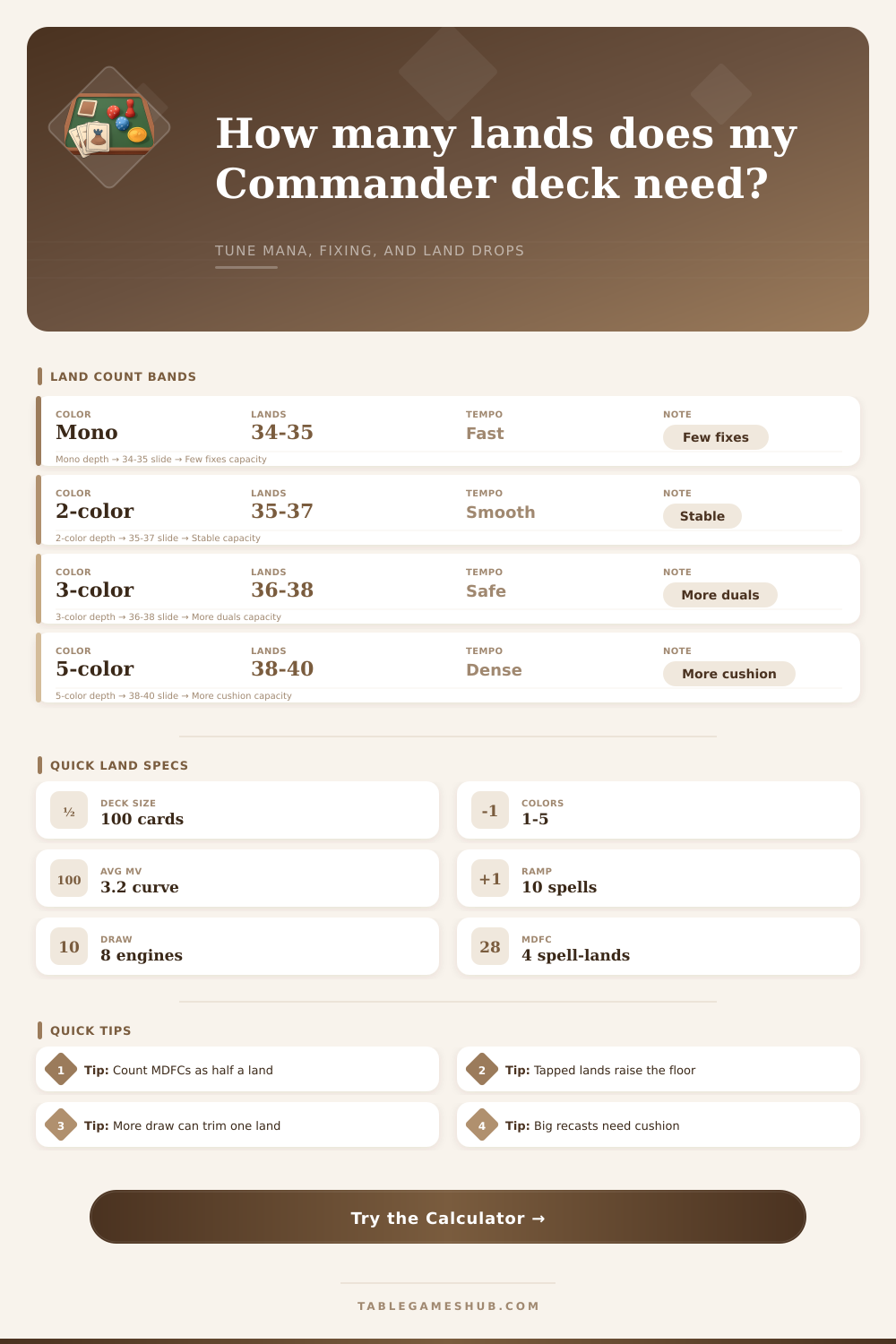
Therefore, a player must have an understanding of how all of these components of a Commander deck relate to each other in order to create a correctly functioning Commander deck. The mana curve for a Commander deck determines how many lands should be included in a Commander deck. The more higher the mana curve, the more lands a player will need in order to play the larger spells during the late game of a game of Magic: the Gathering.
How Many Lands Should a Commander Deck Have
For instance, a Commander deck with a mana curve of 3.5 will require more lands than a Commander deck with a mana curve of 2.8. Spells that allow a player to ramp up their mana pool or mana rocks will reduce the number of land required within a Commander deck. However, ramp spells only will work if the lands within the Commander deck contain the correct colors of mana for those ramp spells.
If the lands does not contain the correct colors, ramp spells will not be of any use within a Commander deck. Color identity for a Commander deck introduces another layer of complexity into the composition of the mana base for the Commander deck. A mono-colored Commander deck can contain 34 lands maximum.
This is because a mono-colored Commander deck will only ever need basic land to produce one color of mana. For a multi-colored Commander deck, however, 37 to 38 lands is typically required. This is because a multi-colored Commander deck will require lands that produce multiple colors of mana.
If a Commander deck contains many lands that are tapped, a player will need to include more lands into the Commander deck. Tapped lands move slow than untapped lands and will make it more likely for a Commander player to fall behind in the game if too many lands in a Commander deck are tapped. Draw engines and Modal Double-Faced Cards, or MDFCs for short, will aid a Commanders consistency.
While draw engines will not provide the mana needed for a Commander deck, draw engines will allow a player to find more lands and more spell for inclusion into the Commander deck. MDFCs will act as a spell during the early games of a Commander deck but will act as a land later into the game. If many of the lands included in a Commander deck has special ability, a player should avoid mana rocks in favor of lands that will be played.
Landfall triggers, for instance, will require a player to play actual lands rather than solely relying on mana rocks to trigger these special abilities. There are specific indicators that can be used to assess if a Commander deck is successful. In an ideal situation, a Commander deck will allow a player to recieve a keepable opening hand 60% of the time.
A keepable opening hand will have between two and four lands. Additionally, four sources of mana should be available by turn four. This can be accomplished with lands and ramp spells.
If the colors of mana needed for the spells in the Commander deck are not being produced, a player should include more fixer lands in the Commander deck. If there are issues running out of mana by the late game, a player should include more lands into the Commander deck. The specific composition of the lands within a Commander deck is just as important as the total number of lands in the deck.
Basic lands will provide stability to a Commander deck. Therefore, a player should include 12 to 18 basic lands in a Commander deck. Fixer lands will be used to provide the necessary colors of mana to spells within the Commander deck.
Thus, between 10 and 16 fixer lands should be included in a Commander deck. The remaining lands in a Commander deck can be composed of utility lands or MDFCs. If there are too many basic lands, there will not be enough color of mana for the spells in the Commander deck.
Alternatively, if there are too few fixer lands, there will be problems producing the colors of mana required by spells in the Commander deck. Therefore, it is important to test a Commander deck. If a player find themself short on mana after turn five, there is a need to add more lands to the Commander deck.