Slingshot Trajectory Calculator
Estimate a safe recreational soft-projectile arc from launch speed, angle, height, target height, wind, and drag. Built for classroom demos, tabletop target lanes, and supervised backyard physics.
| Time | Ideal Distance | Height | Gravity Drop | Drag-Adjusted Distance |
|---|---|---|---|---|
| 0.00 s | 0.00 m | 1.10 m | 0.00 m | 0.00 m |
| Preset | Speed | Angle | Mass |
|---|---|---|---|
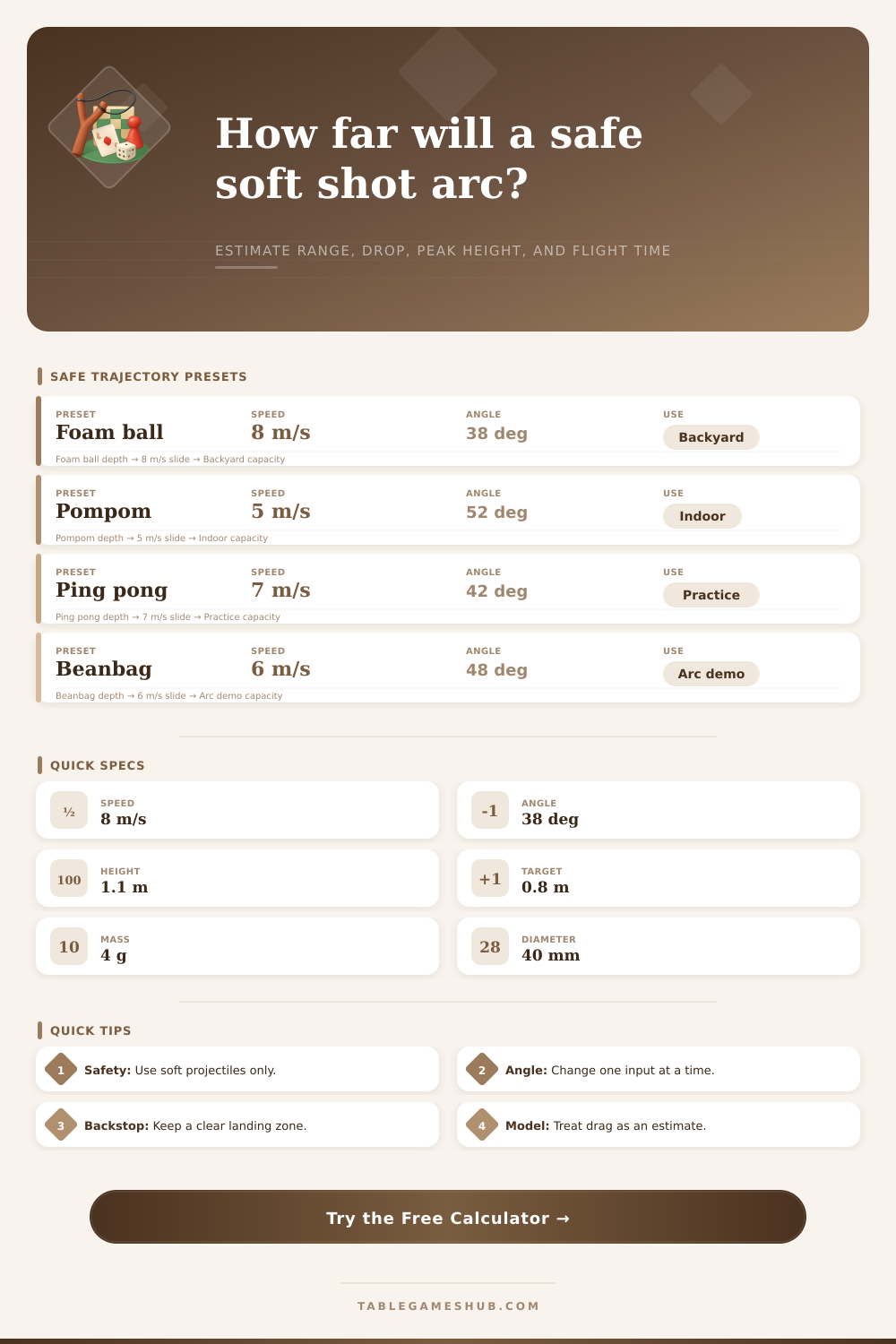
| Foam ball backyard arc | 8.0 m/s | 38 deg | 4.0 g |
| Pompom indoor lob | 4.6 m/s | 52 deg | 0.9 g |
| Ping pong cup target | 7.2 m/s | 42 deg | 2.7 g |
| Mini beanbag toss | 6.4 m/s | 48 deg | 18.0 g |
| Sponge ball practice | 6.8 m/s | 40 deg | 8.0 g |
| Paper ball classroom | 4.5 m/s | 55 deg | 1.5 g |
| Marshmallow demo | 5.0 m/s | 50 deg | 3.0 g |
| Soft cork marker | 6.0 m/s | 35 deg | 4.5 g |
| Foam disc low arc | 5.8 m/s | 28 deg | 6.0 g |
| Angle | Flight Time | Peak Height | Ideal Range |
|---|---|---|---|
| 20 deg | 0.00 s | 0.00 m | 0.00 m |
| Object | Typical Mass | Diameter | Best Use |
|---|---|---|---|
| Foam practice ball | 4 g | 40 mm | Backyard arc demo |
| Craft pompom | 0.9 g | 35 mm | Indoor low-force demo |
| Ping pong ball | 2.7 g | 40 mm | Cup target practice |
| Mini beanbag | 18 g | 45 mm | Short lob comparison |
| Sponge ball | 8 g | 55 mm | Outdoor soft target |
| Paper ball | 1.5 g | 35 mm | Classroom physics |
| Marshmallow | 3 g | 28 mm | Gentle arc demo |
| Soft cork marker | 4.5 g | 24 mm | Marked landing zone |
| Item | Estimate | Meaning |
|---|---|---|
| Drag level | Low | Ideal range is close enough for a demo. |
| Wind modifier | 0% | Positive stretches the range estimate. |
| Object area | 0.0013 m² | Larger area slows soft objects faster. |
| Model boundary | Recreational | Not a full fluid simulation. |
To understand the movement of a soft projectile through the air, an understanding of the effect of the projectile’s angle and launch height on the distance at which the projectile lands is necessary. A soft projectile can travel a long distance from a slingshot with foam ball, pompoms, or other light paper wads. Furthermore, the distance of those projectile can change with the change of the angle from which the projectile is launched or the height from which the projectile is launched.
The calculator provided on this page allows for the user to input their speed, angle, and height to determine the flight path that the soft projectile will take, eliminating the need to perform the calculations with the projectile before it is launched. The height from which the pouch that contains the soft projectile is launched is one of the most important variable to take into account. The height from which the pouch is released will impact the height from which the soft projectile begins to travel.
How Angle, Height and Wind Change How Far a Soft Projectile Goes
If the pouch is released from a height (such as chest level), then the soft projectile will start at a higher launch height. Higher launch height will provide the soft projectile with more time to travel before it lands on the ground. Thus, higher launch heights will increase the range that the soft projectile can travel.
The target height is another of the most important variables. The target height will determine the height at which the soft projectile will land. For instance, if the target is a cup on a table, the height of that table is the target height.
From this input, the calculator can find the distance from which the pouch should be released for the projectile to land on the target at the target height. The effect of drag upon the flight of the soft projectile is another variable. Drag will impact the flight of the soft projectile based off the surface area of the projectile and the density of the projectile.
For instance, a soft projectile that has a large surface area (such as a pompom) will experience a greater drag force than a projectile with a smaller surface area (such as a foam ball). Thus, a pompom will lose speed more quick than a foam ball of the same density. The calculator can compare the drag coefficient of the projectile to the mass and size of the projectile to determine if the distance that it will travel will be the standard or shortened range.
Additionally, the effect of the wind upon the projectile is another variable to consider. The wind will create resistance against the soft projectile. A tailwind will push the projectile forward while a headwind will pull the projectile down before it lands.
The calculator considers both of these variables to provide the best estimate of the safety buffer that should be created around the target. The reference table located on this page provides the typical starting value for the different types of soft projectiles. These presets allow for users who dont have access to a scale and calipers to easily input the variables for common types of soft projectiles.
For instance, if the user select the preset for a backyard foam ball, the calculator will load the speed, angle, and mass of the projectile in the pouch. Each of these variables can be altered to determine their effect on the range of the projectile. Only one variable should be altered at a time to allow for an easier understanding of the effect of that specific variable on the range of the soft projectile.
Although many of the variables on the calculator account for typical backyard conditions, there are a few environmental factor that may have an impact upon the projectile after it leaves the pouch. Factors such as the length of the grass, slopes in the ground, and the way the projectile may tumbler upon landing all have the potential to impact the distance of the projectile. Due to these potential impacting factors, it is recommended to use a safety buffer.
A safety buffer provides for the extra distance for the projectile to bounce or roll on the ground without leaving the cleared area. Thus, creating a safety buffer will help ensure the soft projectile does not roll into another yard. Another variable that the calculator determines is the flight time of the projectile.
Flight time is a measurement of the length of time that the soft projectile will remain in the air. The longer the soft projectile arcs before it lands, the longer that it will remain in the air. Thus, the longer the flight time, the more time that the crosswind will have to impact the projectile.
The projection of the flight time of the projectile allows the user to determine if the crosswind will impact the projectile or not. Soft projectiles that have a shorter arc have a shorter flight time. Therefore, there is less time for the projectile to be impacted by a crosswind.
Many people believe that increasing the angle of the launch will impact the distance of the projectile in a positive manner. However, the increase in the angle will increase the distance of the projectile only to a certain point. Beyond 45 degrees, the additional height of the projectile will impact the distance of the projectile instead of increasing it.
If the projectile is too high, it will drop almost straight down once it reaches the peak of its arc. The angle comparison table displays the different heights and distances that is possible with each angle. The comparisons indicate that while the angle will increase the height of the projectile, the distance will increase to a point and then decrease with increased angles.
Another of the variables that may impact the flight of the projectile is the mass and the diameter of the object. A projectile with a greater mass will maintain its velocity for a longer period of time. However, the greater mass will cause the projectile to have more momentum when it lands.
The calculator keeps these two variables separate to permit the users to view the impact that each of these variables will have upon the distance of the projectile. The third type of wind that may impact the projectile is the crosswind. A crosswind will push the projectile several inch off of its path.
The impact of a crosswind will be stronger the longer that it has to push the projectile. While the calculator does include variables for headwinds and tailwinds, a three-dimensional model for the projectile that accounts for crosswinds would be more complex to calculate. Thus, it is important for the user to understand that the crosswind will require the user to provide extra clear space to the sides of where the projectile will land.
Addition to the variables accounted for in the calculator, it is also important to maintain the height from which the pouch is released. If the pouch is released from different heights, the projection of the distance that the projectile will travel will be an average of each launch height. By maintaining the height from which the pouch is released, the calculations will be more accurately.
Thus, the calculator can assist the user in determining the distance from which the pouch should be released in order for the projectile to hit the target. The same calculations can be applied to soft projectile launches from a slingshot that occur indoors. Indoor spaces typically have lower ceilings than yards or back gardens.
Therefore, by using the target height and the launch height of a projectile launched indoors, a user can determine the angle and speed of the launch so that the projectile will remain within the ceiling height. This calculation can assist users in avoiding hitting the ceiling or other indoor fixture with the launched projectile. Overall, this type of calculator allows for the users to understand the flight path that the soft projectile will take prior to launching it from the slingshot.
Additionally, after determining each of the variables related to the projectile, the users can use these answers to determine where they should stand to launch the projectile, how much space they should create for its flight, and whether or not it will remain within the cleared area. Thus, the safety buffer will aid the user in creating a plan for the launching of the projectile.