Golem Score Calculator
Total the final point structure for Golem across books, golems, artifacts, synagogue progress, knowledge, control gaps, and rabbi planning.
| Scoring Area | Input To Count | Formula Used Here | Why It Matters |
|---|---|---|---|
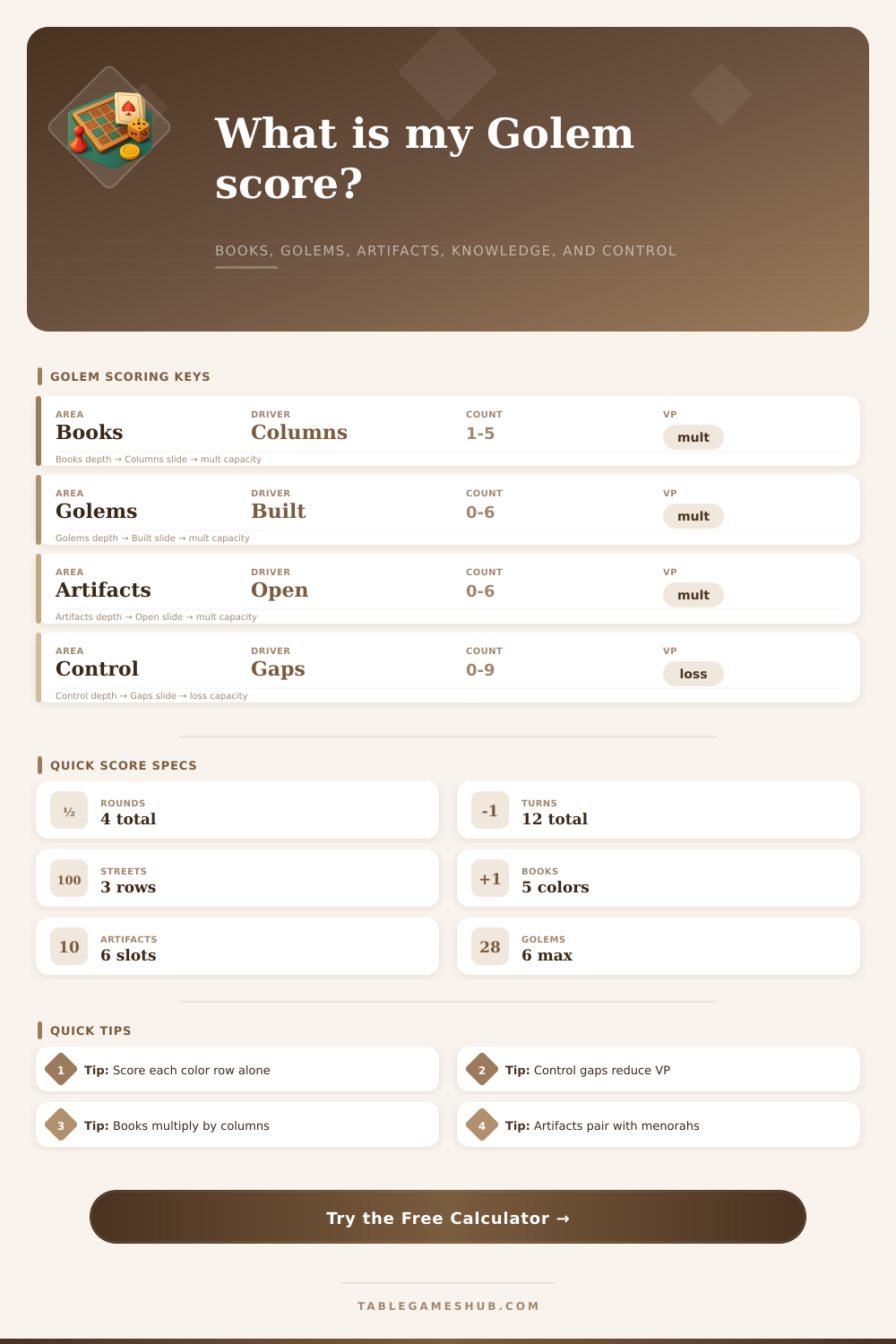
| Books Section | Completed book columns and blue menorahs | Columns x blue menorahs | Measures how deeply the library engine paid off. |
| Golem Section | Golems built and red menorahs | Built golems x red menorahs | Rewards building golems while developing their row. |
| Artifact Section | Unlocked artifacts and yellow menorahs | Artifacts x yellow menorahs | Shows how much the gold and artifact engine produced. |
| Control Section | Student gaps behind active golems | Total gaps x penalty rate | Estimates the VP drag from uncontrolled movement. |
| Rabbi Section | Scoring rabbi actions and assigned VP value | Actions x VP per rabbi action | Captures timing, objectives, and turn-order efficiency. |
| Street Color | Typical Focus | Student Control Signal | Calculator Field |
|---|---|---|---|
| Yellow Coin Street | Coins, artifact upgrades, gold unlocks | Student should stay close to money-row golems | Coin street gap |
| Red Clay Street | Golem builds, movement, golem upgrades | Large gaps often mean a strong but risky golem engine | Clay street gap |
| Blue Knowledge Street | Books, knowledge upgrades, study progress | Late knowledge pushes can overextend the blue row | Knowledge street gap |
| Rabbi Action Area | One non-marble action during a round cycle | Turn-order and objective timing can become final VP | Rabbi action fields |
| Endgame Shape | Book Columns | Golems Built | Artifacts Open |
|---|---|---|---|
| Book-heavy scholar | 4 to 5 | 2 to 3 | 2 to 4 |
| Golem-heavy builder | 1 to 3 | 5 to 6 | 2 to 4 |
| Artifact-heavy forge | 2 to 3 | 2 to 4 | 5 to 6 |
| Balanced menorah plan | 3 to 4 | 3 to 5 | 3 to 5 |
| Score Band | Typical Total | Control Pattern | Reading |
|---|---|---|---|
| Learning game | 70 to 95 VP | Several gaps remain | Engine pieces worked, but control or multipliers lagged. |
| Solid finish | 96 to 125 VP | One row may be loose | At least one row and one multiplier performed well. |
| Strong finish | 126 to 155 VP | Control mostly stable | Multiple color rows converted into endgame scoring. |
| Expert finish | 156+ VP | Low penalty pressure | High multiplier density with controlled golem movement. |
The scoring process in the game of Golem occur after the last action token is placed and the last menorah is revealed. Due to the complexity of the game, there are many different track of scores to calculate at the end of the game. For instance, the books multiplies through one specific track, while the golems multiply through a different track.
Additionally, the artifacts track only provides points for that track if the players used the correct menorah throughout the game. Furthermore, each of the three street can provide penalties for the players if a student falls behind an active golem on one of the streets. The calculator provided above allow the players to enter each of these separate score tracks to calculate their total score for the game.
How to Score in the Golem Game
Furthermore, this calculator is also helpful for those players who would like to track whether the actions taken by the rabbi during the game still have value during the score phase of the game. While the three streets are typically treated as background movement for the players during the game, they can provide penalties for players if the golem engine does not handle the gaps on these streets efficient. For instance, if a golem is uncontrolled on one of the streets, the player may lose two or three point for each gap that the student players fell behind the golem.
Thus, one of the inputs for the gaps on each of the streets allow the players to determine the efficiency of there engine for producing golems. Additionally, each of the knowledge and synagogue step tracks are scored differently from the other tracks. For instance, the knowledge track provides points for the colors that the players claim, but the rate at which the knowledge track fill can change between different types of games.
Furthermore, the synagogue steps provides points for the colors of the marbles that the player claims, rather than the colors that the player intend to claim. Thus, if the player discovers that their score is lower than they had calculated prior to the end of the game, it is likely due to not monitoring the knowledge and synagogue step track during the game. Rabbi actions are performed as a separate track in some tables, and as timing tool for the game in other tables.
Thus, the actions of the rabbi may provide a score of several point for the game if the actions of the rabbi coincide with the timing of the game. Therefore, using the calculator to provide different values for the actions of the rabbi can help the players to understand whether the actions of the rabbi during the game were beneficial to the players efforts. Finally, one of the most important score tracks for the game is the control penalties.
The control penalties score tracks both the successes and failures of the players of the game. For instance, if a player builds many golems during the game, there are more opportunity for one or more of the students to fall behind an active golem. Thus, the calculator indicates the negative aspect of creating many golems for the game, as well.
A high count for the number of golems with a low gap score is favorable for the player, but a high count for the number of golems with a large gap score on two of the streets is indicative of a poor golem engine for that player. The reference tables are provided for players as a means of comparing their score and total to other score possibilities for the game. For instance, a player who controlled many books will score differently then a player who controlled many artifacts.
Furthermore, the reference tables allow the players to understand whether their score for the game was a reasonable outcome of their strategy for the game. The calculator for the game cannot capture the feeling of the game. For instance, it cannot calculate the thrill of realizing the actions of one’s books will multiply, or the disappointment of recognizing that one’s artifacts fell behind an active golem on the street.
Furthermore, it can calculate the value of those scores for the player at the end of the game.