Schnapsen Score Calculator
Total Schnapsen card points, 20/40 marriage announcements, talon-close cases, false 66 claims, last-trick endings, and the traditional seven-down Bummerl score after a deal.
1Preset Schnapsen Hands
Load a realistic deal state, then edit the trick points, marriages, close state, or match score before calculating.
2Deal Settings
3Player Score Lines
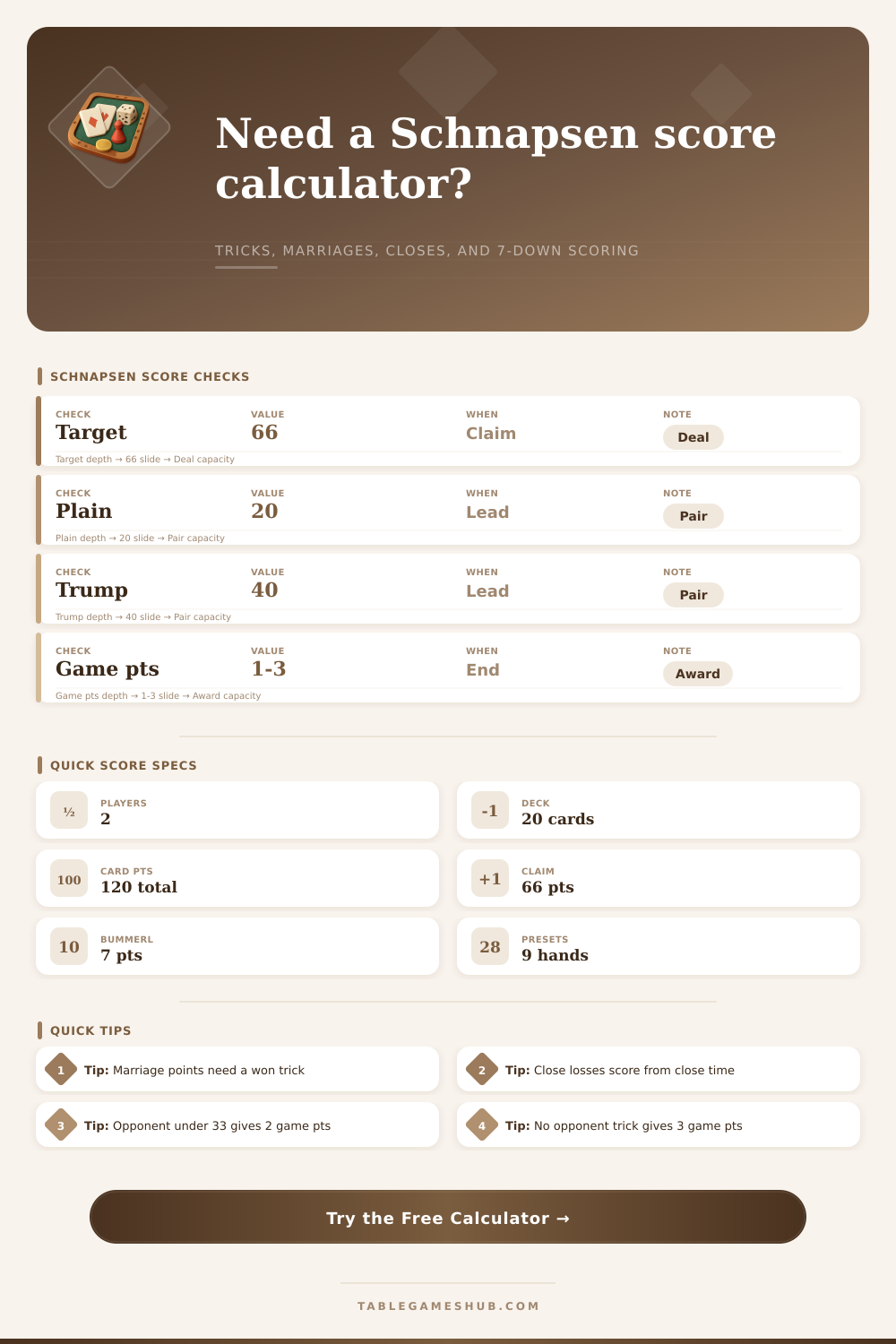
Card points are Ace 11, Ten 10, King 4, Queen or Ober 3, Jack or Unter 2. Marriage points only count for a player who has won at least one trick.
Player A line
Player B line
Scoring Breakdown
4Schnapsen Component Grid
5Reference Tables
| Card rank | German name | Card points | Scoring use |
|---|---|---|---|
| Ace | Daus or Sau | 11 | Highest point card in each suit. |
| Ten | Zehner | 10 | Second-highest point card. |
| King | Konig | 4 | Forms marriages with Queen or Ober. |
| Queen or Ober | Manderl or Ober | 3 | Forms marriages with King. |
| Jack or Unter | Bube or Unter | 2 | Trump Jack or Unter may exchange trump. |
| End condition | Winner card points | Opponent state | Game points |
|---|---|---|---|
| Correct 66 claim | 66 or more | Opponent has 33 or more | 1 point |
| Correct 66 claim | 66 or more | Opponent has 1 to 32 | 2 points |
| Correct 66 claim | 66 or more | Opponent has no tricks | 3 points |
| No player claims | Last trick wins | Talon was not closed | 1 point |
| False 66 claim | Under 66 | Opponent receives equivalent award | 1 to 3 points |
| Announcement | Required cards | Points | Calculator handling |
|---|---|---|---|
| Plain marriage | King and Queen/Ober in a non-trump suit | 20 | Counts only if that player won a trick. |
| Trump marriage | King and Queen/Ober in trump | 40 | Counts only if that player won a trick. |
| No trick after announce | Marriage shown, no trick captured | 0 | Calculator suppresses marriage points. |
| Sharp table reminder | Variant restrictions vary by table | 20 or 40 | Use variant note for audit text only. |
| Talon close case | Closer succeeds? | Opponent measuring point | Award rule |
|---|---|---|---|
| Closer reaches 66 first | Yes | Close moment or final total by sheet rule | 1, 2, or 3 by opponent state. |
| Closer fails to reach 66 | No | Opponent state at close | Opponent receives 2 or 3. |
| Opponent reaches 66 first | No | Opponent state at close | Opponent receives 2 or 3. |
| Closed talon last trick | Not applicable | Close rule overrides last-trick point | Do not award simple last-trick point. |
6Scorekeeping Tips
Marriage audit: Enter every declared 20 or 40, but set "has won any trick" to no when the player never captured a trick. The calculator then leaves that announcement out of the 66 count.
Close audit: When the talon is closed, write both players' card-point totals immediately. If the closer fails, those close-moment values decide whether the opponent receives 2 or 3 game points.
But most of all, people gets riled up when they forget which player won the right to close out the talon first. And while the dealing creates chaos, it resolves in seconds. That’s not how Schnapsen works. It’s fast-paced. You’ve got to know how to clear up the mess in seconds. Before you know it, someone has closed out their tricks and you’re still arguing about if he went over thirty-three points with that last trick. When that happens, the momentum are lost forever. Knowing a sure-fire method to instantly resolve the issue allow for continued game flow and avoids using memory as evidence against you.
After inputting your deal parameters, all math is handled by calculator above. Simply announce marriages, enter the card points each player captured, and it will add them up for you. It splits out the bonus declarations from the raw trick values, helping prevent double counting mistakes due to rushing. Marriage points are tricky as they don’t apply unless person holding them actualy took a trick in that hand. So just because they have the King AND Ober of hearts doesn’t mean they get those points since they lost all their tricks with spades. The tool’s smart enough to check for that condition, preventing fake marriage points awarded to someone who didn’t win a single card point.
How This Calculator Helps You Play Schnapsen
In Schnapsen the goal is to score 66 points before your opponent do. That’s an arbitrary number, but one that is traditional for Schnapsen to serve as a sort of finish line. Whoever feels like they’ve gotten there will end the deal then and there (assuming they’re right). If not, well, that depends on how much they’re off by and what their opponent managed to grab while they weren’t looking. This is where the calculator shines, breaking down each scenario nicely so you know: did this person reach 66? Or were they totally screwed over? Did they claim it and now owe double, triple… who knows! It doesn’t leave you wondering. It lays out in plain terms just how many points change hands in any given situation when the game ends.
To add a further wrinkle, the seven-down Bummerl system counts down rather than up; so as you go from seven hands to zero, each hand matter in reverse order of most games. That provides a bit of a psychological advantage, making it seem more risky to fall behind and safer to lead, the closer you get to zero. It also gives an idea of remaining points, helping player decide if they should of taking risks or staying conservative on each hand. The app has options that allow you to check both open and closed talon situation separately. So if your table applies slightly different rules, you can switch back and forth between them without starting all over again.
Many people confuse trump marriages with plain marriages when the cards are face-down. Twenty points for a plain marriage; double it at forty if its trump. Sounds easy right? Except you need to show the suit of the trump immediately if it’s a trump marriage. After a few hands, you may forget what suit is trump and call those bonus points that aren’t rightfully yours. Trying to keep track of this yourself will lead to long arguments long after the hand is over. Without having to memorize all the details of Austrian card culture, the reference tables let you get a glimpse into what cards are how many points and who gets how much if they have all of them. Just want to double check an ace is actually worth eleven? Need to know that getting no tricks based off a claimant will net you three game points? These aids answer everything in seconds. They act as a safety net for those new to the game and resolve disagreements on odd edge cases for seasoned pros in a hurry.
We want to be able to just deal and shuffle, not resentful of how someone else got those last few points. To have a bit of scoring accuracy takes out all the ambiguity in every score which preserves the fun of the game. You know who won and lost because it was clearly spelled out in the rules, not because you were trying to remember what occurred 10 minutes earlier. Then there are the numbers at the end, the ones that show up in the calculator. Those numbers match reality and allow both players to walk away satisfied with the outcome regardless of who took the points. We keep our friendships intact while keeping the competitive spirit alive that attracted us to play Schnapsen in the first place.