Ax Throwing Target Distance Calculator
Plan the target face, bullseye center, throw line, stance reach, lane length, and safety envelope from one clean geometry worksheet.
| Layout | Center Height | Board Field | Center From Left | Notes For Calculator |
|---|---|---|---|---|
| WATL-style hatchet | 60 in from floor | 48 in x 72 in common field | 24 in on a 48 in field | Use board center and measure line from face. |
| Big axe lane | 60 in from floor | 48 in x 72 in or larger | Half of marked target width | Longer line usually drives lane length. |
| IATF-style line set | 63 in reference center | Five-board face common | Centered on middle board | Use the local fault and safety line values. |
| Practice or backyard | 54 to 60 in target center | Wider field helps catch misses | Board midpoint plus offset | Increase rear and side clearance before marking. |
| Line Type | Face To Back Of Line | Stripe Width | Rear Clearance | Minimum Lane Length |
|---|---|---|---|---|
| Standard hatchet lane | 12 ft | 3 in | 3 to 5 ft | 15 to 17 ft from target face |
| Big axe lane | 15 ft | 3 in | 5 ft | 20 ft from target face |
| IATF-style fault line | 110 in | Local mark | 5 ft preferred | About 14.7 ft plus line width |
| Compact practice mark | 10 to 12 ft | 2 to 3 in | 5 to 6 ft | 15 to 18 ft with clear rear space |
| Lane Element | Input Used | Formula | Output Meaning |
|---|---|---|---|
| Lane length | Line, stripe, toe setback, rear clear | Line + stripe + toe setback + rear clear | Total clear floor from face to rear boundary. |
| Lane width | Board width and side clearance | Board width + both side clearances | Clear inside width around the target field. |
| Release distance | Line, stripe, setback, reach | Line + stripe + setback - reach | Approximate face distance at release point. |
| Bullseye mark | Board size and offsets | Half width + X offset, center + Y offset | Where to mark the bullseye center. |
| Preset | Board Field | Center Height | Line To Face | Clearance Profile |
|---|---|---|---|---|
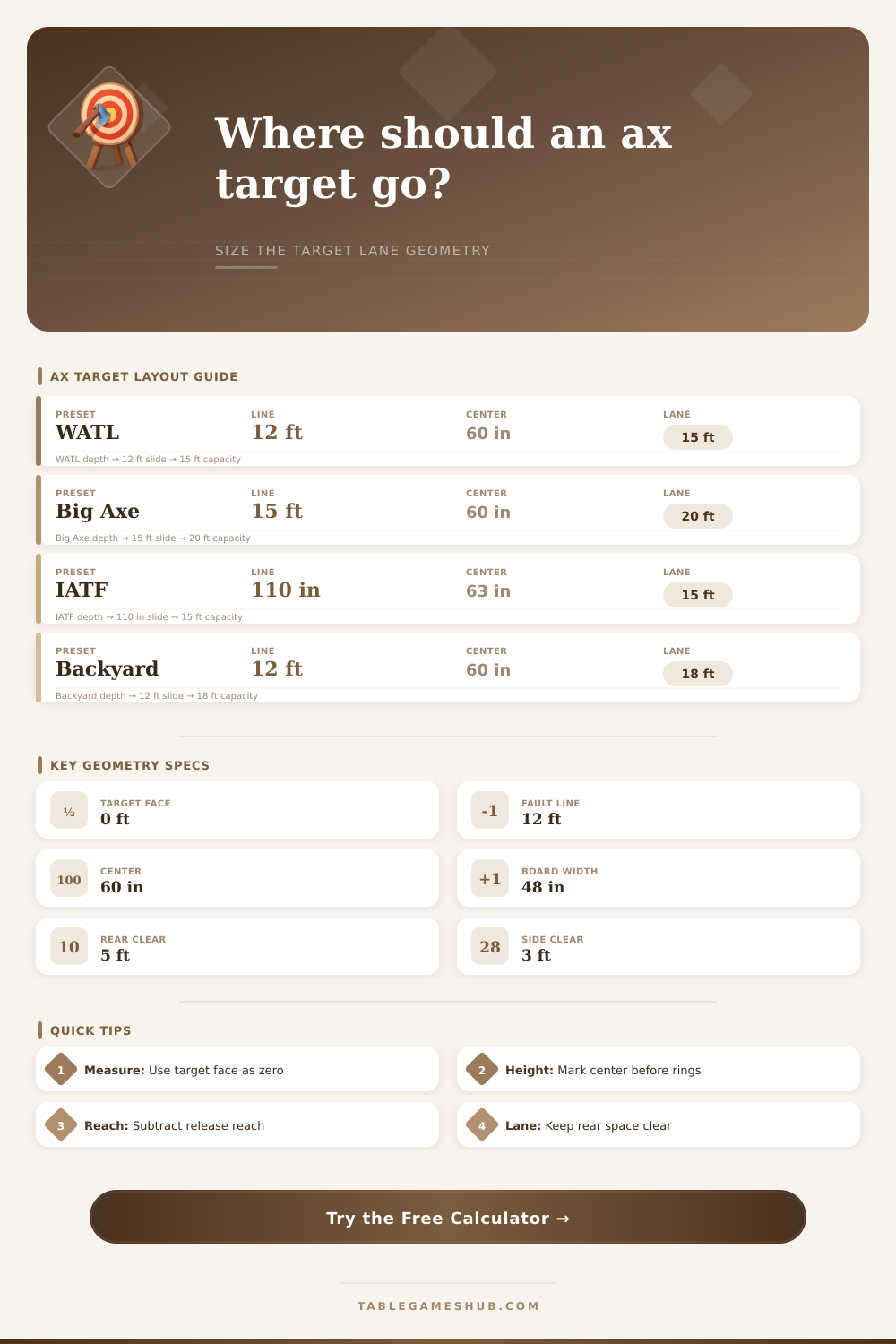
| WATL 12 ft Hatchet | 48 in x 72 in | 60 in | 12 ft | 5 ft rear, 3 ft sides |
| Big Axe 15 ft Line | 48 in x 72 in | 60 in | 15 ft | 5 ft rear, 3 ft sides |
| Mobile Trailer Lane | 48 in x 60 in | 60 in | 12 ft | 3 ft rear, 2 ft sides |
| Offset Board Repair | 46 in x 72 in | 60 in | 12 ft | Offset center for refreshed boards |
The distance between the thrower and the target is the most important measurement for an axe throwing event. The distance between the thrower and the target will determine how much space are required for the thrower to stand behind the throw line. If a person gets the distance between the thrower and the target wrong, then the height of the bullseye and the amount of room for the spectator will also be incorrect.
A person should use the target face as the zero point for measuring the distance between the thrower and the target. From the target face, a person can measure to the throw line, the painted stripe, the front foot, and the forward reach of the arm. Each of these measurements will be either add to or subtracted from the distance between the thrower and the target.
How to Measure the Distance Between the Thrower and the Target
The distance between the thrower and the target is the sum of each of these distances. The distance between the thrower and the target isnt the score that will be used to indicate the success of each throw, but rather is a measurement of the minimum length and width of the floor required for that many participants and with that specific target. Many axe throwing leagues will use a 12-foot line for their standard hatchets, and will use a 15-foot line for their larger axes.
These distances is established only because the remainder of the lane is sized to accommodate these specific distances between the thrower and the target. For instance, if the lane behind the thrower is expanded, the distance between the thrower and the target will need to change as well to ensure that the participants have enough space. The same is true of a backyard axe throwing lane that features a taller target board than official competitions require.
The height of the bullseye must be measured from the floor. You should not measure the height of the bullseye from the bottom of the target board, as the target board may be placed several inches above the floor. If the height of the bullseye is set too low, the axe heads will miss the target and land on the floor.
If the height of the bullseye is set too high, the shorter throwers will have to change the rotation of their axe when they release it to aim for the bullseye. The clearance of the axe throwers to the sides of the target is another measurement that those that are establishing an axe throwing program in their home often underestimate. Three feet of clearance to the sides of the target might seem to be plenty of space for the throwers to perform, but if the axe misses the target, it may hit a fence post.
The width of the axe throwing lane is the width of the target plus the clearance to the sides of the target. In locations such as a garage or a basement, the width of the axe throwing lane will determine if the axe throwing program can be established in that area. The forward reach of the arm of the axe throwers will vary from thrower to thrower.
An individual that has a longer forward reach with their arms than another individual will have a shorter distance between the thrower and the target. The distance between the thrower and the target should reflect the distance that the axe will travel from the thrower to the target. If the forward reach of the arms of the throwers is ignored in measuring the distance between the thrower and the target, the distance may feel too short for the throwers, or too empty in the middle of the target lane.
The tables that are provided show the different measurements for each of the different organizations. Each row within the table may show different distances between the thrower and the target, different rear clearances, different side clearances, and different heights for the bulls eye. The distances, clearances and heights will not be copied exactly from any of the rows of the table, but the table will help the organizers to understand what distances, clearances and heights might best suit the available space within the throwing lane.
For instance, youth axe throwing lanes may use different measurements for the height of the bull’s eye and the distance between the thrower and the target so that the parents can stand beside the children when they throw. Additionally, axe throwing lanes that are established in mobile trailers may have different dimensions than those established in a standing venue, as the trailer has a limited width. Once the distances, clearances and heights have been established and decided upon, the floor needs to be marked accordingly.
The distance from the target face to the back edge of the throw line can be measured. The width of the stripe and the toe setback can be added to that distance to establish the distance from the front of the throw line to the front foot of the throwers. Finally, the sight lines for the throwers should be checked to ensure that the bull’s eye will be visible from the point from which the throwers will release their axes.
If the bull’s eye is not visible from the release point, the dimensions of the axe throwing lane have been established incorrecty. The same calculations can be used if the target is to be moved, or if there are changes to the target boards. For instance, if the target is to be offset on its center, such as in the repair of the target, the bullseye mark will need to change, but the distance between the thrower and the target will not change.
The calculator allows the distance between the thrower and the target to be established independently of the bull’s eye mark. Thus, if the target is to be offset, or if the throwers are to move the target to a different place, the distance between the throwers and the target can be established according to the requirements of the axe throwing site. Additionally, understanding each of these measurements will allow the organizers to size the axe throwing lane for the number of individuals that will use the lane, and for the dimensions of the target boards that will be used.