Village Green Score Calculator
Build a 3 by 3 green, choose the six visible row and column award cards, then total ponds, pavilions, trees, flower colors, symbol patterns, village-card bonus, and final score.
1Preset Villages
2End Scoring Controls
3Award Cards Around the Green
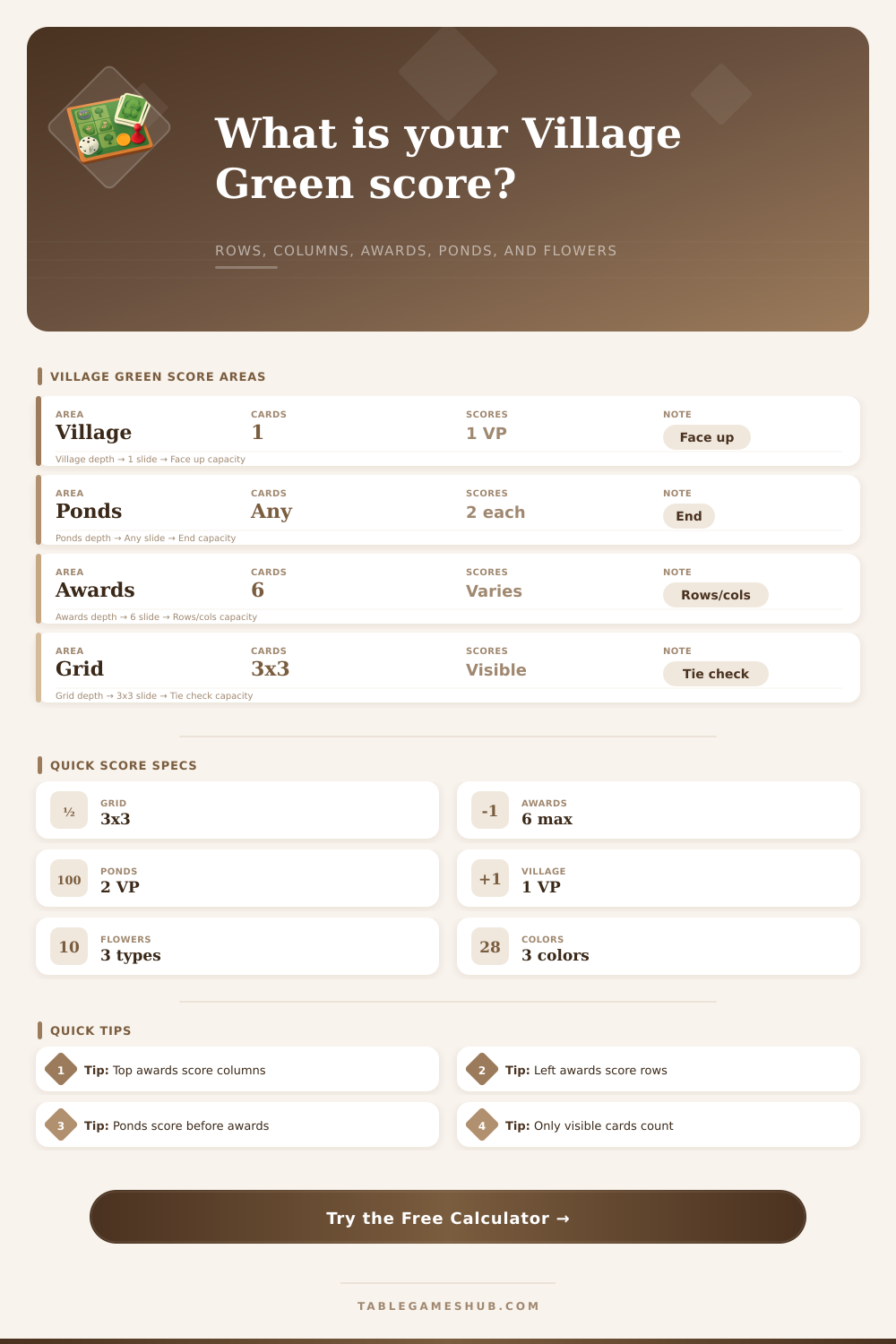
Top awards score the three green cards in that column. Left awards score the three green cards in that row. Use manual correction for a rare card text that is not represented by the presets below.
4Green Card Grid
Live village map
| Space | Flower color | Flower symbol | Card feature | Trees | Tree type |
|---|
Score Breakdown
| Award slot | Rule selected | Line contents | Points |
|---|
5Village Component Snapshot
6Reference Tables
| Scoring item | How this calculator treats it | Score timing | Common check |
|---|---|---|---|
| Village card | 1 point when face up | End scoring | Tick the face-up checkbox |
| Pond card | 2 points for each visible pond | Before awards | Covered cards are ignored |
| Top award cards | Score the green cards below them | End scoring | Column 1, 2, and 3 |
| Left award cards | Score the green cards to the right | End scoring | Row 1, 2, and 3 |
| Award family | Input used | Example scoring | Best use |
|---|---|---|---|
| Color patterns | Red, blue, yellow flowers | Color mix can add or subtract | Rows with many flowers |
| Flower symbols | Rose, petunia, lily icons | Symbol mix can add or subtract | Columns with repeated icons |
| Tree awards | Tree count and tree type | More trees or one type can score | Oak, birch, willow lines |
| Feature awards | Ponds, pavilions, lawns, gaps | Sets, lawns, or penalties | Mixed green-card rows |
7Scoring Tips
Rows and columns: Every green card can matter twice: once for its row award and once for its column award.
Visible cards only: If a green card or award card was covered, score the visible top card, not the card underneath.
Pond timing: Count all visible ponds first, then add award cards, the village-card point, and any manual correction.
Exact award text: Use the correction input when a printed award card has a special condition outside the built-in patterns.
Village Green isn’t so much about having the most gorgeous garden as it is about tallying your score without losing your mind. After three rounds of playing cards (and moving pavilions over ponds, and arranging columns of red flowers along rows for award points), it’s finally time to find out whether two misplaced trees will cost you two points and make you the loser.
The calculator here do all the math, after you input your current board state, sparing you the mental effort of keeping track of each column and row at once. When the board get crowded, it’s simple to get confused about what’s even counting. The scoring are divided into various layers, and the sequence is more important than players think.
How to Count Your Score Correctly
Before even considering the award cards, we have base level scoring: you get two points per pond if it is viewable. If a pond is obscured behind a lawn card or a pavilion, it doesn’t count. Many people overlook a big difference: they think that the assets they hide still count toward their score. They don’t.
And the calculator is designed to keep those base scores separate from the awards, so you can know precisely what kind of value is sitting there just by itself, before the whole thing gets complicated. It’s the six award cards surrounding your three by three grid that are really tricky. There is three on top of the columns and three to the left of the rows. Each green card in the middle contribute to two sets of scoring lines.
And this is where most people mess up: They see a set of cards as a good contender for an award, like all the red flowers in one row. However, they don’t consider that those same cards also belongs to columns that lose points for having red flowers. Each line must be judged on its own merits. If you’re using the tool, you can choose which rule goes into each slot so there aren’t contradictory goals muddying things up in your mind. Be sure to check yourself here before you commit to the final tally.
Another common pitfall: You think you know exactly what is scoring on your board, but you don’t. According to the rules, only the top card in each stack can be counted when scoring. For example, if you put down a flower card early on and then overlaid it with a tree card, that flower card is gone from an award perspective. It is still in your garden’s history, but it doesn’t count toward points any longer. To follow the rules, the calculator will look at the current state of the grid.
What do you have in front of you? Enter that. Don’t get caught up in what used to be there. That encourages you to make realistic judgments about where you stand. A lot of people over-estimate their point total because they’re remembering all those flowers underneath the lawns and pavilions.
And then there’s a second level of details from tree types to flower symbols. Will it be an oak or a willow? Does it matter what kind of icon is on the card at all? Or are they looking for some pattern in the icons, whether they’re acorns or flowers or whatever? That’s where you need to know what category this award falls into before allocating its points. The calculator has that built-in, so you don’t have to remember exactly what was written on each card in the last round. It groups the awards for you.
This makes the final round go faster. It also prevents people from doing something like putting a color-based rule onto a symbol-based row. And lastly, don’t forget about the village card itself. You get a point if it’s faced up at game end. It is another little bonus which, in a very close game like this, could of made all the difference. There’s a toggle for it on the calculator. Remember to look there too, as it’s easy to forget when your mind is busy figuring out the complicated awards.
That’s what I love about Village Green, it favors thoughtful gardening more than ambitious growth. It isn’t so much about having the largest garden as it is about having the best-scored garden. Breaking it down into the parts (the awards, the ponds, the visibility checks) takes away the tension from the last round. It’s simple arithmetic rather than a stress test. When you break down your points and see them all added up neatly, you realize how well-thought-out your strategy was.
Congratulations: You’ve created a garden that adds up beautifuly under the hood and looks beautifull on top.