Pathfinder 1e Encounter Calculator
Build treasure-free Pathfinder 1e encounter math with adjusted APL, target CR, creature XP totals, difficulty band, and per-character XP.
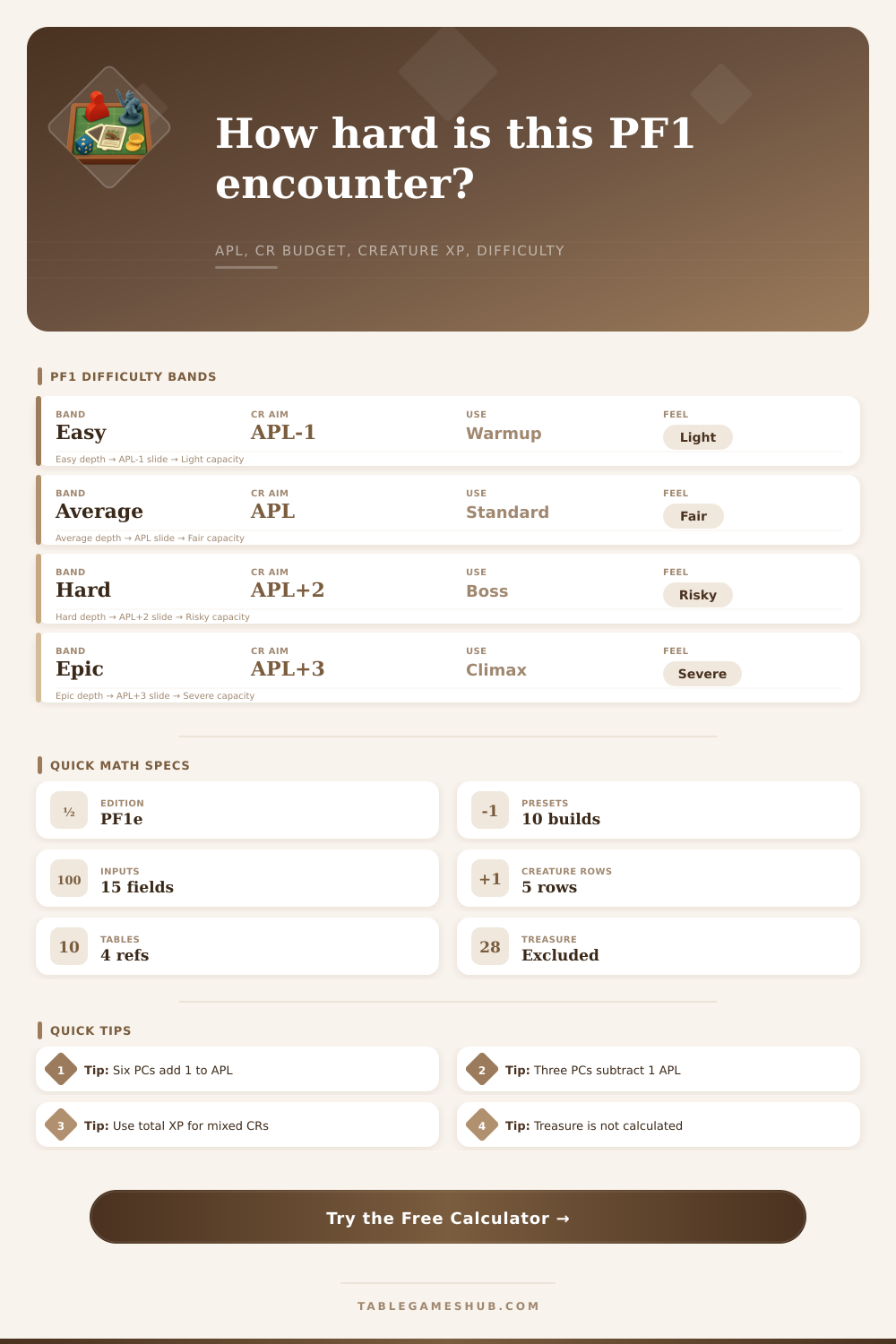
| Difficulty | Encounter CR Aim | Typical Use | Pressure |
|---|---|---|---|
| Easy | APL -1 | Warmup, guard post, light attrition | Low |
| Average | APL | Baseline combat for four or five PCs | Moderate |
| Challenging | APL +1 | Important scene or stronger enemy mix | Meaningful |
| Hard | APL +2 | Boss, elite squad, dangerous terrain | High |
| Epic | APL +3 | Major climax or risky set-piece | Severe |
| CR Band | Low Anchor | Middle Anchor | High Anchor |
|---|---|---|---|
| Fractional | CR 1/4: 100 XP | CR 1/2: 200 XP | CR 1: 400 XP |
| Low levels | CR 2: 600 XP | CR 4: 1,200 XP | CR 6: 2,400 XP |
| Mid levels | CR 8: 4,800 XP | CR 10: 9,600 XP | CR 12: 19,200 XP |
| High levels | CR 14: 38,400 XP | CR 16: 76,800 XP | CR 18: 153,600 XP |
| Party Size | APL Adjustment | Why It Matters | Calculator Handling |
|---|---|---|---|
| 1 to 3 PCs | Subtract 1 | Small parties have fewer actions and fewer tools | Adjusted after rounding average level |
| 4 to 5 PCs | No change | Baseline assumed by PF1 encounter design | Uses rounded average level directly |
| 6 or more PCs | Add 1 | Large parties can absorb and answer more threats | Raises APL before target CR is set |
| Group | CR | Quantity | XP Each | XP Total |
|---|---|---|---|---|
| Calculate an encounter to fill this table. | ||||
Pathfinder 1e Encounter Design
Pathfinder 1e encounter design require a systematic approach because the mathematical volatility of the Pathfinder 1e game can make encounters either too easy for player or too difficult for players. If the encounter is too easy, combat is considered trivial. However, if an encounter is too difficult, combat can result in the wipe of the entire party.
Encounter design requires a balance between challenging encounters for players and providing difficulty that dont result in the destruction of the party during combat. The first step in encounter design is to determine the Average Party Level (APL). This number represent the average level of the players in the party.
How to Design Pathfinder 1e Encounters
However, this number isnt an accurate representation of the power of the party because the size of the party can change the game’s mathematics. The average party size in Pathfinder 1e is four players. If a party include more than four players, they have a mathematical advantage in combat because more players mean more actions can be performed during a round of combat.
A round of combat includes all actions that can be taken in one minute. The more players there are in the party, the more turns each player get during combat. If there are six players in the party, encounter designer should consider the APL a higher level because of the advantage in action economy.
Conversely, with three players in the party, the APL should be considered to represent a lower level of players compared to an average party size of four. Thus, encounter designer must adjust the APL based on the number of players in the party. After establishing the APL, encounter designers must establish the difficulty of the encounter that is to be created.
There are three difficulty band for encounters: average, hard, and epic. Average encounters are encounters that test the resources of the players and do not put the players in a situation of possible death. Hard and epic encounters test the most powerful aspects of the players and require the use of their best spells and characters.
The experience point (XP) budget can be used to control these difficulty bands. A single monster encounter should be avoided because the action economy of the players will allow them to eliminate a single monster. If a monster face a group of players, the players will have more actions during a round of combat than the single monster will have.
Therefore, the players will be able to eliminate the monster that is facing them. To avoid this, encounter designers should include a variety of creatures of different Challenge Ratings (CRs) within an encounter. This will allow players to feel challenged without the use of action economies to eliminate a single opponent.
In addition, the total experience points that the creatures release will allow designers to ensure the encounter remains within the appropriate difficulty band. The terrain within the encounter also impacts the difficulty of the encounter. An encounter in a narrow hallway is not the same as an open field in which encounters can run from player to player.
If the terrain within the encounter provide an advantage to the players, the effective difficulty of the monsters that are to fight the players decreases. Conversely, challenging environments that include hazards can make encounters more difficultly for players. These situational adjustments must be included when encounter designers plan encounters because they can make a fair encounter into an ambush.
It is not necessary for every encounter to be mathematically perfect. An encounter that is slightly challenging is more beneficial for players than one that is perfectly calculated. If an encounter is slightly too difficult, it will force players to use items and spells that they do not usually employ.
In most cases, encounter designers should use the XP budget as a guide for encounter difficulties. The XP budget will help designers to determine if additional guard or hazards should be incorporated into the encounter. Pacing within encounters is another element of encounter design.
If encounters are all of an average difficulty, players will begin to feel the attrition of combat. Attrition is when players use their characters hit points and resources over time in encounters. When players have few hit points left, an average encounter will seem difficultly to them.
Designers should plan encounters so that not every encounter is a battle against a boss monster. Creating this type of experience for players will leave them feeling panic throughout the game. Finally, encounter designers should use the mathematical calculation of the APL and the XP budget as the foundation of encounter design.
While the math of encounter design can inform players of the danger that is to come into the campaign, it does not control the story that unfolds within the game. However, encounter designers should ground their encounters in a solid APL and XP budget for players to have an enjoyable game experience.