🃏 Card Game Probability Calculator
Hypergeometric distribution for any standard 52-card deck game — draw odds, hand probabilities & poker rankings
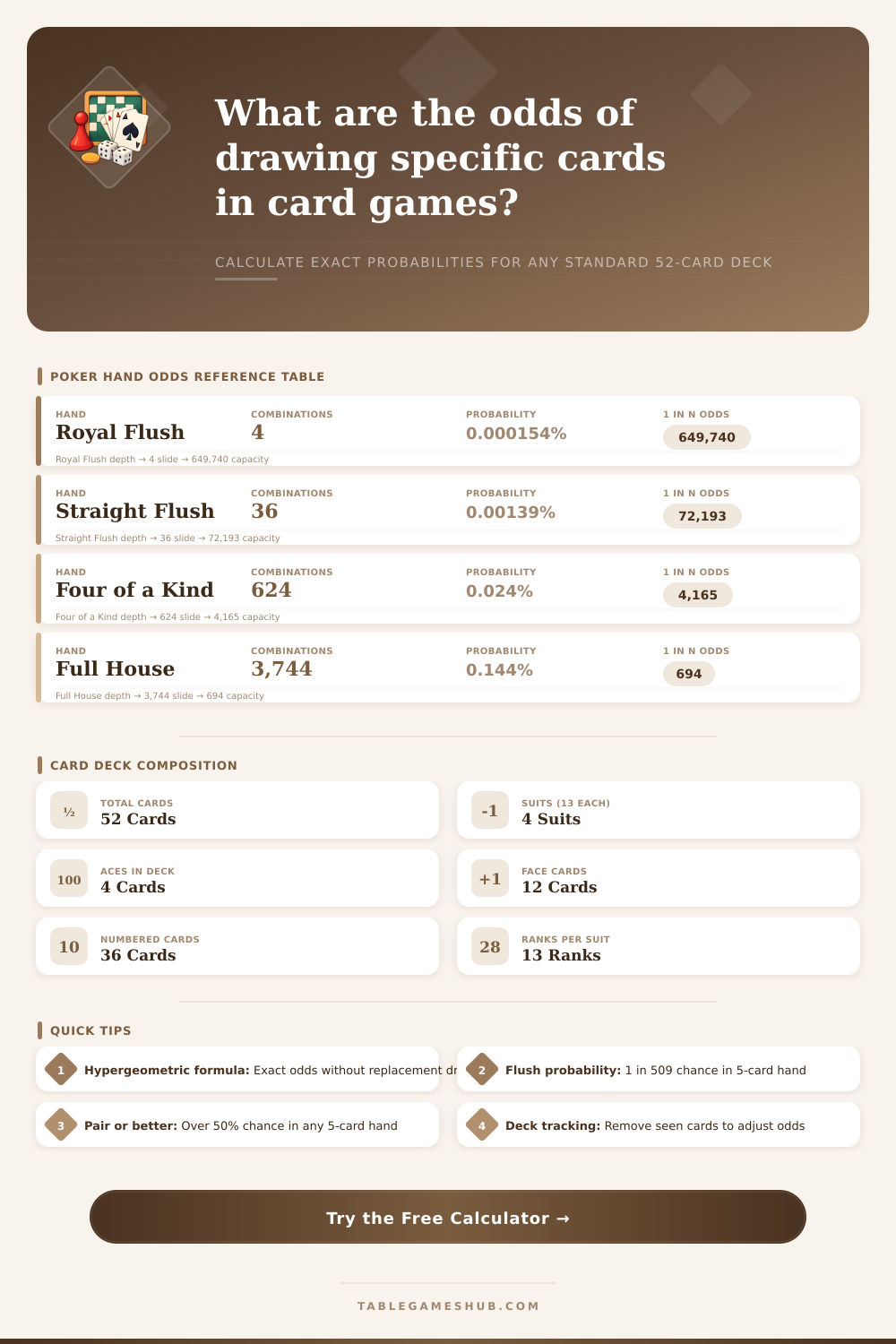
| Hand | Combinations | Probability | 1 in N Odds | Cumulative (or better) |
|---|---|---|---|---|
| Royal Flush | 4 | 0.000154% | 1 in 649,740 | 0.000154% |
| Straight Flush | 36 | 0.00139% | 1 in 72,193 | 0.00154% |
| Four of a Kind | 624 | 0.0240% | 1 in 4,165 | 0.0256% |
| Full House | 3,744 | 0.1441% | 1 in 694 | 0.170% |
| Flush | 5,108 | 0.1965% | 1 in 509 | 0.366% |
| Straight | 10,200 | 0.3925% | 1 in 255 | 0.759% |
| Three of a Kind | 54,912 | 2.1128% | 1 in 47 | 2.87% |
| Two Pair | 123,552 | 4.7539% | 1 in 21 | 7.62% |
| One Pair | 1,098,240 | 42.2569% | 1 in 2.37 | 49.88% |
| High Card | 1,302,540 | 50.1177% | 1 in 1.00 | 100% |
| Card Type | Count in Deck | Probability | 1 in N |
|---|---|---|---|
| Any Specific Card (e.g. Ace of Spades) | 1 | 1.92% | 1 in 52 |
| Any Ace | 4 | 7.69% | 1 in 13 |
| Any Face Card (J, Q, K) | 12 | 23.08% | 1 in 4.33 |
| Any Specific Rank (e.g. all Kings) | 4 | 7.69% | 1 in 13 |
| Any Specific Suit (e.g. all Hearts) | 13 | 25.00% | 1 in 4 |
| Any Number Card (2-10) | 36 | 69.23% | 1 in 1.44 |
| Any Red Card | 26 | 50.00% | 1 in 2 |
| Any Black Card | 26 | 50.00% | 1 in 2 |
When drawing cards without replacement, use the hypergeometric formula: P(X=k) = C(K,k) × C(N-K, n-k) / C(N,n). This accounts for the changing deck composition with each draw, giving exact probabilities unlike the simpler binomial formula which assumes replacement.
In games like Blackjack or Rummy, tracking cards already seen dramatically shifts probabilities. If you know 2 aces have been played from a 52-card deck, remaining ace probability drops from 7.69% to 3.92% (2 aces in 50 cards). Always enter seen cards for accurate results.
Almost each card game has an element of chance. A classic example is the chance to get certain hands in poker. In card games the results are so complicated that you hardly “feel” the real probabilities.
That makes them attractive though hard to calculate
Simple Probability in Card Games
Standard deck is made of 4 suits with 13 cards each. To find the probability of drawing two cards of the same suit in a row, follow a simple process. The chance for the first card of any suit is certain, so equal to 1.
Later the probability for the second card of same suit is 12 from 51, because 12 such cards remian from 51 total.
In card games the order does not matter. The probability for a straight flush is easy to calculate. Because there are 4 suits and 10 possible sequences, there are 40 hands of that type.
Similarly you can find probabilities for a straight or a flush.
Online are free hypergeometric calculators for probabilities of card draws. They work well for games as MTG, Yu-Gi-Oh!, Pokemon TCG, Marvel Snap, Hearthstone and others. Some even simulate thousands of games to show the chance to get cards with wanted traits, when abilities overlap.
Here is a funny card game that also teaches probability. Mix the pack and lay it face down. Set a target score, say 100.
The first player turns the top card and keeps turning more, adding their values, until they decide to stop. It is a simple game of risk and reward.
Other game works like this: lay the deck face down and loudly count from 1 to 3, then repeat. For each called number turn the top card. If its value matches the called one, the player loses.
For instance, probability that card is 2 is obviously 1 from 13.
Some card games let players change probabilities for better chances to win, mixing strategy with probability ideas. Making a game with several dice and many decks adds probabilities to count at any time, but that does not necessarily make it better. Practice probability, as well as negative and positive numbers, with math card games.
Playing them will help to understand the chance to win or lose.