4d6 Drop Lowest Probability Calculator
Calculate exact ability-score odds, six-stat array chances, reroll-ones variants, point-buy comparisons, and expected D&D-style modifiers.
| Score | Weighted count | Exact chance | At least | Modifier |
|---|
| Threshold | Single roll | At least one in array | All scores at least | Expected count |
|---|
| Hits in array | Exact chance | At least this many | Expected note |
|---|
| Ability slot | Entered score | Modifier | Point-buy cost | Status |
|---|
When creating a character for a campaign, you must decide how to generate the six ability scores for that character. How you generate those scores will impact the character’s effectiveness in combat, as well as there roleplaying aspect within the game. Most tables use a rule that players roll four six-sided dice (d6), and drop the lowest die.
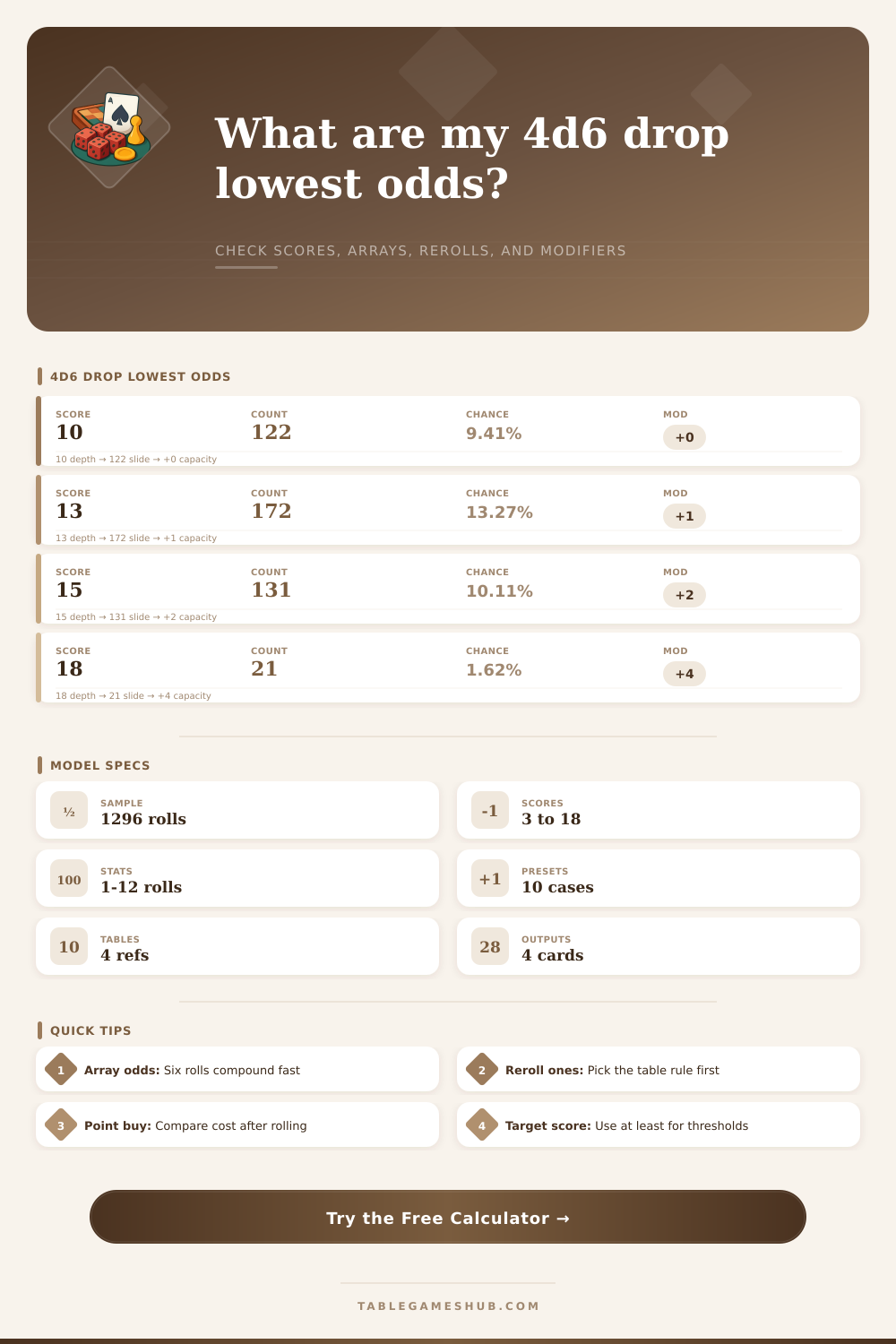
This type of dice roll is common; it ensures that there is a variety of possible results, though the distribution of those results isnt even (or uniform). Each ability score begin with a roll of the four six-sided dice. Each roll has a 1296 total possible outcomes.
How to Make Your Character’s Ability Scores
Scores between 10 and 13 are the most common rolls, while high and low scores is less likely to be rolled. Because of this tendency for heroic arrays to reveal a variety of scores, some characters will have scores that are above average, average scores, and scores that is below average that require the assistance of ones race and background. Changing the rule for generating ability scores will change the distribution of those scores.
For instance, some tables chooses to reroll rolls of a score of one (1), or prefer the use of three six-sided dice instead. The calculator allow one to calculate the math behind these scores. In the instance that one has chosen a rule for generating the scores, and a target for those scores, the calculator can reveal how often a single score will meet that target, or what the chance of that target being met for an entire array of six scores.
Each roll is an independent event from all of the other rolls. Thus, the difference between the chance of scoring one high score versus two high scores is much wider then players may expect. For instance, while a 10% chance of success on a single roll, there is a 47% chance that at least one of six rolls will be successful.
However, the chance of two or more successes is significantly lower. Such distinction within the game is crucial in that it allows players to decide whether to accept the chance of receiving an array of below-average scores, or to ask the table for a reroll. Reroll variants is important in that they will alter the distribution of scores before calculating the array of six scores.
For instance, rerolling scores of one (1) only once will guarantee that no score will be lower than a minimum of four (4), but the rerolling scores of one (1) until a score between two and six (2-6) is rolled will ensure a higher average score for that character. The table and the campaign in which the players wish to create there characters often determine the choice between these two rules. However, the choice between these two rules will impact how many characters has scores above 15.
Another way of generating ability scores are point-buy systems. In point-buy systems, players dont use the rolls to determine there scores; each player selects there scores within a budget. The calculator can help players to determine the cost of there rolled scores.
For instance, players can enter the results of there rolled scores, and the calculator will show each player how costly there scores are compared to an average player. Additionally, the calculator will flag scores outside of the typical range (below 8 or above 15) to alert players of such scores outside of the normal purchase range. Such a flag will assist in players in deciding whether to use the point-buy system.
Another rule that many tables use is the requirement of a minimum acceptable score for each character. For instance, some tables require that no score be lower than eight (8) or nine (9). The calculator can show the probability of each score being at least that minimum score.
Additionally, if the minimum score is raised even slightly, the calculator will show how this changes the scores of the entire character. The same logic applies to targets for the number of scores that must be met at a higher level than average. One of the most important aspects regarding characters and score generation is that of the expected modifier totals.
Because modifiers are calculated from the ability scores, any change in the average score will have a direct impact upon the total modifiers. A character with an expected modifier of +1 (or -1) per ability score will feel more heroic than a character with an expected modifier of +0.5 (or -0.5) per score. Additionally, because games often use bounded accuracy, any modifier is important to attack rolls and saving throws.
Many players make errors in score generation because of a lack of understanding of the actual probabilities of scoring certain arrays. For instance, players may focus upon the chance of scoring an 18, but ignore the rarity of scoring an 18 in six rolls. Additionally, players may assume that rerolling scores of one (1) will result in a greater number of characters with scores of 16 or higher, but there will be a modest increase in the number of scores that are 16 or higher.
While the calculator can help players understand these differences, the real value of the calculator is in helping players to ask the right questions of the game before rolling the dice to generate there scores. The six ability scores will have a major impact upon the type of character that players play and control. For instance, a high strength score will enable a player to control a character in certain ways, while a low intelligence score will prevent players from utilizing there characters in those same manners.
Thus, the choice of ability score generation method for players will have a major impact upon the types of characters that are created for the campaign. Thus, while the math of generating those scores does not remove the luck of the roll, it does allow players to understand whether they would of like to play in a system that rewards patience for high scores, or one that protects against disastrous outcomes for the players and there characters.