Rook Score Calculator
Total a Rook hand from bid, trump color, captured count cards, the Rook bird, last trick, set penalty, and partnership target.
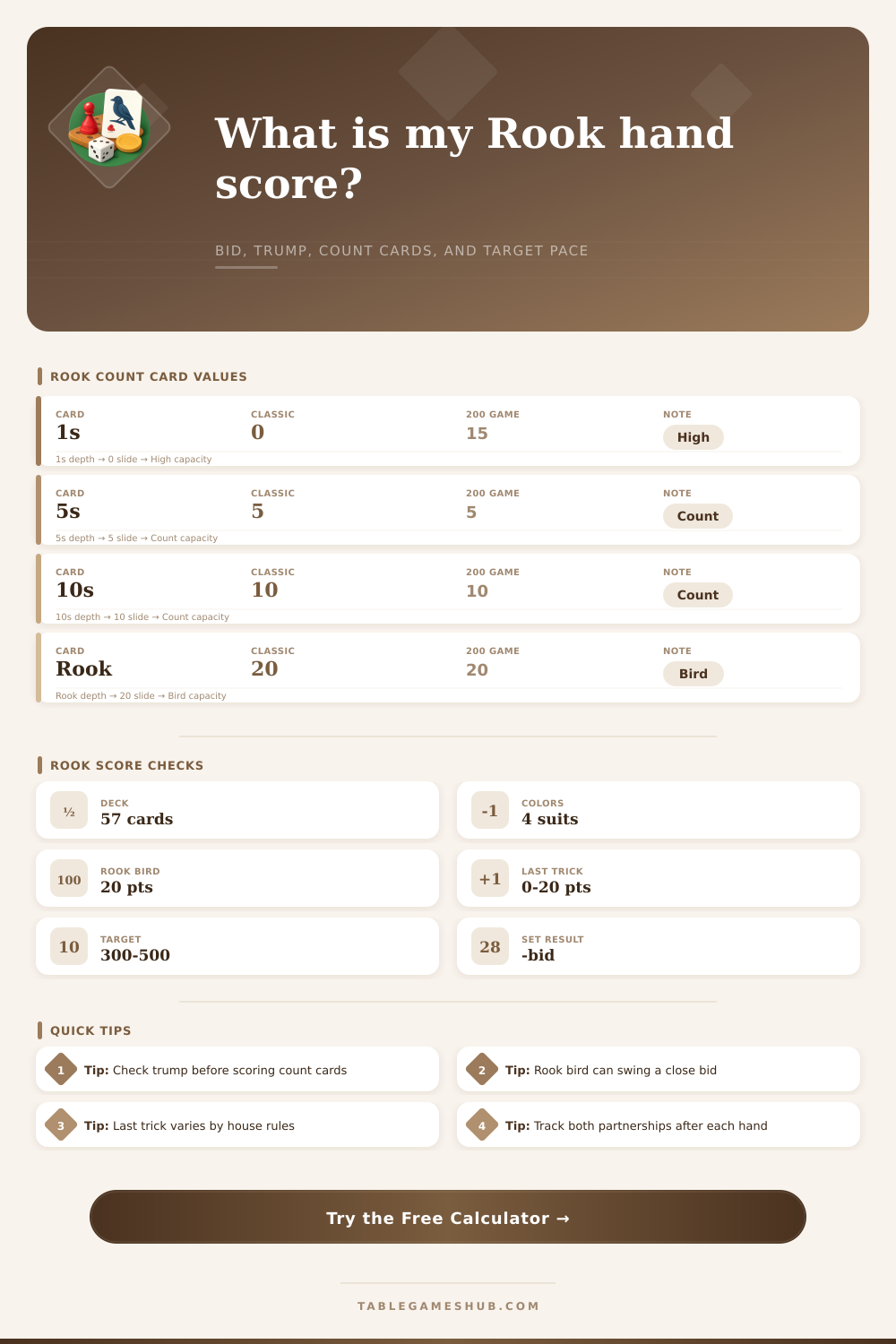
| Captured card | Classic 120 | Last Trick 140 | Tournament 200 |
|---|---|---|---|
| Each 1 card | 0 points | 0 points | 15 points |
| Each 5 card | 5 points | 5 points | 5 points |
| Each 10 card | 10 points | 10 points | 10 points |
| Each 14 card | 10 points | 10 points | 10 points |
| Rook bird card | 20 points | 20 points | 20 points |
| Last trick | 0 points | 20 points | 20 points |
| Contract check | Captured score | Bid | Score applied |
|---|---|---|---|
| Made exactly | 90 | 90 | Add 90 to bidder |
| Made with room | 125 | 100 | Add 125 to bidder |
| Set by small margin | 80 | 85 | Penalty rule applies |
| Set by large margin | 55 | 120 | Usually minus bid |
| Target reached | 140 | 110 | Check both totals |
| Trump color | Typical tracking note | Rook bird effect | Last trick effect |
|---|---|---|---|
| Black | Mark black as high suit | 20 point swing | 0 or 20 points |
| Red | Confirm red trump call | Counts for capturer | House rule varies |
| Green | Check green count cards | Can save a bid | May decide margin |
| Yellow | Separate yellow tricks | Use 20 points here | Record winner |
| No trump | Use table convention | Still count bird | Match house sheet |
| Preset | Variant | Bid | Rook score focus |
|---|---|---|---|
| Kentucky Safe Bid | Classic 120 | 85 | Moderate count capture |
| Rook Bird Swing | Last Trick 140 | 100 | Bird and final trick |
| Yellow Trump Set | Classic 120 | 95 | Penalty comparison |
| Tournament 200 Push | Tournament 200 | 145 | 1 cards included |
| Red Trump Closeout | Last Trick 140 | 120 | Target pace check |
Rook scoring is the system used to determine the points earned or lost during a game of Rook. Rook scoring is important to the game of Rook because it can tell a player if the bidding side successfully complete the contract or if they failed to complete there contract. To calculate the Rook score for a round of play, a person must track several different component of the game.
These components include the count card, the Rook bird, the trump color, the last trick bonus, and the set penalty rule. The count cards are one of the primary component of Rook scoring. Count cards are a series of specific cards that have a point value associated with them.
How to Score in Rook
The point value of each count card is always the same; the fives, the tens, and the fourteens is each worth one point. The Rook bird is another of the components of scoring that is a separate from the count cards; the Rook bird is a separate playing piece that is worth twenty point. Aside from collecting as many count cards as possible, a partnership must also collect the Rook bird and earn enough point to fulfill the contract that they made when bidding on the game.
If a partnership does not collect enough count cards and the Rook bird to fulfill their bid, then they will fail their contract and earn a penalty score for failing to complete their bid. The specific penalty rule that is used in a game can impact the points that are given back to the partnership. For instance, some penalty rules will require the partnership to subtract the bid amount from there total score, but other rules may require the partnership to score zero point on that round of play.
The trump color is another of the critical components of Rook scoring. The trump color will determine which suit of cards is used to capture the count cards. If the bidding side has the trump color, they will likely succeed in capturing the count cards.
However, if the opposing side has the trump color, they will likely succeed in capturing the count and the Rook bird, as well. The last trick bonus is another component of Rook scoring that exists in some version of the game only. The last trick bonus will award twenty points to the side that wins the last trick of the round.
However, if the game does not incorporate the last trick bonus, that side does not receive the bonus point. The current totals for each partnership is another component of the game that can help to determine the bidding on each round. The higher the total score for a partnership, the more conservative they will be with there bids.
A low total score for a partnership will make them more aggressive in their bidding. A calculator can be used to keep track of these score for each partnership. The set penalty rule is the rule for the game that determines how much of a loss a player will suffer if they fail to make there bid.
There are several different type of set penalty rules that may be used at different tables. For instance, the negative bid rule will cost the partnership some points for failing to complete their bid, but the zero rule will give the partnership zero point for that round of play. Because there may be different set penalty rules at different tables, each player must agree upon the penalty rule before play begins.
There are a few common mistakes that can be made when scoring a game of Rook. For instance, some people may treat the Rook bird as if it were one of the count cards, ignoring its value of twenty point. Additionally, some people may forget that if the last trick bonus rule is activated for that round, then the side that won the last trick will earn twenty points.
People must also remember to adjust both partnership totals after a set is completed. Only adjusting one of the partnership totals will lead to an incorrect Rook score for that round. If people have incorrect score for a round, they will make incorrect decisions during the next deal.
Reference tables can assist people in understanding the components of Rook scoring. A calculator can help with calculating the score for each player. Using a calculator helps people to not have to perform the calculation in their head, and avoiding calculations in the head will prevent people from making error with their score for that round.
There are a few human factor that may impact a player during a round of Rook, even if those factor do not impact the rules of the game. For instance, if a player is very tired, they may make mistakes in their dealing of the count cards. Additionally, table talk may reveal information to a player about the location of the Rook bird.
These human factor will affect the players, but they will not impact the rules of the game. The final score for a round of play can be used as a checkpoint for each partnership. If a partnership made their bid, they should review the margin of their bid to determine how many point they have left to earn in the remaining deals.
If a partnership failed to make their bid, then they should review the set penalty rule to ensure that they are scoring according to that rule. If problem are noticed with a particular rule, the partnerships should discuss the rule with each other during the game. Eventually, playing and scoring games of Rook will become a habit for each player.
Time will allow each player to remember which color of cards could win the Rook bird and the last trick. The partnership totals and scores will also be remembered by each player. Although the calculator will make the math behind the game of Rook easier, the players will still have to make the decisions for that round of play.