In the Year of the Dragon Calculator
Plan palace floors, person tiles, privileges, rice, fireworks, money, the next event, monthly scoring, and end scoring in one compact Dragon score sheet.
Choose a real board-state pattern, then adjust the palace, person, resource, event, and scoring inputs below.
People and round VP
Action and event symbols
For each monk, multiply Buddha symbols by the floors in that monk's palace. Leave unused monk rows at zero.
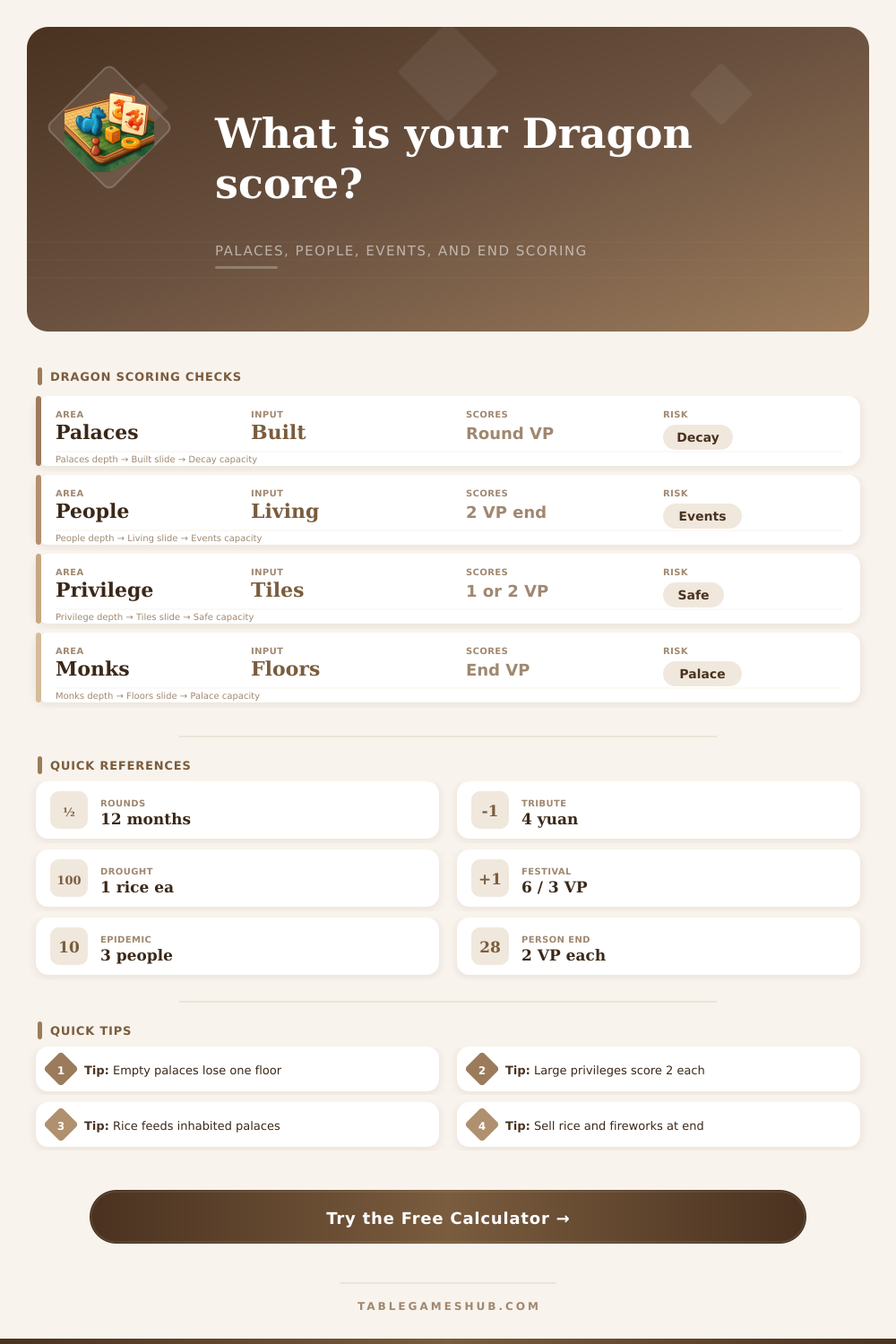
| Event | Immediate Check | Calculator Output | Useful Input |
|---|---|---|---|
| Peace | No event penalty | Only palace decay and round scoring | Palaces, privileges, court ladies |
| Imperial Tribute | Pay 4 yuan | Short yuan becomes person loss | Current yuan, tax action, surcharge |
| Drought | Pay 1 rice per inhabited palace | Unfed palaces release people | Rice, inhabited palaces, harvest action |
| Mongol Invasion | Score helmets | Fewest helmet flag adds 1 person loss | Warrior helmets, military comparison |
| Dragon Festival | Most scores 6, second scores 3 | Adds festival VP and spends half fireworks | Fireworks rank, fireworks tiles |
| Epidemic | Release 3 people minus healer mortars | Shows protected or lost people | Healer mortars, living people |
| Score Area | When It Scores | Formula Used | Common Mistake |
|---|---|---|---|
| Palaces | Every round scoring phase | 1 VP per palace | Counting floors instead of palaces |
| Court ladies | Every round scoring phase | 1 VP per court lady | Forgetting lost people stop scoring |
| Privileges | Every round scoring phase | Small 1 VP, large 2 VP | Missing the recurring points |
| Research | Action phase | 1 plus scholar books | Adding books again at game end |
| People | Game end | 2 VP per living person | Scoring people lost to events |
| Monks | Game end | Buddhas x floors in that palace | Using total floors for every monk |
| Rice and fireworks | Game end sale | 2 yuan each, then 1 VP per 3 yuan | Scoring tiles directly as VP |
In this game, the dragon represent power, but it’s also an endless clock. Each turn is a month in your reign over an empire where politics shift, disasters strike, and taxes are due. The board gets wild fast, creating a frantic pace. Once you’re actualy playing, it can be hard to keep up with where you stand.
In reality, taking a step back to check your position is far more important different than rushing to make your next move. Your palaces is your engine. Your engine are your source of points every round, but it’s also the magnet for trouble. Each event will cause one empty palace to lose a floor. That sounds like no big deal when you’re starting out, but those floors is used to score monk later on.
How to Play This Game Well
Maybe you need points now; maybe you should of rush to build up some quick points. But if you leave them hollowed out, you’ll pay the penalty. The calculator (above) takes the math off your hands. Put in your vacancy rate and your number of floors, and it’ll do the math for you. This way, when you’re trying to feed everyone during a drought, you don’t have to do math in your head.
The tiles with a picture of your person is not just vulnerable, they’re also your workers! At the end of the game, each living person score you two points. That means survival are more important than getting things done now. If you have an epidemic, and lose three people, you suffer the loss right then and there, but you’ll also be less productive for the rest of the months. It is a double whammy that adds up fast.
A lot of players gets caught up chasing resources and neglect the fact that their people produce them in the first place. Simple things may be worth more than meets the eye. Fireworks are great to spend at festivals. Rice is a good thing to have around to keep people in your palace, which help retain inhabitants even when they would flee from drought. You can always sell your fireworks on the final turn if you don’t want to use them for anything.
Each two yuan is a point of victory. It’s usually better to hold onto extra tiles because you never know what you’ll need in a disaster (like a tribute demand, or a Mongol invasion). The reference table on the page lays out how each event impacts your score, but understanding the timing is just as important than knowing the rules.
But it’s not only about understanding the rules… When they hit matters too. Early in the game, you may be fine with a drought because you have lots of rice, but late in the game, if you run out, you’ll be forced to release individuals from the scoring palaces, losing those points quickly. Your goal should be to match your risk level to your resource buffer. If a festival is on the horizon, hoard fireworks. If an epidemic are looming, stockpile healers.
Multiple monk buildings scores further because it doesn’t just add but multiplies. If there are four floors in your building and you have four buddhas, you get 4 x 4 = 16 for the palace. Having lots of monks in high towers will give you more points than having few monks spread around the palace. Build dense and specialize, don’t build broadly.
Most games will have an event that reduces the size of your tower, which can be a major penalty since floors is required for monk scoring later. In general, don’t build too quickly if it leaves your structures hollow, because empty palaces loses floors and create penalties. Year of the Dragon deals with dealing with decay. If you don’t guard things they will fall apart. Resources are devoured, people perish, palaces collapse.
How do you combat that? Build engines that churn out points in spite of it. How do you slow its progression? You cannot control the events or the cards you draw, but you can control how you prepare for them. Random chance becomes manageable risk when you check your situation on a regular basis. A well-prepared emperor doesn’t burn; the dragon may breathe fire.