Le Havre Score Calculator
Total final score from buildings, ships, francs, goods, bonus buildings, loans, and round-end food coverage.
| Score Area | What To Enter | Formula Used | Result Effect |
|---|---|---|---|
| Standard buildings | Printed values on owned non-special buildings | Entered building value | Adds to asset score |
| Special buildings | Printed values on special buildings | Entered special value | Adds to asset score |
| Ships | Printed values on owned ships | Entered ship value | Adds to asset score |
| Francs | Remaining cash francs | Francs x 1 | Adds final points |
| Loans | Unpaid loan cards | Loans x -7 | Subtracts final points |
| End-Game Profile | Typical Strength | Main Risk | Calculator Focus |
|---|---|---|---|
| Building engine | High printed building value | Cash can lag behind | Separate standard and special values |
| Shipping line | Strong ship values and food help | Fewer bonus buildings | Ship total and food coverage |
| Goods conversion | Large leftover goods value | Value can be overcounted | Goods value as one explicit input |
| Loan recovery | Strong assets despite debt | Negative loan swing | Loan penalty and net score |
| Bonus building finish | Extra final scoring text | Manual scoring mistakes | Manual or counted bonus method |
| Food Source | How It Helps | Input Treatment | Scoring Note |
|---|---|---|---|
| Ships | Often reduce feeding pressure | Add covered food value | Ship printed value still scores |
| Fish and smoked fish | Common direct food | Add food value available | Food itself is not final points unless valued separately |
| Cattle and grain | Can cover late feeding | Add converted food value | Leftover value may also be entered as goods |
| Emergency loans | Cover shortfall if needed | Shown as risk estimate | Each extra loan is -7 points |
| Bonus Method | Best For | Formula | When To Use |
|---|---|---|---|
| Manual bonus total | Complex special text | Manual bonus + occupation | Use when the card text is unique |
| Count times points per building | Building set bonuses | Count x rate + occupation | Use for repeated building scoring |
| Count times points per ship | Fleet-related bonus cards | Count x rate + occupation | Use for ship-based scoring |
| Mixed bonus plus occupation | Hybrid final scoring | Manual + count x rate + occupation | Use for layered bonus buildings |
| Component | Direct Points | Needs Manual Entry | Common Mistake |
|---|---|---|---|
| Buildings | Printed value | Yes | Missing newly bought buildings |
| Ships | Printed value | Yes | Counting food ability as points |
| Francs | One point each | Yes | Forgetting loose cash |
| Loans | Negative seven each | Yes | Ignoring emergency loans |
| Bonus buildings | Card text | Yes | Double-counting manual bonuses |
| Goods | Entered value | Yes | Mixing food coverage with sale value |
The game of Le Havre requires a person to track many different category of points that can be earned during the game. These different categories include the value of the buildings, ships, francs, goods, loans, and food coverage. The total score for a player in Le Havre is each of these values total together.
The balance of each of these categories will determine the winner of the game. Due to the number of different value to be calculated, it is helpful for a player to use a calculator to determine the total score for the game. A player can use the calculator to not only calculate the total value of each of the game components, but also to note the number of unpaid loan that a player has accumulated during the game.
How to Keep Score in Le Havre
Many players tend to focus on the value of the buildings that they construct and operate within their game board. Building values score point for each player, and can provide an easy way to gain points during the game. However, ships are another valuable component of the game.
Each ship provides points for the player that own the ship, and the points from that ship can also help cover food coverage for the player. The player’s score will add the value of each ship regardless of the use of that ship during the game. Consequently, players must decide whether to invest in ships or buildings.
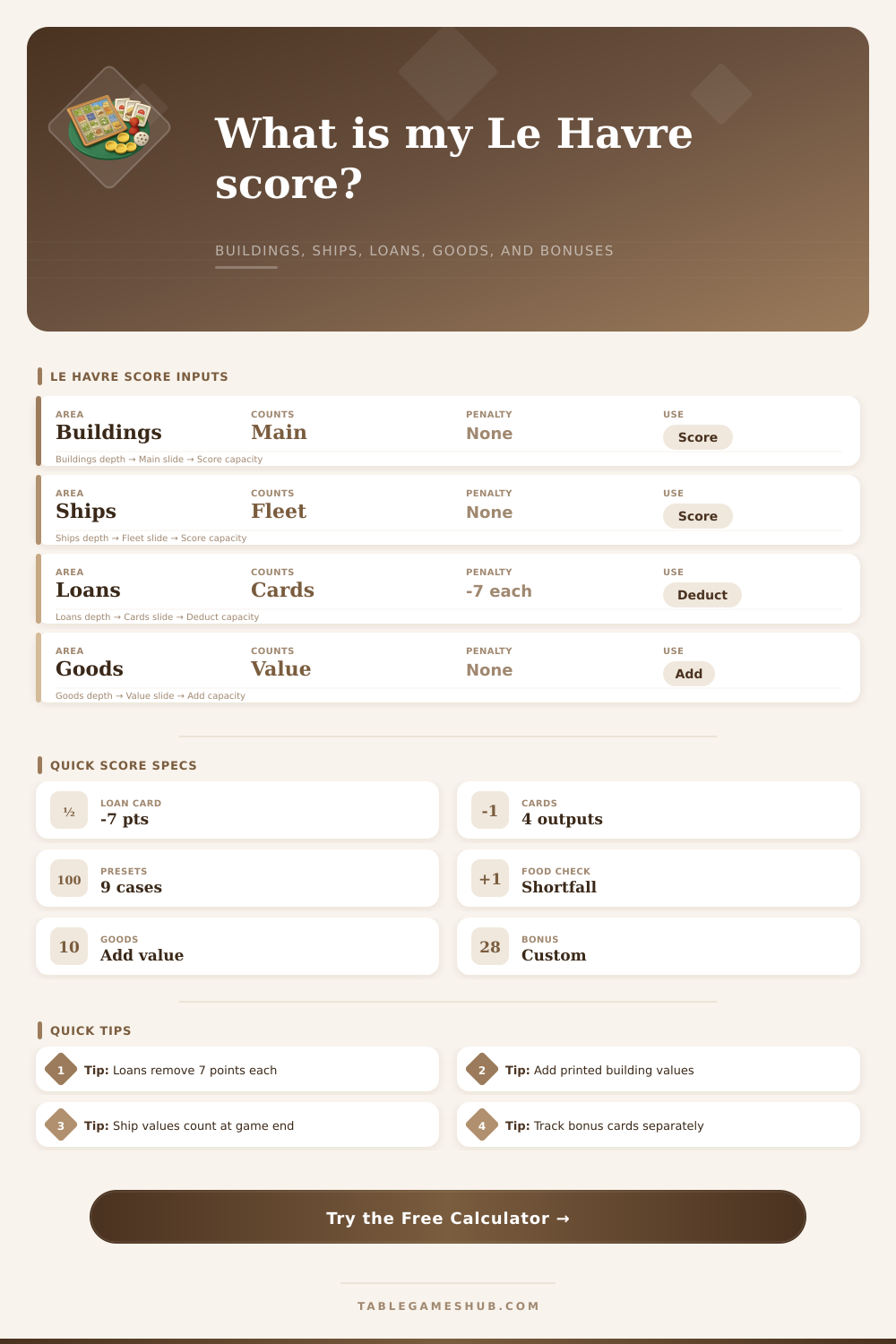
Another category of points for a player are the loans that they have taken out during the game. Each loan creates a penalty for the player of seven points. These points are subtracted from the player’s total score.
Many players use loans to gain the items or resources that they need for their game. However, they dont pay those loans off prior to the final round of feeding of the game. It is useful for a player to use the calculator to manually enter the number of loans that they have taken out during the game.
This will display for the player the potential effect that their loans has on their total score. Another component of the game is food coverage. Food coverage does not score any points for a player.
However, if a player does not have enough food coverage for there population, they will need to take on additional loans to gain the food that they need. Each of these additional loans will contain a penalty of seven points, which will reduce the total score of that player. There is a significant difference between having enough food coverage and having a food coverage deficiency for the population.
Therefore, a player must manually enter food coverage into the calculator to determine how their food shortage may impact their total score. Bonus buildings score points for each player, but use different methods for each building. Some bonus buildings provide points for the player based off the number of buildings that they control.
Others provide points for the number of ships that they own. Other bonus buildings may provide a specific number of points to the owner of that building, or may be associated with points for occupation of a building. A player can manually enter each of these into the calculator to prevent any over-scoring of bonus buildings.
Goods provide points to a player, but only if those goods has a franc equivalent to them. A player must enter the total number of goods that they have into the calculator to ensure that their score includes potential points from their goods. The reference tables included in the article provide further information on the components of the game and how each component may impact the score of a player.
These tables provide information on which game components impact which aspects of the total score of a player. Consequently, these tables help to remind a player of the components of the game. For instance, the row for loans in the tables makes clear that there is a penalty for loans, and that any food shortage will create additional loans.
It is possible that a player may be surprised with the total score for their game if they treat scoring as an afterthought during the game. However, if players check their scores with the calculator during the game, they can make better decision during their game. For instance, they can determine if taking out a loan will provide enough points to even offset the purchase of a new building for the player.
Additionally, they can use the calculator to determine if building a ship will help them to even solve their food problems during the game. Finally, using the calculator during the game will ensure that a player’s total score is error free and accurately reflect.