Woodcraft Score Calculator
Total Woodcraft final scoring with current VP, claimed public contracts, reputation-per-order scoring, uncompleted order penalties, leftovers, dice manipulation notes, and optional workshop or helper bonuses.
Choose a Woodcraft finish profile, then edit the dice, contracts, workshop, and end-scoring fields to match the player board.
Lumber pile and potted dice
Tokens and berries
Next contract requirement
Workshop manipulation capacity
| Step | What to score | Calculator field | Important note |
|---|---|---|---|
| 1 | Public contracts | Claimed public contract VP | Score printed VP for each claimed public contract. |
| 2 | Leftovers | Dice, berries, scrapwood, glue, saw | Sum all leftover values, then score one VP per full ten. |
| 3 | Uncompleted orders | Orders still beside board | Move reputation back two spaces for each remaining order. |
| 4 | Completed orders | Completed orders and reputation VP | Each completed order scores the final reputation value. |
| Move | Needs | Calculator input | Use in score check |
|---|---|---|---|
| Saw lumber | 1 saw token or ready sawing tile | Saw tokens, sawing tiles, reuse tokens | Helps create two dice whose values total the original die. |
| Glue lumber | 1 glue token and ready gluing tile | Glue tokens and gluing ready | Helps combine two dice into one die up to value six. |
| Splice scrapwood | 1 scrapwood and a splicing tile | Scrapwood and splice power | Raises a die by the selected tile range, never above six. |
| Reuse tile | 1 tile-reuse token | Tile reuse tokens | Extends saw, glue, or splice capacity in the readiness estimate. |
| Card type | Score basis | Calculator option | When to use |
|---|---|---|---|
| Tool attic helper | VP by tools in attic | Tool end-scoring card | Select only if your helper or contract scores tool count. |
| Pots and glue helper | 3 VP each | 3 VP per pot and gluing tile | Counts workshop pots plus the gluing tile installed. |
| Saw and splice helper | 3 VP each | 3 VP per saw and splicing tile | Counts sawing tiles plus splicing tiles installed. |
| Other bonus card | Printed or manual VP | Other helper/card VP | Use for fixed VP, market-track, or custom card scoring. |
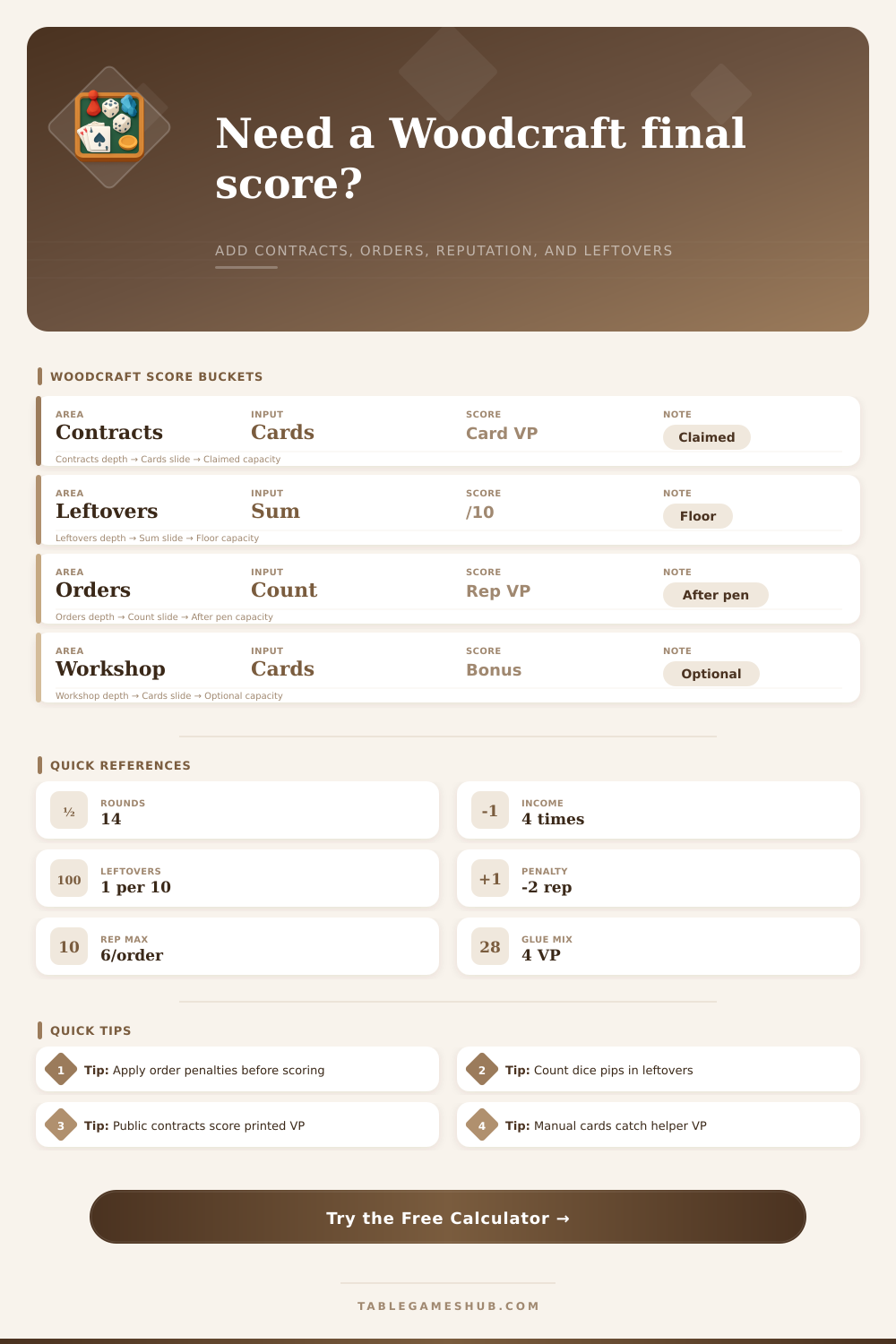
Apply reputation penalties first. Uncompleted orders move the reputation marker back before completed orders score, so one late order can lower every order's end-game VP.
Separate track VP from final VP. Mixed-color gluing, market purchases, income scoring, and many helper rewards are already in current VP; final scoring adds contracts, leftovers, order reputation, and selected card bonuses.
It’s taken you 14 rounds of carefully sawing lumber and gluing scraps into usable block. You’ve carefully arranged your workshop tiles, stockpiled blueberries for the final round, and now you’re staring down a board that resembles some kind of insane masterwork. Now comes the hard part. Scoring in Woodcraft isn’t a basic addition problem. It’s a series of complex countings of all the resources you squirreled away til the very end. One unfinished order can destroy months of reputation building. Meanwhile, a couple extra dice pips could be the difference between winning or losing against an opponent who over-invested in early points.
It’s complicated math with an easy solution. You’ll know that completing orders and claiming public contracts are good things, right? Right! But not every player knows how those numbers gets added up, since that order is key. By inputting your current board state into the calculator, it will do the math for you, applying penalties first before locking down your reputation values.
How to Count Your Points
Your uncompleted orders pull back your reputation marker by two spaces for each leftover order on your mat. So if you’re already sitting at a nice chunk of rep but also have three undone jobs on the mat, that penalty knocks your total way down before multiplying your score by however many contracts you finished. This is a lesson in both starting tough projects and seeing them through to completion.
A lot of players also miss out on points by leaving items unused. Small tokens like glue, saws, scrap wood, and blueberries can add up big time… And so do leftover dice. Any pips showing on dice when they’re not rolled up is scored. Ditto with the small tokens, those glue tokens you didn’t use? The blueberries you haven’t used yet? All those get added up and then the total is divided by ten. That’s the number of victory points you’ll be awarded in the end.
This creates a strange situation near the end of the game: should I use my last saw now, even though I need it for the final score? Is that extra glue worth the minor order? The how-to is laid out in the reference table, but the idea is just that sometimes being efficient mid-game isn’t as efficient as being efficient at the end of the game.
In addition, there’s another seemingly-to-miss aspect: Workshop upgrades. Perhaps you’ve splurged on specialized workshop setups, or purchased helper cards. Maybe you can score extra points from splicing, gluing, or your pots. Regardless of your primary order production, you’ll receive some bonus points for all this. These are static bonuses during scoring, though potentially substantial.
It frequently serves as the insurance policy for players who had trouble during the more uncertain claiming contracts. Instead of needing to carefully track each helper card condition under which it becomes active (while also exhausted by 15 rounds of frenetic resources management), the tool handles the optional scoring triggers. There’s no need for manual checking; the app just knows if your splicing/sawing/tile-glueing configuration are eligible for some additional points.
It’s all about reputation, which is a tricky thing. It gains points when you’re moving up the track in-game. However, it also risks becoming a liability if you have outstanding orders and are holding on to those points by the final buzzer. The balancing act here is fascinating: should I accept this easy point now, knowing I’ll probably get dinged for it eventually, or wait around for something more valuable while risking falling behind? Both choices can feel right, there’s no one “right” way to play, but understanding the value of each option help show what the best move is.
As time runs out, you have to shift gears from aggressive to conservative and back again. You have to be flexible, and the game will reward that flexibility. So at Woodcraft, the secret is that you need short term thinking for immediate gratification. You also need long term planning for strategic planning. That means you don’t just throw all your resources at something, but you also can’t hold onto them forever. There’s no point building up cash if you’re not going to leverage it for anything.
Ultimately, you’ll know whether your plan has worked out or failed when you reach the end and see how many VPs you have. You’ll get to see exactly what each tile you placed meant and which dice rolls realy paid off. What did you do wrong? How could you change things up next time? Did your points come from the contracts? Were they leftover points? Maybe you got a sweet bonus on a workshop? Understanding where your points came from is key to understanding how to best adjust your play next time. What started as an exercise in chaos becomes a strategic race towards victory.