Sergeant Major Card Game Calculator
Calculate 8-5-3 contracts, 9-5-2 and 6-3-8 variants, trick surpluses, next-hand card exchanges, running scores, and the table space needed for a clean three-player deal.
1Preset Sergeant Major Hands
Load a realistic hand state, then adjust the contracts, tricks, exchange cap, and table setup for your group.
2Hand Settings
3Component and Deal Specs
4Reference Tables
| Variant | Deck and Deal | Targets | Calculator Use |
|---|---|---|---|
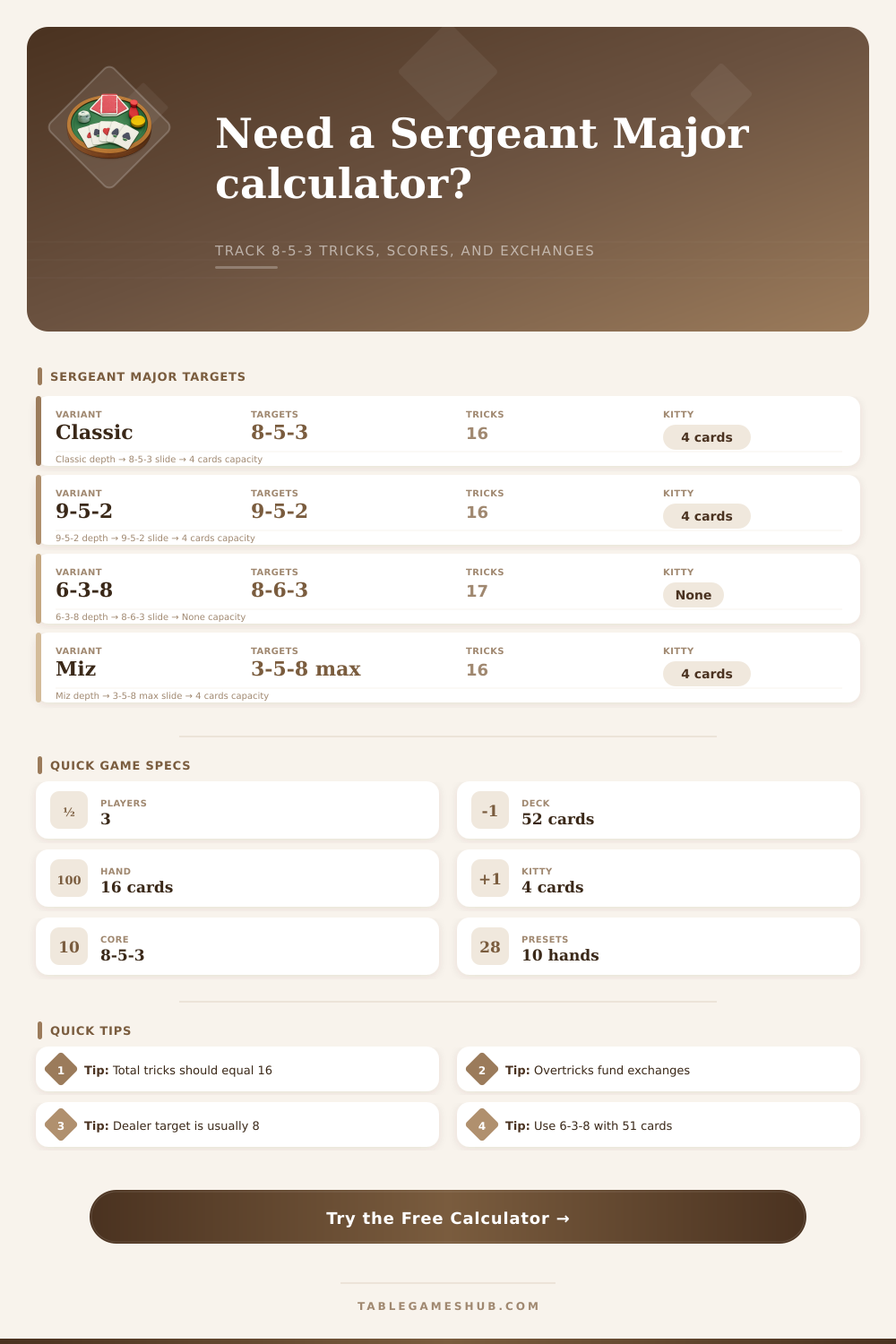
| Classic Sergeant Major | 52 cards, 16 each, 4-card kitty | Dealer 8, eldest 5, middle 3 | Standard trick surplus, shortfall, and exchange tracking. |
| 9-5-2 | 52 cards, 16 each, 4-card kitty | Dealer 9, eldest 5, middle 2 | Harder dealer contract with the same 16-trick total. |
| 6-3-8 | 51 cards, 17 each, no kitty | Dealer 8, eldest 6, middle 3 | Short-deck table when one card is removed. |
| Woburn Bid | 52 cards, bid sets dealer target | Bid table from 8 to 16 tricks | Balance a high dealer bid by lowering opponent quotas. |
| Miz Call | 52 cards, usually no trump | Maximum tricks instead of minimums | Low-trick scoring where fewer tricks are better. |
| Dealer Bid | Dealer Target | Eldest Target | Middle Target |
|---|---|---|---|
| 8 | 8 tricks | 5 tricks | 3 tricks |
| 9 | 9 tricks | 4 tricks | 3 tricks |
| 10 | 10 tricks | 4 tricks | 2 tricks |
| 11 | 11 tricks | 3 tricks | 2 tricks |
| 12 | 12 tricks | 2 tricks | 2 tricks |
| 13-16 | 13 to 16 tricks | 2 to 0 tricks | 1 to 0 tricks |
| Hand Result | Net Score | Exchange Meaning | Next-Hand Note |
|---|---|---|---|
| Dealer wins 10 in classic | +2 | Dealer passes 2 unwanted cards | Down player returns highest cards in those suits. |
| Eldest wins 4 in classic | -1 | Eldest receives 1 exchange card | Shortfall is matched by another player’s surplus. |
| Middle wins 6 in classic | +3 | Middle may pass 3 cards | Use the cap field if your group limits exchanges. |
| All players hit target | 0 each | No exchange pressure | Next hand starts without owed cards. |
| Table Setup | Suggested Surface | Player Edge | Best For |
|---|---|---|---|
| Compact card table | 34 x 34 in | 22 in each | Quick scoring with small scorepad. |
| Comfort rectangle | 48 x 36 in | 24 in each | Dealer kitty, discard area, and notes. |
| Wide kitchen table | 60 x 36 in | 28 in each | Long sessions with visible exchange notes. |
| Travel setup | 30 x 30 in | 20 in each | Fast play where cards stay tight. |
5Calculation Tips
Target tip: Sergeant Major balances because the contracts add to the number of tricks in the hand. If your entered tricks do not match the hand total, the calculator flags the mismatch in the breakdown.
Exchange tip: A player who finishes above target creates exchange pressure for the next hand. Use the cap field for groups that limit the number of cards any one player can pass.
The way the dealer holds those sixteen cards make you nervous, as if you’re wondering if they can actualy honor the deal. The math is clear enough on paper; it’s just too hard to keep up with the tricks once the game starts. That’s where your trusty calculator comes in. It is your trusted friend that handles the complexity for you, keeping track and providing guidance for strategy so you can concentrate on the game.
In the classic Sergeant Major game, the targets is balanced: Eldest Hand shoots for 5 tricks, Middle Hand takes 3 and the Dealer require 8. If added up, that comes to 16, the total number of tricks played per round. It’s a balanced system where one player’s excess make up for another player’s shortfall. It is difficult to track your cards manually while keeping them hidden. A device to take this task off your shoulders allow you to focus on play.
Why You Need a Calculator
But wait a minute! That’s not all the calculator does… It counts card exchanges too. Say you win 10 tricks instead of your target of 8. Well, now the dealer has two more tricks then needed. And in most circles, those additional tricks become cards that must be passed around to those who didn’t get theirs. It makes for a fairer game by making sure no one can gain an unfair advantage over another player. Then it adds up the number of cards owed and subtracts them from the number your group caps it at.
The balance shifts with different versions of the game. For example, some tables works with nine-five-two targets. That adds an additional hurdle for the dealer. Or, another variant might drop one of the cards and produce a game with only 51 cards (17 for each player) and no kitty. It changes probabilities a bit, but the basic premise remain unchanged: keep track of how many tricks you think you’ll take versus how many you’re supposed to take. And that’s where the calculator comes in; it adjusts itself to the rules so that you don’t have to be doing math in your head while playing.
Games is physical. A game like this takes up real estate: three people (each dealing 16 cards + four kitty cards) on a table and that gets crowded fast. It means cards get tossed around, errors occur on limited surfaces. The tool has a check that asks about table size, how much surface do you need for tricks, deals, keeping track of points? It is another dimension of strategy called spatial awareness.
Things get complicated with running scores. Points are hand by hand in casual games and cumulative for more-serious types where the object is to reach a certain number such as plus ten or twenty-one. That means keeping both an up-to-the-instant count and the overall score. Tempers are bound of flare when someone forgets how far ahead someone else was. A definitive record settles such squabbles.
The other thing is that it alters pressure. You can see from the reference tables what that changes from bid to bid. In the case of a variant like Woburn (bids over 8 tricks), when the deal bids more than 8 tricks, the targets for the eldest and middle hands is lowered. The number of tricks stays the same, but the risk changes. So a player with a good hand now knows that they can push things further up the table.
With only partial information, you have to manage your uncertainty in the game. It’s also about making sense of what other people might or might not have in their hand based off cards they play. Knowing where you stand helps guide you as to which cards to lead and when it makes sense to concede a trick. The calculator takes away the arithmetic noise, allowing you to concentrate on the game itself.
And when it’s your turn to look at your cards, you know that someone else did the math for you. Now you just need to worry about what’s in your hand. Playing confidently rather than being confused is the win. It’ll take care of the score.