Wizard Card Game Score Calculator
Total a full Wizard hand with exact-bid bonuses, missed-bid penalties, zero bids, house adjustments, standings, and a trick-count audit before you copy scores to the sheet.
1Preset Wizard Hands
Load a real table state, then edit player names, bids, tricks, and house adjustments.
2Game and Scoring Inputs
3Player Bid and Trick Lines
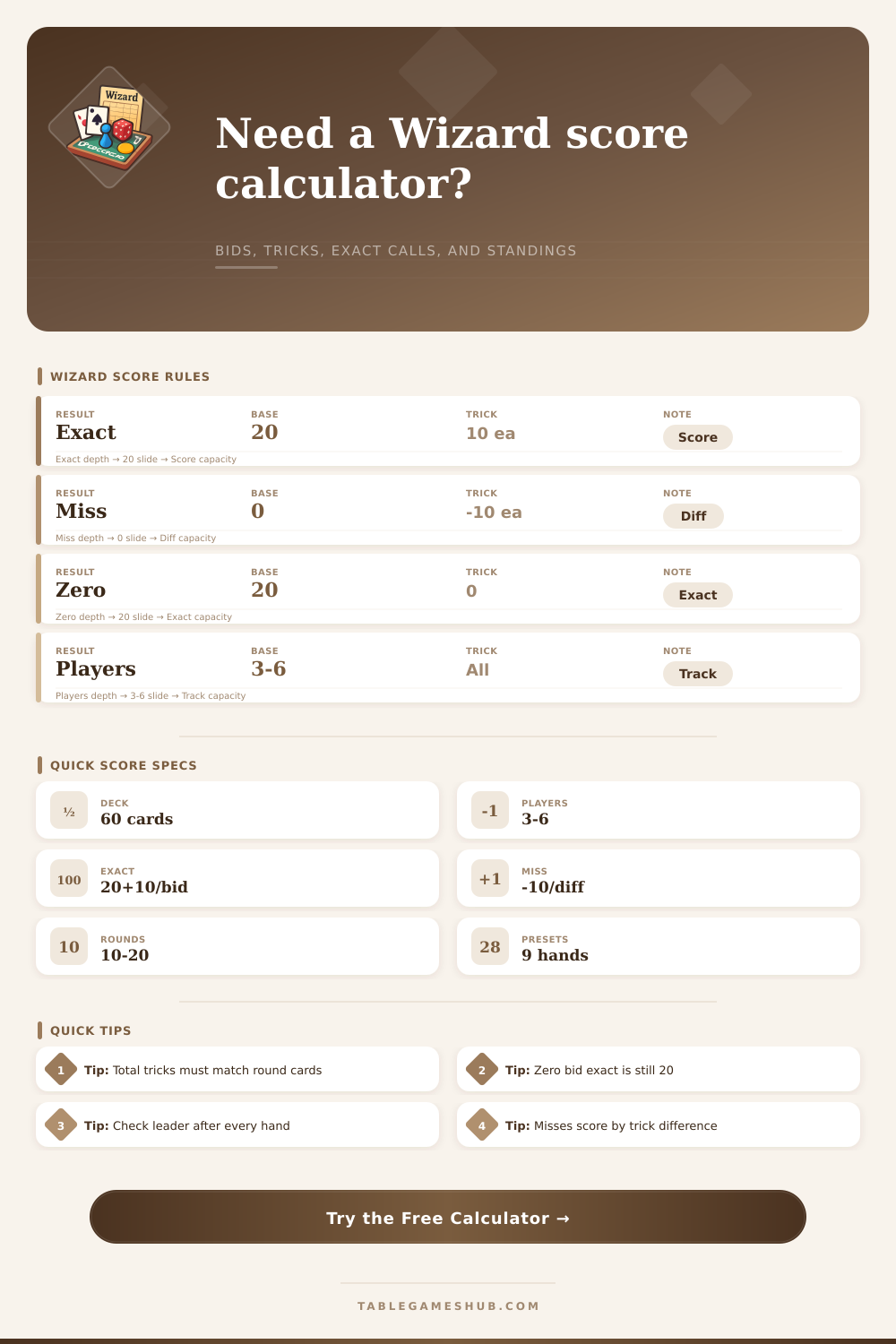
Standard Wizard scoring: exact bid scores 20 plus 10 per bid trick; a miss scores minus 10 for each trick above or below the bid.
| Player | Previous score | Bid | Tricks won | Bonus points | Penalty points | Round score | New total |
|---|---|---|---|---|---|---|---|
| +40 | 210 | ||||||
| -10 | 175 | ||||||
| +30 | 172 | ||||||
| -10 | 150 | ||||||
| 0 | 0 | ||||||
| 0 | 0 |
4Wizard Component and Score Specs
5Reference Tables
| Bid result | Standard formula | Example | Score |
|---|---|---|---|
| Exact zero | Zero bonus | Bid 0, win 0 | +20 |
| Exact positive | 20 + 10 x bid | Bid 3, win 3 | +50 |
| Over bid | -10 x difference | Bid 2, win 4 | -20 |
| Under bid | -10 x difference | Bid 4, win 1 | -30 |
| Players | Max cards | Full rounds | Common pace note |
|---|---|---|---|
| 3 players | 20 cards | 20 rounds | Longest score arc |
| 4 players | 15 cards | 15 rounds | Balanced full game |
| 5 players | 12 cards | 12 rounds | Sharper table swings |
| 6 players | 10 cards | 10 rounds | Fastest full game |
| Round card count | Likely bid range | Audit target | Score pressure |
|---|---|---|---|
| 1-3 cards | 0-2 tricks | Low total tricks | Zero bids matter |
| 4-7 cards | 1-4 tricks | Watch overbids | Medium variance |
| 8-12 cards | 2-6 tricks | Compare total bids | Large swings |
| 13-20 cards | 3+ tricks | Exact totals rare | Endgame pressure |
| Score check | What to compare | Good sign | Fix before saving |
|---|---|---|---|
| Trick audit | Total tricks vs cards | Equal numbers | Correct a trick entry |
| Bid accuracy | Exact players count | Clear winners | Check copied bids |
| House entries | Bonus and penalty fields | Intentional values | Remove stray points |
| Target gap | Leader vs finish line | Gap shown | Adjust target score |
6Scoring Tips
Audit first: In every Wizard hand, total tricks won must equal the number of cards dealt that round. If the audit says over or short, one trick entry needs correction.
Keep variants separate: Put nonstandard table awards in the bonus or penalty columns, so the base Wizard bid formula stays visible for every player.
By about round ten, something happen in a Wizard game: you feel it in the air. At that stage, the chit-chat ends; it’s no longer casual. If you see potential for five tricks, then what? What do you see when you look down at your hand? There is a potential for five tricks, yes. But eyes across from you have Jesters in them, too. Do you bid four to be safe or go for the high score on an exact five? Mistakes are quickly punished, but precision are greatly rewarded. It’s a controlled risk game, and your memory works just as much as your strategy.
There’s nothing particularly complicated about the score keeping, in fact, that’s part of why players screw it up when they get too amped on competitive rounds: make an accurate bid, and you’ll get 20 points plus the number of tricks you pledged (plus a point if it happens to be a Trump suit). The game reward accurate bids and confident players. Miss by even one trick, however, and a penalty apply to every trick above or below your bid. It’s symmetrical, meaning that being off by two tricks penalize you the same amount as betting low by two tricks. In other words, there’s a big old cliff where there used to be a safety net for incorrect guesses. Most rounds at home games crumble here.
Why Score Tracking is Important
You need to keep all this in your head while recalling what was played and who had the lead last round. So you can go back to thinking about your next bid, the calculator does the math for you. Based off the actual tricks won, plus everybody’s bids, it makes a new standing right away using your old numbers. And it has an audit function which check whether or not all those tricks add up to the number of cards dealt in the round. That may seem like a small thing, but it’s also what keeps the game fair. Three people say they each had four tricks, while another say she got none. Something was off. The tool highlights that mismatch before it turns into a “well I think I did, so therefore…” argument about whose turn it was to take that last trick with the Jack of Hearts.
By about round fifteen, most tables has settled into a groove. There’s typically one player who’s far ahead of the rest, with another who’s trying desperately to stay in the game by betting big every round. At this point, you’re not thinking only about your hand; but about everyone else’s as well. You begin paying attention to other players’ bids; how confident do they seem? Are they holding back, going conservative? That could mean you should double down and bet high (fewer people will be competing for that same trick). Is the table crazy and unruly? Play it safe with lower bets to avoid large penalties on your score.
To help sort all that out, the tool also come with reference tables to break it all down by both round size and number of players. A six-player game moves much faster than a three-player one because fewer cards is dealt per hand. The player count change the probability of holding high-value cards and also alters how you should view each bid. In ten card rounds, every single card counts more, while they’re less important in longer rounds with about 15 or 20 cards. There’s greater variance in those short rounds, meaning exact bids are less likely and penalties comes up more often. Knowing that will allow you to adjust your bidding threshold to match as the game unfolds.
That’s where house rules can get tricky. Regular guides don’t take them into account, but some will include bonuses for winning a certain streak of consecutive tricks or penalties for not following suit. Tracking this across several rounds is almost impossible by hand. Simply type in those values under bonus/penalty and you retain the pure math of the main scoring system without losing track of the special tweaks your group uses. That way it stays clear what the base logic of the game is, even when there are extra layers added to it.
On the last hand, victory or defeat can depend on one or two points. The player who carefully kept track of his scores all day knows precisely how many he needs to win. He can tell if he should of go for broke or play safe. Without a clear memory of the scores, he may overbid, or underbid. Scorekeeping isn’t just bookkeeping. It’s strategic. If you don’t know exactly how much you’re behind, you have no idea how aggressive or conservative you should be.
That’s the Wizard magic. It all depends on both the skill to calculate and the chance of the draw. You can’t know what your cards will be. However, you can see how those cards compare to the rest of the scoreboard. A solid system for tracking points ensures that the excitement isn’t lost to math mistakes, but stays focused on strategic play calls. Let the machine do the math and you’ll spend more time reading the faces at the table. And then when you get down to the last hand, that’s where the true magic happens… Deciding whether to play it safe or take a risk based on your exact deficit.