TrueSkill Mu Sigma Calculator
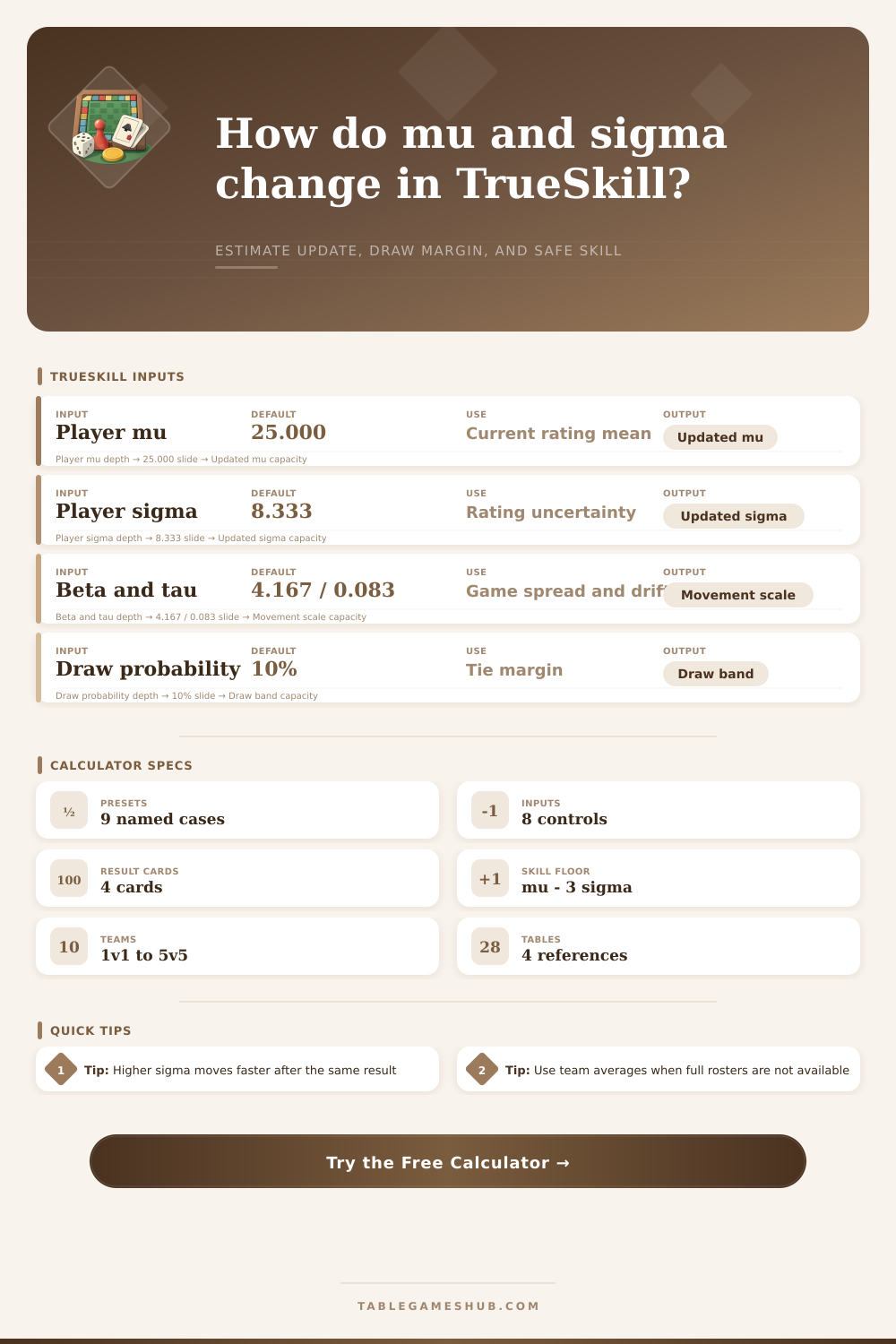
Estimate how one match changes a player's mu, sigma, conservative skill, and team-weighted rating movement from beta, tau, draw probability, team size, and result rank.
| Step | Value | Use |
|---|
| Preset | Rating state | Result | Why it matters |
|---|---|---|---|
| Fresh placement upset win | 25.0, 8.333 vs 31.0, 6.0 | Win | Shows high new-player movement against a stronger table. |
| Balanced table draw | 25.0, 5.5 vs 25.2, 5.6 | Draw | Pulls means together and reduces uncertainty. |
| 2v2 clutch underdog win | 23.4, 6.8 vs 27.1, 5.2 | Win | Team variance softens a single player's delta. |
| Four-player rank 2 finish | 28.2, 4.4 vs 29.0, 4.8 | Rank 2 | Uses a partial positive score for podium finishes. |
| Result label | Internal score | Rating direction |
|---|---|---|
| Team win / rank 1 | 1.00 | Positive mu movement unless already heavily favored. |
| Draw inside tie margin | 0.50 draw band | Moves the two team means closer together. |
| Team loss / lower rank | 0.00 | Negative mu movement, larger for expected wins. |
| Rank 2 of 4 pod | 0.67 | Small positive or neutral finish depending on opponent average. |
| Rank 3 of 4 pod | 0.33 | Small negative or neutral finish depending on opponent average. |
| Setting | Common value | Effect on estimate |
|---|---|---|
| Beta | 4.167 | Larger beta treats matches as noisier and lowers sharp movement. |
| Tau | 0.083 | Adds small pre-match uncertainty for active ladders. |
| Draw probability | 10% | Creates a narrow central draw margin around even performance. |
| Team size | 1v1 to 5v5 | More players add performance variance and dampen individual updates. |
This happens when you play a game that you should of wipe the floor with but end up losing. And now your rating hasn’t moved much, if at all. So what gives? Is this match making blind to your performance? Or maybe it’s shielding something that you don’t get to see: your hidden rating?
The issue is most people don’t understand TrueSkill. Players tend to look at whatever number they’re given as their current rating and think, “oh yeah, thats my actualy skill level.” This is exactly why so many people are frustrated.
Understanding Your Hidden Rating
Here’s the thing: your rating isn’t a shelf ornament. It is a probability distribution. It is a cloud of probabilities centered around your perceived skill (mu) with an uncertainty radius (sigma) surrounding it. It’ll do the math for you on the calculator above, but knowing how it works with the update are much more important than just clicking the button.
The first thing it does when you put in your current sigma and mu is define where you start. A new player will have high sigma, which means wide uncertainty from the system. Huge swings in ratings happen because the system doesn’t have enough data yet to narrow down your actual level. It’s designed to be aggressive. The more you keep playing, and that sigma decreases over time, the smaller and more steady those updates will be. The system stop guessing wildly and starts fine tuning. That’s where most of the ladder anxiety lives. The transition from being a volatile new player to a stable veteran rating.
This is governed by two invisible hands: beta and tau. Beta represents the amount of noise present in every individual match result. If your chances of winning are very high, a loss doesn’t do much damage. This is because the system recognize that randomness, bad luck, or momentary slip-ups can cause upsets. If you’re a clear favorite but lose once, a high beta will spare your rating.
Tau is the drift factor, meaning it allows people to rise or fall even when they haven’t produced results one way or another recently. For example, if someone took a long hiatus, they’d get stuck at their old rating level forever if it weren’t for tau, breaking the integrity of the matchmaking system. Get these right for your particular game mode and the matches feels more fair then punitive.
The value of each contribution also depends greatly on team size. If you’re dueling someone one-on-one, then everything you do is on-the-record. If you’re playing a team match with five players, then what you do gets averaged with four other people, which lowers that signal-to-noise ratio. To account for this variation, the tool reduces the amount it updates its estimate based off bigger teams.
If there are four other variables in play, then how can you get full credit? How can you get full blame? That’s why big team ratings tends to feel slower than ranked solos. The system knows that even if you lost, it might have been because of a teammate instead of you playing worse.
The difference comes from draw margins and partial finishes. Binary win-lose thought doesn’t cover all cases. Board game draws are one example; ladder tournaments that only count podium placements another. Partial information is still information. It shows you did better than third place (rank 2) or worse than second place (rank 3). Small changes reflect these kinds of results, as the reference table on the page show. This acknowledges that second is not equal to first nor last, leaving some leftover ranking between extremes of good/bad. Intermediate results help ratings adjust more slowly while avoiding the jolt common with other Elo systems.
Mu-minus-three-sigma: this is your conservative skill. This number is a reasonable estimate of your lowest possible rating. It is the answer to ‘what would my rating be in the worst case scenario?’. This number can help you understand how fair matchmaking is, and also when you’re going up against tougher players, when you’re inside someone else’s uncertainty bounds, you aren’t just playing against their average; you are navigating the range of what they might actualy be able to perform.
Once you master the knobs, though, matchmaking becomes a clear feedback loop instead of a black box. Instead of blindly chasing abstract numbers, you’ll be controlling how much your rating distributes across different area. It’s no longer about winning at all costs… It’s about removing uncertainty as quickly as possible with each point increase.
When you can do this, it means you’ve gone beyond being merely good; you’re now great.