Whist Score Calculator
Total odd tricks, contracts, honors, slams, penalties, running scores, and target gaps for classic partnership whist, bid whist, solo hands, and rubber-style score sheets.
1Preset Score Sheets
Choose a realistic whist round, then adjust the scoring table to match your house sheet.
2Round Inputs
Score Breakdown
3Whist Component and Score Specs
4Reference Tables
| Whist format | Primary input | Usual target | Calculator treatment |
|---|---|---|---|
| Classic partnership whist | Tricks above six | 5 or 10 points | Scores the side with seven or more tricks; ignores bid unless entered for notes. |
| Long whist | Odd tricks each hand | 10 points | Same base scoring as classic with a longer race-to-target view. |
| Bid whist contract | Declared odd-trick bid | House-defined | A made bid scores actual odd tricks; a set bid subtracts bid value plus penalty. |
| Solo whist hand | Declarer trick total | Hand-based | The selected side is treated as declarer and compared against its bid. |
| Tricks won | Odd tricks | Classic score | Score sheet note |
|---|---|---|---|
| 7 tricks | 1 | 1 point | Minimum scoring hand for the trick-winning side. |
| 8 tricks | 2 | 2 points | A common two-point swing in ordinary partnership play. |
| 10 tricks | 4 | 4 points | Often enough to flip a close long-whist race. |
| 13 tricks | 7 | 7 points | Grand-slam house bonuses can be added separately. |
| Contract result | Formula | Example | When to use |
|---|---|---|---|
| Made exactly | Bid times trick value | Bid 4, value 1 = 4 | For strict contract score sheets. |
| Overtrick hand | Actual odd tricks times value | Bid 3, made 5 = 5 | For tables that reward extra tricks. |
| Set contract | Negative bid times value | Bid 5, made 3 = -5 | For bid whist or solo contracts. |
| Penalty hand | Base score minus penalty | 4 score, 2 penalty = 2 | For revoke or table adjustment entries. |
| Bonus line | Typical value | Entered as | Score check |
|---|---|---|---|
| Three honors | 2 points | Honor card bonus | Only add when honors are part of the house score. |
| Four honors | 4 points | Honor card bonus | Keep it separate from trick points in the breakdown. |
| Small slam | 2 points | Slam bonus | Use for twelve-trick house bonuses. |
| Rubber close | Custom | Game or rubber bonus | Add when this hand completes the agreed rubber condition. |
5Score Sheet Tips
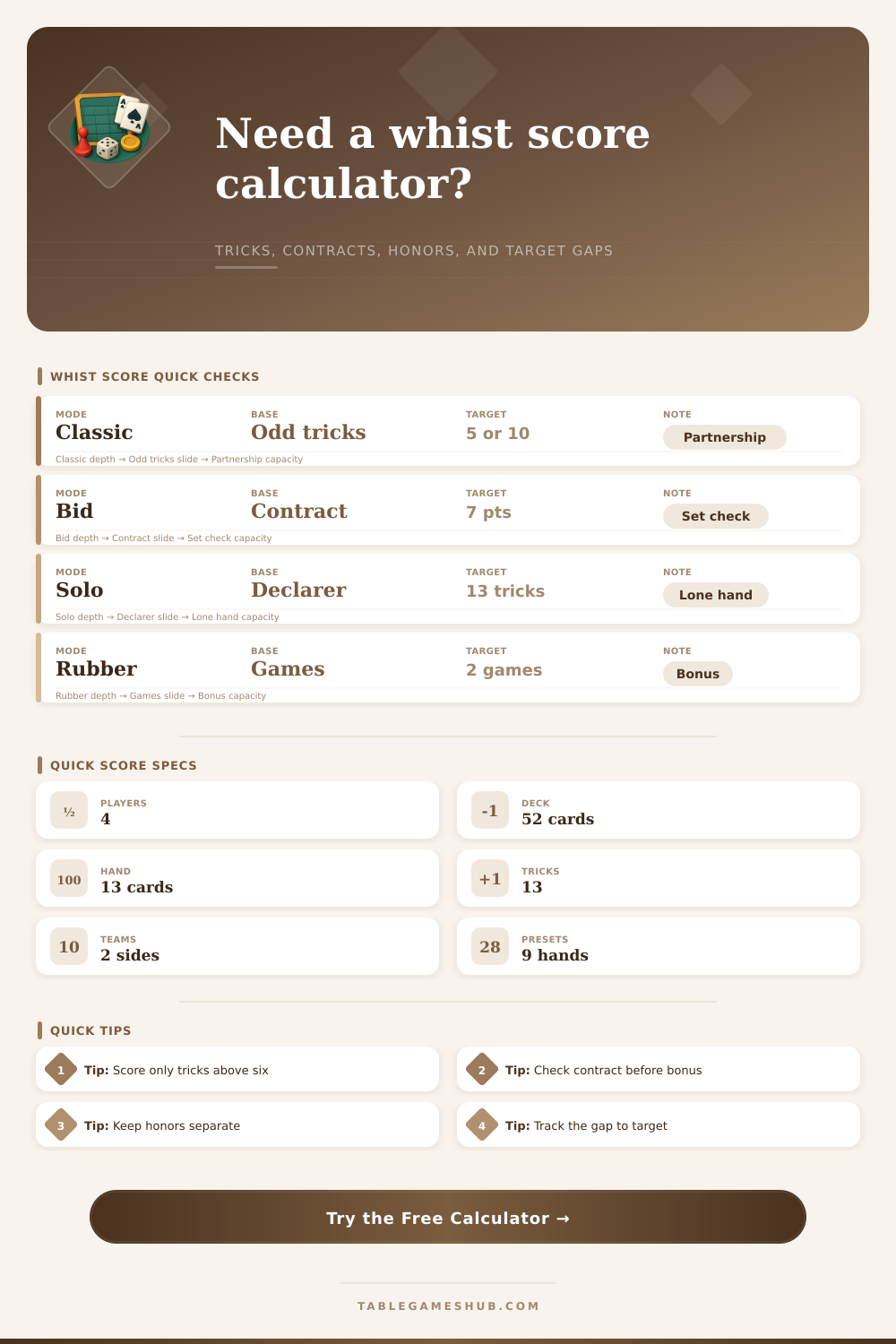
Odd-trick check: In classic whist, count only tricks above six. A 7-6 hand is worth one, while a 6-7 hand scores one for the other side.
Contract check: For bid or solo formats, confirm the contract first. Bonuses are clearest when listed after made-or-set scoring, not blended into trick count.
Deceptively simple, that’s what people say about Whist. A group of four people sit around a table, take turns playing cards, and try to win tricks. But any player who’s fought over a score sheet will tell you it isn’t simple. It is an illusion. Because then someone forgot which odd number they bid (three or four?), and all hell breaks loose. Or the trick count gets mixed up with the honor bonus. You want a system that takes away the raw math. Just let the game remain social, not statistical.
Book tricks are at the heart of the idea. Classic partnership whist has the first half-dozen tricks as an entry fee into competition. Those don’t accrue points. You start counting only from seventh trick onward. That is, a 13-trick sweep nets seven points; a seven-trick hand scores one. Plug your numbers and contract status into the upper calculator. As soon as you’ve done so, the math are applied. Everyone can sit back and wait for their turn to deal without doing any head math. It is a small thing, but it matters when it comes down to a single point late in a rubber.
Keep Score Easily
Different formats change how those points translate into victory, depending on the style you play. Odd-trick scoring with classic whist is pretty straight-forward. With bid whist, there’s a bit more risk, since you’re declaring ahead of time what you intend to do. You’re still scored based off whatever contract you declared if you make it (e.g., “I’ll take three odd tricks,” then make exactly three). But if you don’t make it, well, depending on your house rules, that could get pretty steep. Solo whist takes out the partnership aspect altogether, putting all the pressure on a single declarer to hold up against three opponents. For each mode, there’s a different way of thinking involved for keeping track of where you are in relation to reaching the desired score.
The desired score may vary; a quick game may require only five points, whereas a long match might be ten. Things also gets more complex with honors and slams. Bonus points can be given for having certain high cards, such as king and ace of trumps; others give bonuses for winning 12 tricks in a row (or even 13). Often it is here that things go wrong on the score sheet, since they come in addition to the trick count but come in the same hand. By keeping them distinct, you prevent yourself from making an error that inflates the advantage of one side at the expense of another.
This page lays out what the variables mean together. What happens when you include a slam bonus? How does that shift the margin different than just normal trick scoring? That is exactly right. The biggest error, however, comes when you concentrate only on the hand in front of you without consideration for the running tally. Sure, you won seven tricks which was nice, but now your opponents has closed the game by making their bid. You’re still three away from closing out yours.
That’s where keeping track of the gap to goal makes all the difference: Does it make sense to play conservatively to eke out a few more points so that you get a little breathing room? Or should you go aggressive and try to end things quickly? This could of happen if someone is falling behind and they don’t want to let anyone else pick up any momentum. Knowing how close the leaders are to the back-runners will help with this decision as well.
Penalties for a misdeal or revoke should be applied immediately after the hand concludes rather than waiting until the end of the rubber. This way you avoid confusion about which side received the adjustment and why. If you use a scoring system with a penalty field, each point on the sheet will come from something obvious. There is also less arguing, since folks know what’s being deducted from their score right then, instead of finding out when they’re supposed to add up everything.
Whist, then, isn’t just about playing well with cards; it’s also about keeping good records and remembering the state of your partnership. If you don’t have any idea what is going on in the race to get to the target score, how can you possibly play better? Keeping track of all the tricks, the bonus, and the penalties in one reliable way eliminates the friction involved in keeping up with the score. It frees you to think about what’s in front of you; both in terms of the cards in your hands and the signals that your partner is sending you. When you see the numbers clearly, the strategy becomes apparent as well. Instead of wondering if you’ve won or lost, you’re thinking about an efficient way to get the next ten points. And the game plays better without having to pause the rhythm while doing the math.