🃏 Bridge IMP Calculator
Convert one board result, compare it to another score, and read the IMP swing instantly.
| Measure | Selected side | Opponent | Notes |
|---|
| Point diff | IMPs | Point diff | IMPs |
|---|---|---|---|
| 0-10 | 0 | 20-40 | 1 |
| 50-80 | 2 | 90-120 | 3 |
| 130-160 | 4 | 170-210 | 5 |
| 220-260 | 6 | 270-310 | 7 |
| 320-360 | 8 | 370-420 | 9 |
| 430-490 | 10 | 500-590 | 11 |
| 600-740 | 12 | 750-890 | 13 |
| 900-1090 | 14 | 1100-1290 | 15 |
| 1300-1490 | 16 | 1500-1740 | 17 |
| 1750-1990 | 18 | 2000-2240 | 19 |
| 2250-2490 | 20 | 2500-2990 | 21 |
| 3000-3490 | 22 | 3500-3990 | 23 |
| 4000+ | 24 | Max | 24 |
| Strain | 1st trick | Later trick | Game trigger |
|---|---|---|---|
| Clubs | 20 | 20 | 100+ |
| Diamonds | 20 | 20 | 100+ |
| Hearts | 30 | 30 | 100+ |
| Spades | 30 | 30 | 100+ |
| No trump | 40 | 30 | 100+ |
| Result | NV score | V score | Note |
|---|---|---|---|
| Partscore | 50 | 50 | Below game |
| Game | 300 | 500 | At 100+ |
| Small slam | 500 | 750 | Level 6 |
| Grand slam | 1000 | 1500 | Level 7 |
| Insult | 50 | 50 | Double bonus |
| Down 1 dbl | 100 | 200 | Penalty base |
| Diff | IMPs | Board type | Typical use |
|---|---|---|---|
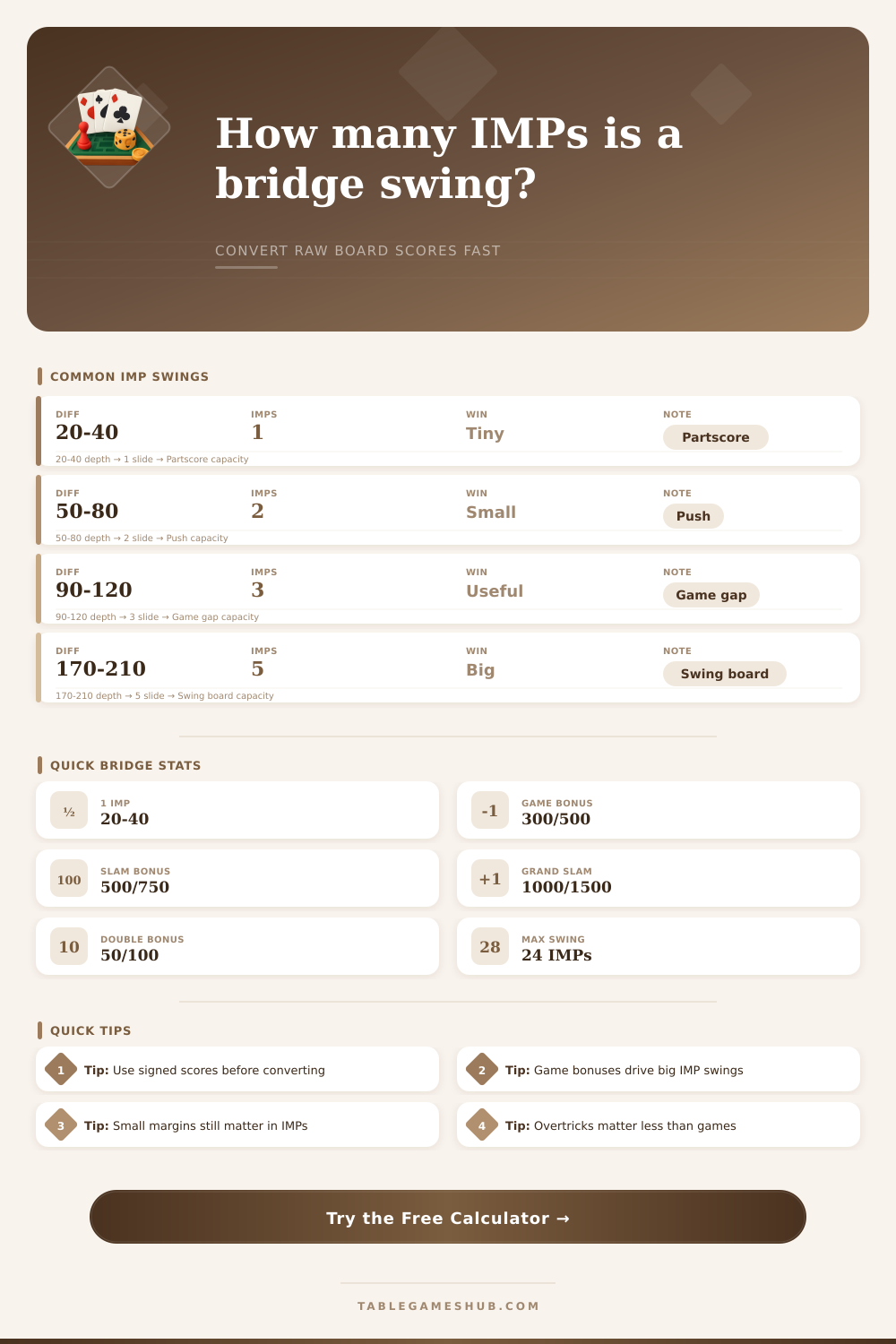
| 20-40 | 1 | Small | Partscore edge |
| 90-120 | 3 | Useful | Game swing |
| 170-210 | 5 | Big | Contract gap |
| 500-590 | 11 | Huge | Game plus bonus |
Signed scores first
Keep both board scores in the same perspective before you compare them.
Bonuses swing boards
Game and slam bonuses usually matter more than overtricks.
Compare signed bridge scores, convert the margin to IMPs, and see which board swung. Use the breakdown to check bonuses, undertricks, and game thresholds before you tabulate results.
International Match Points, or IMPs, is used as a system to calculate the difference between the raw score of two opposing bridge teams. Raw scores isnt always the most best indicator of the difference between two team. For instance, it is possible for one player to have a large difference in raw scores compared to the other player yet have a small number of IMPs between the two team.
Conversely, it is also possible for two players to have a small raw score difference yet have a large difference in the number of IMPs that each player earn; the IMP scale is based upon a non-linear scale of values for the number of points that a team receive. Thus, each IMP value represents a large range of raw scores for large point differences yet small range of raw scores for small point differences. To calculate the IMPs for each match, each player must first determine the raw score that each of their team earned.
How to Calculate IMPs in Bridge
Furthermore, each score must be calculated from the same perspective. A raw score can be either positive or negative based off which team earn the points. Players must subtract the raw score of the opposing team from the raw score of their own team to find their margin of victory or loss.
For instance, raw scores in the range of 20 to 40 point result in one IMP for the winning team, and raw scores in the range of 170 to 210 points result in five IMPs. There is a variety of different factor that can contribute to the raw score of a team during a bridge game. Some of these factor include the contract of the team, the number of tricks that is made during the hand, and the vulnerability of the players.
Each contract provide a certain base number of points for each trick, and provides additional points for each trick that is made beyond the number required to fulfill the contract. Additionally, making a game or slam in the contract can provide additional raw score point to a team. Furthermore, the vulnerability of the players changes the raw score of each of these bonuses; vulnerable players receive more raw score points for winning bonuses yet lose more raw score points with losing bonus.
Other factor for raw score differences include the doubling and redoubling of contracts. By default, a team that lose a contract by bidding undoubled will receive a small number of raw score points for losing the contract. However, a doubled or redoubled contract will result in more raw score points being award to the losing team.
These number of raw score points can be simulated with the use of presets on some bridge program. Presets allow players to simulate losing game, redoubling contracts, making sacrifices, and other action. Through these presets, players can learn of the relative value of raw score points for each of these action; for instance, by simulating losing overtricks yet winning game, a player can determine that making overtricks earn fewer raw score points than winning bonuses for a game or slam.
One of the most common error in determining raw scores and IMPs is not accounting for the score of the opposing bridge team. Each of the players score must enter the score of the opposing team into the program; if the score is entered incorrectly, the calculation of the raw score for each team will be incorrect. For instance, if the opposing team earn 400 raw points, each player must enter that raw score as minus 400 raw points.
An incorrect entry will result in the raw score of each team being calculated incorrectly, and the IMP calculation will be wrong. By using this system of calculating raw score and IMPs for bridge match, players gain a better understanding of the value of their different decision during bridge match. For instance, players learn that attempting to win overtricks in a minor suit is not as valuable as winning a game in a major suit.
Additionally, players learn that making a sacrifice when vulnerable is a more riskier strategy than making a sacrifice when not vulnerable. Using raw score and IMP calculations enable players to understand the value of each of their decision during a bridge game. An understanding of the value of each of their decisions allow each player to make better decisions during the game.
As a result of making better decisions, each player develop better results during each game of bridge that is played. Youll find that better results comes from this. It is actualy a lot of work.