Trampoline Mat Size Calculator
Calculate replacement mat size from frame shape, frame dimensions, spring length, spring count, V-ring spacing, and fabric overlap allowance.
| Nominal frame | Frame diameter | Typical springs | Approx stitch-line diameter |
|---|---|---|---|
| 8 ft round | 96 in | 48 or 56 | 83 to 85 in with 5.5 to 6.5 in springs |
| 10 ft round | 120 in | 60 or 64 | 107 to 109 in with 5.5 to 6.5 in springs |
| 12 ft round | 144 in | 72 | 131 in with 6.5 in springs |
| 14 ft round | 168 in | 80, 84, or 88 | 153 to 155 in with 6.5 to 7.5 in springs |
| 15 ft round | 180 in | 90 or 96 | 165 to 167 in with 6.5 to 7.5 in springs |
| 16 ft round | 192 in | 96 or 108 | 175 to 179 in with 6.5 to 8.5 in springs |
| Spring length | Use in calculator | Frame-to-mat gap | Notes |
|---|---|---|---|
| 5.5 in | Subtract 11 in from round diameter | About 5.5 in per side | Common on smaller round frames |
| 6.5 in | Subtract 13 in from round diameter | About 6.5 in per side | Common all-purpose replacement size |
| 7 in | Subtract 14 in from round diameter | About 7 in per side | Check hook shape and V-ring count |
| 7.5 in | Subtract 15 in from round diameter | About 7.5 in per side | Often appears on larger frames |
| 8.5 in | Subtract 17 in from round diameter | About 8.5 in per side | Used where frame gap is wider |
| Frame shape | Primary measurement | Secondary measurement | Perimeter method |
|---|---|---|---|
| Round | Outside diameter across center | Second diameter at 90 degrees | Circle circumference from stitch line |
| Square | Outside side length | Confirm equal width | Four straight sides from stitch line |
| Rectangle | Outside long frame length | Outside short frame width | Two lengths plus two widths |
| Oval | Outside long axis | Outside short axis | Ramanujan oval perimeter estimate |
| Calculated spacing | Fit signal | What to recheck | Typical result |
|---|---|---|---|
| Under 4 in | Very close V-rings | Spring count or perimeter | Often a high-count mat |
| 4 to 5 in | Common close spacing | Count every attachment point | Usually acceptable if count matches |
| 5 to 6 in | Common broad spacing | Compare old mat ring spacing | Typical on many round frames |
| Over 6 in | Wide spacing | Frame dimension and spring length | May indicate missed V-rings |
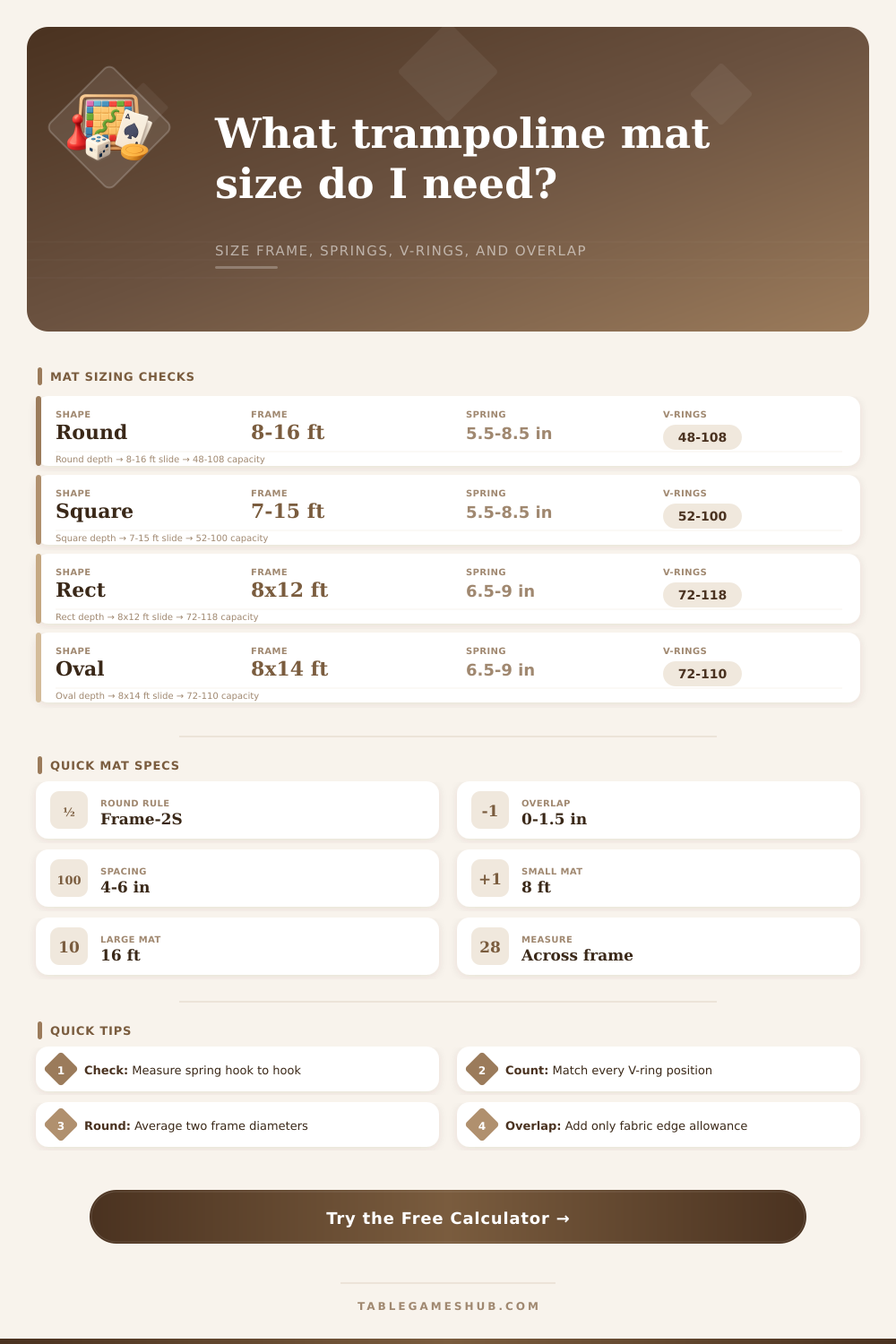
To order a replacement trampoline mat, the customer must determine the dimension of the mat. The dimensions of the trampoline frame isnt the same as the dimensions of the mat. Furthermore, the mat must be smaller than the trampoline frame because the mat must fit within the frame and an springs on the mat must hold it in place.
If the mat is too small, the mat will eventually stretch the spring until they break. Additionally, if the mat is too large for the frame, the mat will sag within the frame due to the low tension between the mat and the frame. To determine the size of the mat, it is important to understand the difference between the frame diameter and the stitch-line diameter.
How to Measure Your Trampoline Mat for Replacement
The frame diameter is the diameter of the metal frame of the mat. The stitch line is the circumference of the mat where the V rings is sewn into the mat. The stitch line is important in relation to the mat because the stitch line determines the tension that the springs on the mat create.
To calculate the stitch line diameter, a customer can use a calculator to subtract the spring gap from the frame diameter. The spring gap is the distance between the jumping mat and the metal frame. By subtracting the spring gap from the frame diameter, the customer can determine the diameter of the stitch line.
In addition to the stitch line diameter, it is important to determine the fabric overlap of the mat. The fabric overlap is the portion of the mat that extend beyond the V rings. The fabric overlap prevents the springs from rubbing against the stitching of the mat.
The fabric overlap does not impact the tension of the mat, but it does prevent the mat from fraying. When considering the total size of the mat, the customer should consider the total piece of fabric including the fabric overlap. Another important measurement is the count of the V rings on the mat.
V rings are used to allow for the even distribution of the customers jump on the mat. It is possible for mats with the same diameter to have a different number of V ring. Each different number of V rings results in a different distance between each V ring.
If the customer purchase a mat with a different number of V rings than the existing mat, the V rings will not align with the springs on the mat. This will lead to an even distribution of the customers jump on the mat. Additionally, due to the even distribution, the mat will tear.
By measuring the number of V rings on the existing mat, the customer can ensure that the purchased mat have the same number of V rings as the mat to be replaced. The length of the springs on the mat is another measurement that will impact the size of the mat. The length of the springs must be measured from hook to hook.
The length of the spring impacts the diameter of the mat that the customer requires to order. If the length of the springs is changed, the size of the mat must be changed. The length of the springs should not be measured while the springs are attached to the metal frame of the mat.
When attached to the metal frame, the tension on the springs will impact the accuracy of the measurement of the length of the spring. For rectangular or oval mats, the mathematics are more difficult to calculate than for round mats. For oval mats, the perimeter must be calculated for the mat, which is different than round mats.
For rectangular mats, the length of both the long and short sides of the mat must be calculated. A calculation tool can be used to calculate these measurements so that the mat does not bunch at the corner of the metal frame. Finally, it is important to make sure that all the measurements of the mat are accurately calculated.
If the tension of the mat is not correct, the mat will eventually tear. Furthermore, if the tension is not correct distributed even across the mat, the life of the mat will be shortened. By taking the time to measure the metal frame of the mat, the stitch line of the mat, the number of V ring of the mat, and the length of the spring on the mat, the customer can ensure that the new mat will have the appropriate size to fit the metal frame of the mat.