Washer Toss Distance Calculator
Set washer boxes by box-to-box spacing, cup-to-cup spacing, foul line rule, player mode, backyard scale, and diagonal clearance for the space you actually have.
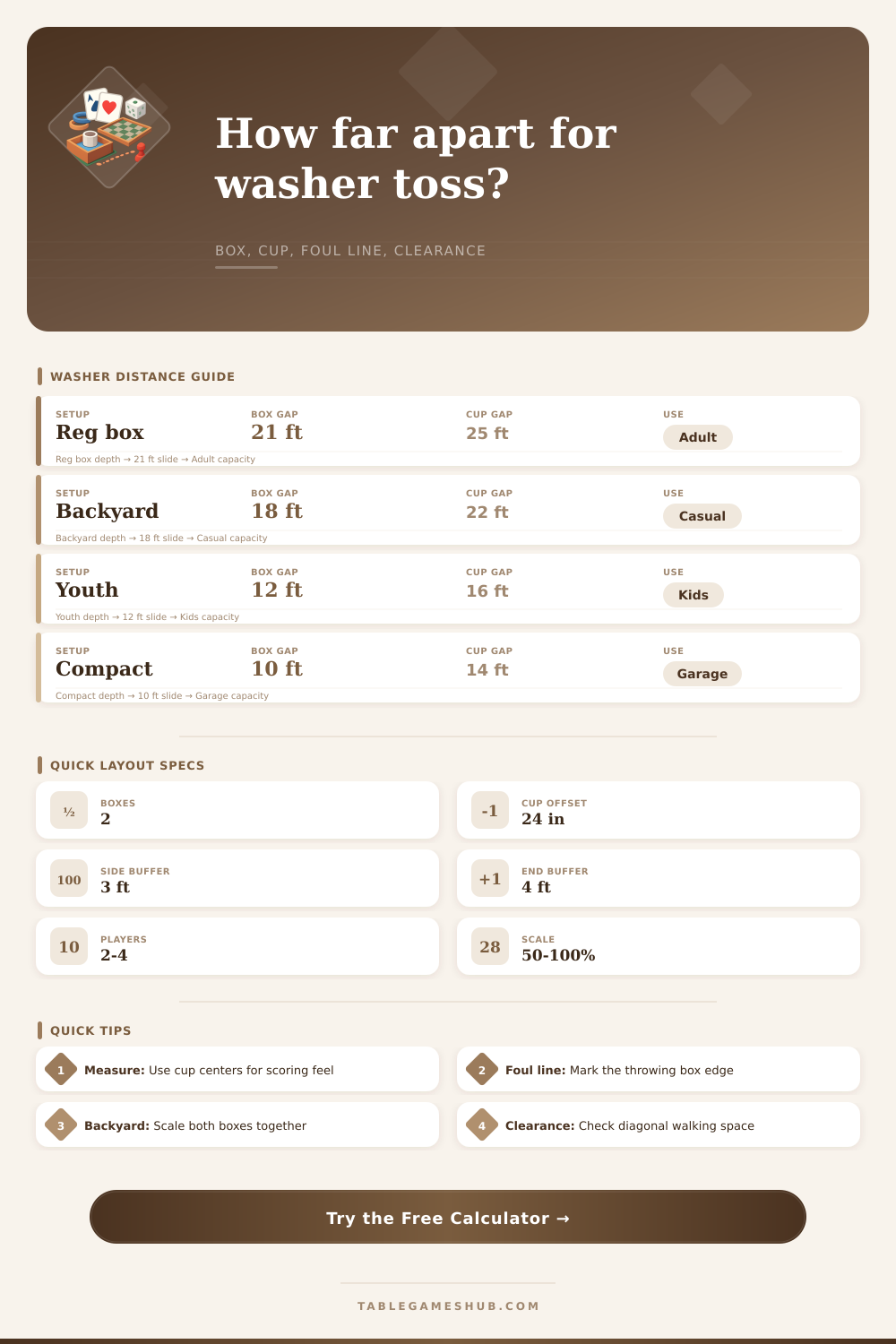
| Setup | Box-to-box distance | Cup-to-cup distance | Best use |
|---|---|---|---|
| Adult box layout | 21 ft front to front | About 23 to 25 ft | Standard backyard and league-style play |
| Backyard social | 18 ft front to front | About 20 to 22 ft | Mixed skill groups and smaller yards |
| Family lane | 16 ft front to front | About 18 to 20 ft | Casual games with shorter throws |
| Youth setup | 12 ft front to front | About 14 to 16 ft | Younger players or tight patios |
| Compact practice | 10 ft front to front | About 12 to 14 ft | Garage, basement, or solo toss practice |
| Foul line option | Reference point | Calculator effect | When to use it |
|---|---|---|---|
| Front edge | Throwing-side front of each box | Foul gap equals box-to-box distance | Most simple backyard markings |
| Cup center | Line through each cup center | Foul gap equals cup-to-cup distance | When players measure all calls from cups |
| Rear edge | Back edge of each box | Adds one box length at each end | When players stand behind the entire box |
| Custom setback | User-entered setback from front edge | Adds two setback distances | For painted lines, mats, or house rules |
| Scale result | What it means | Suggested change | Player feel |
|---|---|---|---|
| 100% or more | Full entered layout fits | Keep target distance and buffers | Normal adult throw feel |
| 85% to 99% | Slightly short after buffers | Trim box gap or end buffer | Still close to full game |
| 65% to 84% | Compact backyard layout | Use a family or youth preset | Shorter, faster rounds |
| Under 65% | Practice lane only | Use solo drills or one-box toss | Not a full head-to-head lane |
| Mode | Players at ends | Recommended side buffer | Layout note |
|---|---|---|---|
| Solo practice | 1 active end | 2 ft each side | Prioritize straight throw line and backstop room |
| Singles | 1 player per end | 2 to 3 ft each side | Cleanest setup for narrow patios |
| Doubles | 2 players per end | 3 to 4 ft each side | Allows partners to stand clear of throws |
| Rotation group | Variable queue | 4 ft or more each side | Add walking room near both boxes |
The distances between the boxes is a critical factor in playing the game of washer toss. The distance between the boxes determine the difficulty of the game. If the distance between the boxes is too large for the players, then it becomes a long range game that is difficult to play.
However, if the distance is too small between the boxes, then the skill gap between players are too large, and it becomes difficult for players of all skill levels to compete against each other. The distance between the boxes also dictates the length of the game and the layout of the yard in which the game is played. Washer Toss Yard Calculator provide mathematical calculations after you input the available space in the yard and the preferred style of measurement for the game of washer toss.
Choose the Right Distance Between the Boxes
The yard calculator will calculate the distance between the boxes (box to box gap), the distance between the cups (cup to cup gap), and the distance from the foul line to the center of the boxes (foul-line distance). The yard calculator will also tell you whether the yard has enough length and width to play the game, as it requires space for standing room for players to stand behind the box. Many groups use a default adult preset in the yard calculator that sets the distance between the boxes to 21 feet.
This distance works well for experienced players who can arc the washer to clear the 21-foot distance without using a large windup to throw the washer. The 21-foot distance also ensures that the game continues as the missed washers will land near the box. However, this distance can be difficult for people who have never played the game before.
For this reason, people use a backyard preset at 18 feet to make the game more easier for new players to the game of washer toss. The location of the foul line also affects the way that people play the game. The foul line determines where the player must stand when throwing the washer.
You can measure the foul line from the front edge of each box. This is one of the simplest ways to measure the foul line as all players will stand in the same place. An alternative foul line measurement is from the center of the cup.
This alternative foul line rewards players who have precision when throwing the washers. The yard calculator allows players to change between these two foul line settings to calculate the effect on the distance measurement. Another factor in setting up the game is the placement of the cup inside the box.
The distance of the cup from the front edge of the box determines if it is close to the player or deep into the box. Placing the cup deep into the box requires the player to arc the washer more to get it over the cup. Deeply placed cup also rewards players who use touch to place the washer into the cup instead of relying on the strength of the player.
A cup placed close to the front edge of the box creates the feeling of a larger target for players. This also makes the game move faster as players can arc their washers more. The size of the backyard may require players to change the scale of the game.
If the available space in the backyard is shorter than the standard distance between the boxes, the percentage will be less than 100 percent. A percentage of 85 percent means that the scale is relatively normal for most backyards. However, a percentage of 65 percent means that the yard for washer toss will be somewhat different than the standard game.
The scale will change the way that the game moves as the throws between boxes will be shorter and the round will last less time. Some players use a smaller scale when they are warming up before playing but others consider this to be a different game to washer toss. The number of players will also affect the amount of space for the game.
Four players in doubles mode will require more space on the sides of the yard than two players in singles mode. This space is for the players’ partners to stand in areas that do not interfere with the players’ washers. The larger the group of players, the more space that will be required on the sides of the yard for the next player in line to stand in an unobstructed view of the playing players.
The yard calculator takes these factors into consideration when players select the number of players and the total headcount for the game. Another measurement to consider when setting up the game is the diagonal distance of the yard. Many groups often forget this measurement when preparing for the game of washer toss.
The diagonal distance will tell players if the yard will create a bottleneck of players when turning the corner to continue playing. If the diagonal distance of the yard is tight between the boxes, it will be difficult for the players to move around without breaking their rhythm when playing the game. If the diagonal distance of the yard is comfortable for the players, they will be able to easily pass each other during the game.
This distance will also determine whether the yard feels open or if it may feel cramped when playing the game. A good way to test the yard for washer toss is to mark the foul lines and the boxes and play a complete round of the game. If the players find that the throws are too easy or too difficult to complete the rounds, then the distance between the boxes is likely not correct for the group of players.
By adjusting the distance by one or two feet, the players can test that distance to see if it is more suitable for the individuals in the group. The yard calculator will provide the measurements for players to use when setting up the game of washer toss and the safety checks to ensure that players will have enough space to play. However, the players will have to make the decision of whether or not the distances between the boxes are correct for their group of player.