Viscounts of the West Kingdom Calculator
Total a final score across constructed buildings, castle workers, manuscript ribbon sets, printed manuscript bonuses, castle and cleric cards, debts, deeds, and poverty or prosperity rankings.
Choose a game shape, then overwrite any field with the values on the player board, manuscripts, and revealed kingdom cards.
Constructed Buildings
Castle Workers
Ribbon Sets
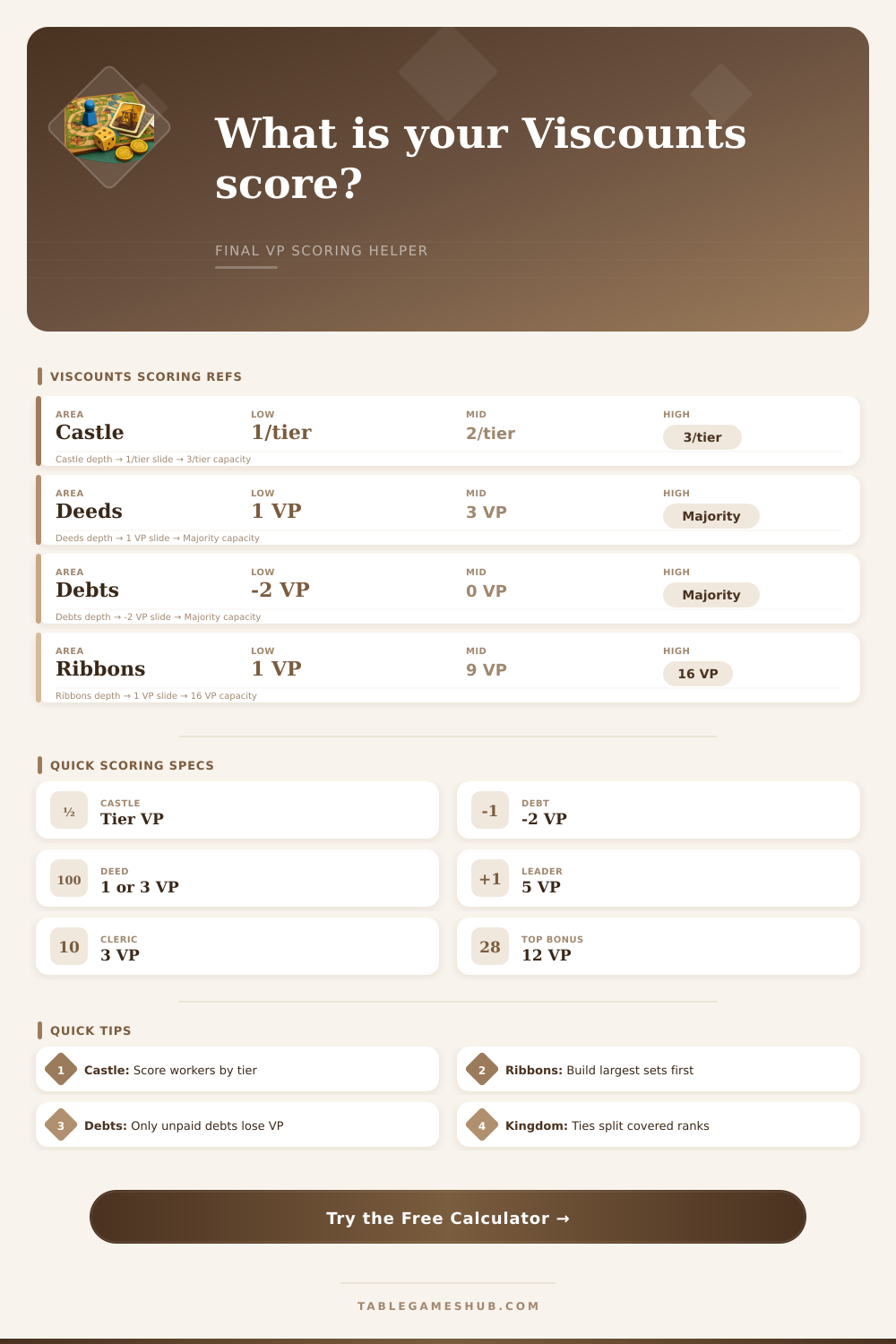
Sets are optimized as largest different-color groups first: 4 colors = 16 VP, 3 colors = 9 VP, 2 colors = 4 VP, 1 color = 1 VP.
Printed Manuscript Bonuses
Your Debt and Deed Cards
Other Players for Tie Splits
| Area | Input to Count | Scoring Rule | Calculator Field |
|---|---|---|---|
| Constructed buildings | Printed VP above empty building spaces | Add the revealed VP totals | Trading post, workshop, guildhall VP |
| Castle workers | Workers still in castle tiers | Tier 1 = 1 VP, tier 2 = 2 VP, tier 3 = 3 VP | Tier worker counts |
| Manuscripts | Ribbon sets and printed bonuses | Set value is different colors squared | Ribbon and printed manuscript fields |
| Cards | Castle leader and cleric bonuses | Leader is 5 VP; cleric bonus cards are 3 VP each | Castle leader and cleric cards |
| Card Type | Unflipped Side | Flipped Side | Kingdom Bonus |
|---|---|---|---|
| Debt | Unpaid debt scores -2 VP | Paid debt has no penalty | Prosperity ranks flipped debts |
| Deed | Acquired deed scores 1 VP | Approved deed scores 3 VP | Poverty ranks flipped deeds |
| 3-4 players | At least one flipped card required | Ties share covered ranks | 12, 8, and 4 VP levels |
| 2 players | Middle reward ignored | Ties still split covered ranks | 12 and 4 VP levels |
| Different Ribbon Colors | Set VP | Example Use | Calculator Method |
|---|---|---|---|
| 1 color | 1 VP | Single leftover manuscript | Counts after larger sets |
| 2 colors | 4 VP | Two-color partial set | Pairs one of each color |
| 3 colors | 9 VP | Official example size | Scores as 3 squared |
| 4 colors | 16 VP | Complete different-color set | Built before smaller sets |
Use printed values: Building and special manuscript VP depend on what you actually revealed or collected, so the calculator keeps those entries editable.
Check kingdom ties: Enter every opponent's flipped deeds and debts before trusting the poverty or prosperity bonus, because tied ranks split the VP bands.
Until the end of Viscounts of the West Kingdom, counting victory points are an exercise in faith. Workers is on the tiered castles, ribbons cover manuscript boards, and debt cards is piled up. These cards either reward or punish you based off which kingdom card flips over at the very last minute. It is beautiful chaos.
When the final round closes, it all becomes arithmetic. That’s where the calculator comes in. It crunches your board state, converting what was beautiful chaos into a definitive score. Can you see now if your strategy paid off? Or were you simply lucky to get high roller worker placement?
Calculating Your Final Score
Viscounts’ central conflict involve gathering long term points while under short term financial pressure. In the beginning of the game you’re scrambling to pay down debts lest they cost you two points per unpaid card. If you play aggressively that adds up fast. Eventually though, it’s not about damage control anymore, it’s about gaining points. That’s when your castle worker come into play. They are engine. Tier one workers are nice, but tier three workers is where it’s at. They’ll pump out the points. You can plug into the calculator exactly how many workers is on each tier (and account for the resource/timer cost for shuffling someone around) and see if all the points built at the workshop was worth neglecting your castle.
The next level of complexity come in the form of manuscripts, those sets of colorful ribbons that trip up beginners. They’re not just decorative: each represent a set. Two two-color sets aren’t as good than one four-color set (which is worth sixteen). That’s why it pays to eyeball your collection of ribbons at some point before the last round. Which sets could you reasonably hope to fill in? What do you have an abundance of? The payoff table on the page spells this all out, but thinking ahead will help you make right call.
If you’ve got mostly blue and gray ribbons, for example, trying to chase down a fourth color may be a fool’s errand. Tossing together a nice three-color set is often more wise than risking piecemeal results that will net little or nothing.
This is when the game really moves away from optimizing yourself alone into optimizing everyone else around you. You know how poverty/prosperity flip the value of all your debt/edeed? It does that for everyone too. Want deeds that gets approved? Then poverty is good for you. Want debt that you’ve already paid back? Then prosperity is good for you. To find out if you’re first, the calculator will ask which cards your opponents has flipped over and how many. Did you tie? Then you split the victory points with those who tied with you. Did you think you were first but found out you tied with two other people? Your expected 12 points just dropped a lot.
The virtue and corruption mechanics is tied to decks as well. Every card with a criminal on it adds corruption when it comes out during a shuffle check. You don’t score for this directly. Instead, it tracks your moral standing. How this affects end game scoring will depend on which kingdoms are set up. There is a little bit of pressure here reminding you to keep your deck pure, or to decide if you want to deal with these negative events.
And at the end of the day, that’s what Viscounts is all about: managing several engines together. No longer can you zone out on one thing while ignoring another. With Viscounts, you get a view of how well you’re doing across each area. It removes the uncertainty of having to juggle between two or three scoring sections and gives you a number that represents your strategy. Did you go heavy on debt? Go with manuscript sets? Play it safe with construction? What you’ll see is whether going in that direction was right given that particular game state. That snapshot will help you focus for your next try, making guesses a thing of the past, replaced by calculated risk.