Tuscany Score Calculator
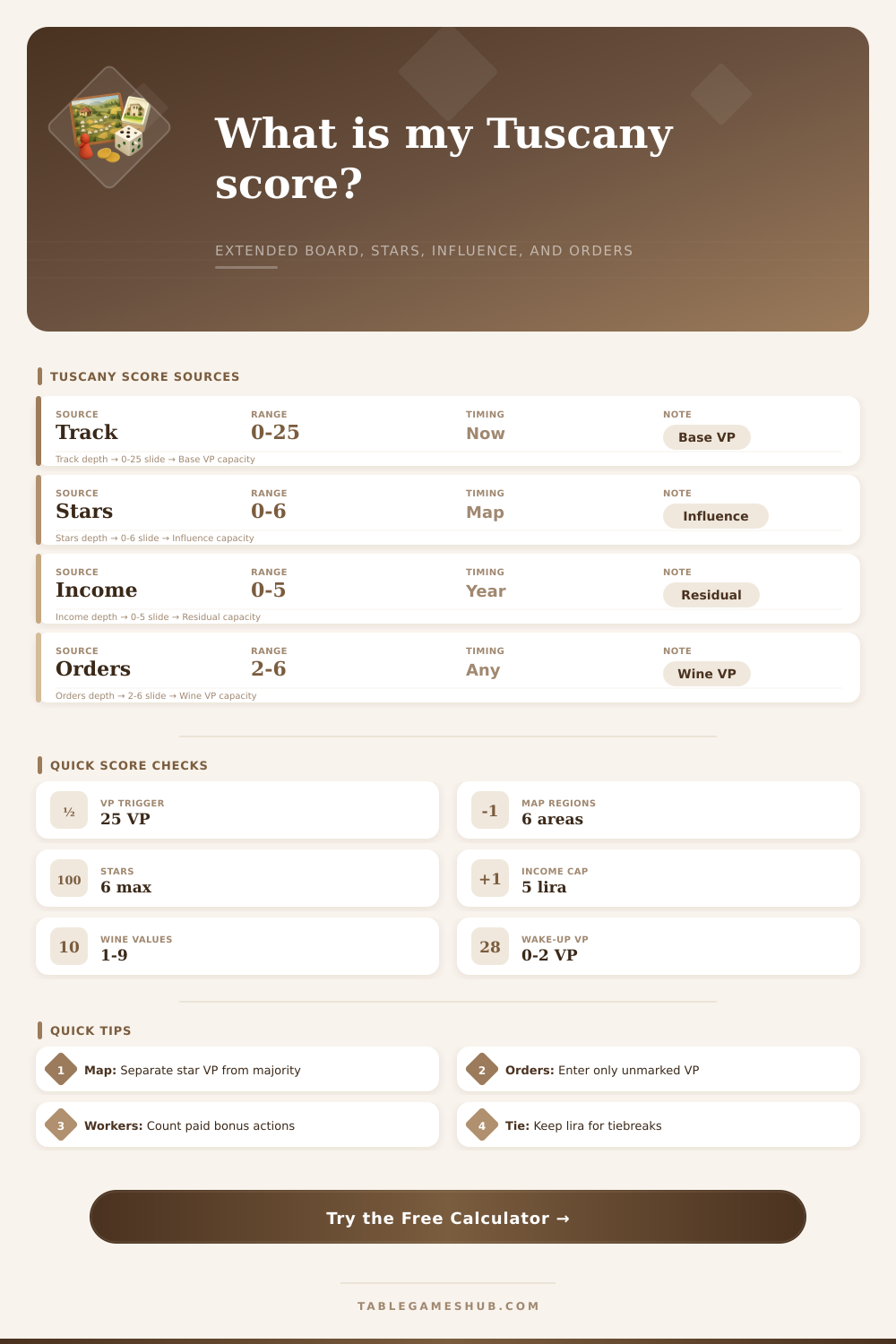
Total a Viticulture Essential Edition table with Tuscany extended-board points, structure cards, special workers, influence map stars, wine orders, residuals, and tiebreak position.
| Tuscany Source | Calculator Field | Score Timing | Counting Note |
|---|---|---|---|
| Wake-up chart VP | Wake-Up Chart Bonus VP | Start of year | Enter only if the VP is not already on the track. |
| Trade and extended actions | Extended Board Action VP | Season action | Useful for action spaces that convert cards, grapes, wine, or lira into VP. |
| Structure cards | Structure Card and Building VP | Built or final | Use printed VP, endgame structure conditions, and structure-triggered point gains. |
| Special workers | Special Worker Bonus VP | Worker action | Count bonus VP from worker abilities or spaces enabled by a worker choice. |
| Wine orders | Unrecorded Wine Order VP | Fulfill order | Do not double count points already moved on the VP track. |
| Map Item | Typical Range | Calculator Estimate | Use When |
|---|---|---|---|
| Regions with your star | 0 to 6 | 1 VP each | You want a quick spread value for board-control pressure. |
| Region majorities | 0 to 6 | 2 VP each | Your final star count is ahead in a region. |
| Star tokens placed | 0 to 6 | 1 VP per 2 stars | You need a conservative value for map reach and bonus access. |
| Opponent pressure | Table based | Shown in recommendation | Use the leader comparison to decide whether map points are enough. |
| Item | Range | Score Effect | Calculator Treatment |
|---|---|---|---|
| Wine order VP | 2 to 6 per card | Direct VP | Added to projected score when not already marked. |
| Residual income | 0 to 5 lira | Future lira | Projected into tiebreak total, not direct VP. |
| Lira on hand | 0 or more | Tiebreak | Combined with remaining residual income. |
| End trigger gap | 0 or more VP | Tempo signal | Shows how many VP remain before the chosen threshold. |
| Module Focus | Main Input | Best Result Card | Score Risk |
|---|---|---|---|
| Extended board actions | Extended Board Action VP | Tuscany Add-On Points | Double counting VP already moved on the track. |
| Influence map | Regions, majorities, stars | Influence Map Estimate | Overvaluing stars that do not win regions. |
| Structure cards | Structure Card and Building VP | Projected Final Score | Missing final-condition structure points. |
| Special workers | Special Worker Bonus VP | Tuscany Add-On Points | Counting ability setup instead of actual VP. |
| Residual engine | Residual level and harvests | Projected Lira Tiebreak | Treating lira income as victory points. |
Scoring a game of Viticulture with the Tuscany expansions is different than scoring a game of the base Viticulture. The Tuscany expansion include new ways to earn points, such as an extended board, the influence map, and the structure card. While many players keep tabs on their order points and the actions they earn on the extended board, they often fail to track the others ways to earn points from the Tuscany expansion.
Therefore, to ensure that a player dont count the same points twice in there score, it is necessary to keep track of each of these separate bonuses from the Tuscany expansion. The inputs in the calculator represents these different types of points from the Tuscany expansion. The number in the top victory point box represents the total of all of the victory points that have already being scored.
How to Count Points in Viticulture with the Tuscany Expansion
Each of the other fields in the calculator represent the point that have yet to be scored. For example, the wine order points slot represent the wine order points that players have not yet moved, the structure bonus field accounts for the bonus points from structures that have yet to be scored at the end of the game, and the worker upgrade slot include the points from workers that have been upgraded for extra actions. Each of the influence regions account for the star that a player has placed on the influence map; however, only the stars that earn a majority in each region for each player earn those points.
Thus, the separate inputs for influence points allow for the total number of victory points to accurately be reflected in the calculator rather than counting the potential points that may appear impressively for players in the game. The residual income for each game is different from the victory points that is earned in the game. Any lira that is earned each year will contribute to the tiebreak for the game; therefore, residual income is not scored as victory point.
However, players that score a few points less than their opponents will often still win the game due to having more lira at the end of the game. Thus, the calculator will account for the residual income and the number of harvest yet to be completed, as will the amount of lira that each player has on hand. This will determine whether a players engine will provide substantial lira for the tiebreak.
The number of players in the game can change the value of the inputs in the calculator. For instance, if there are five or six players in the game, the chance of earning points from the wake-up chart increase. The value of each star in the influence map also increase if there are five or six players competing for the same region.
Both of these variables can be altered in the calculator for adjustment to the suggestion from the calculator based off the actual number of players in the game. Some of the most common error in scoring for games of Viticulture and the Tuscany expansion include earning structure points prior to meeting the condition for earning those points. Another error is scoring influence points without verify that the players have a majority of stars in each region.
Finally, one of the most common error is scoring residual lira as victory points when the residual lira is actualy scored for the tiebreak. Each of these error are flagged by the calculator due to the fact that each type of point is accounted for on its own line. Thus, players will be able to more easy recognize if their score is based upon assumption rather than calculated points.
The setting for the end trigger is another variable that can change the goal for the game of Viticulture and the Tuscany expansion. Since the game often continues past scoring twenty points, if the goal is set at twenty-five or thirty points, the score will change how players pursue their points for influence and order. By using the calculator, players can determine the gap between their score and their goal for the game.
Each of the component of the game, whether measuring the value of the map, the structures, the players’ workers, or even the residual engine, all contribute to the final score for each player. However, each of these components earn those points at different rate or schedules. The calculator makes each of these schedules visible to the players to assist in their decision making during the game.