Village Score Calculator
Total final prestige from the score track, village chronicle, anonymous graves pressure, travel, council chamber, church, market customers, coins, craft inventory, family members, and time.
🎯Village Score Presets
Score Breakdown
📝Score Track, Family, and End Trigger
🧭Travel, Council, and Church
🛒Market, Crafts, Coins, and Goods
🧩Village Scoring Grid
📊Reference Tables
| Scoring source | What to count | Point ladder | Calculator field |
|---|---|---|---|
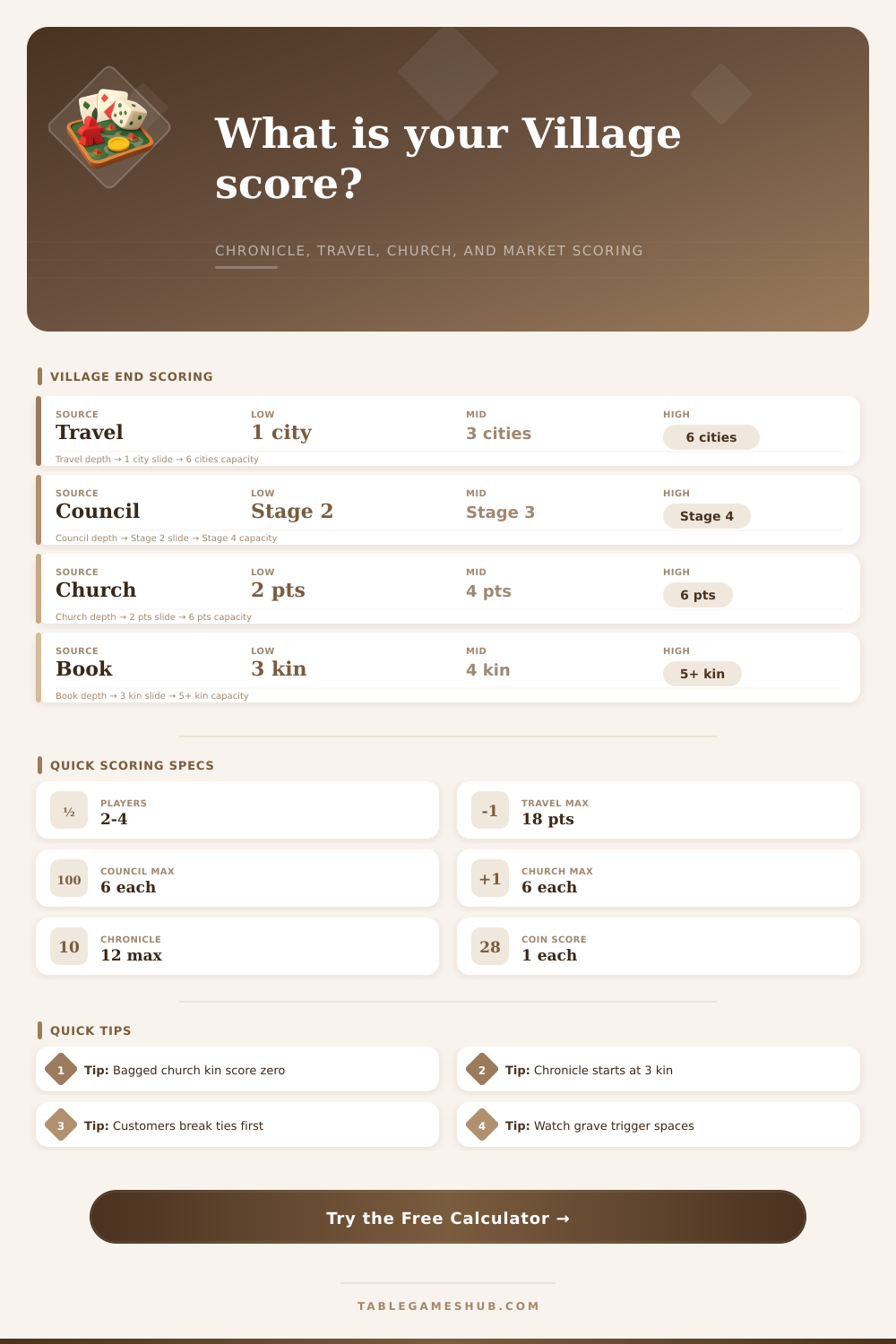
| Travel | Different cities visited by your family | 0, 1, 3, 6, 10, 14, 18 | Travel cities visited |
| Council chamber | Family on stages 2, 3, and 4 | 2, 4, or 6 points each | Council stage member counts |
| Church | Family drawn from bag and moved into windows | 2, 3, 4, or 6 points each | Church window positions |
| Village chronicle | Your dead family recorded in the book | 0 for 1 to 2, 4 for 3, 7 for 4, 12 for 5+ | Your family in chronicle |
| Customer tiles | Printed prestige on served market customers | Use tile values exactly | Market points and customer count |
| Coins | Unspent coins after final scoring | 1 point per coin | Unspent coins |
| Endgame item | Scoring impact | Trigger impact | Audit note |
|---|---|---|---|
| Anonymous grave | No prestige points | Can trigger the game end when full | Track separately from chronicle entries. |
| Family in black bag | Scores zero in church while still bagged | Can still appear in final mass | Enter only drawn family in church windows. |
| Craft goods | No direct end points | May support final market or travel | Use craft inventory as a readiness check. |
| Time marker | No direct end points | Forecasts additional deaths before scoring | Passing the bridge causes an oldest visible family member to die. |
| Living family | No direct end points | Second tie breaker | Count farmyard, board, and church, not dead members. |
| Preset | Main lane | What it checks | Best manual audit |
|---|---|---|---|
| Market Closer | Customers and coins | Printed tile points plus tie breaker count | Verify all customer tiles were actually served. |
| Travel Family | Six-city travel ladder | Travel reward threshold and wagon readiness | Count city markers, not current traveler position. |
| Church Elders | Final mass scoring | Church windows and bagged family warning | Move family with grain before entering final church values. |
| Chronicle Rush | Book threshold scoring | Chronicle count and category pressure | Confirm the right professional category had room. |
💡Scoring Tips
In most board games, a supply eventually runs out, or a player hits some kind of point threshold and that’s it, game over. In Village, somebody dies, and that’s what ends the game. That shift in perspective alter your strategy on every single turn. It’s no longer about simply accumulating points; it’s about managing risk. No, you’re not just creating an empire; you’re attempting to ensure your family line survives long enough to enjoy spoils. For many, the last scoring round is agonizing as they juggle competing desires to expand while also staying alive.
Once you input your current state, the calculator does all of the work for you (above) and spares you the embarrassment of rifling through rulebook with everyone watching. Where the true strategy lies are understanding why some of these variables is weighted differently. For example, the Village Chronicle is an old-school threshold scoring engine. It’s depth vs. Breadth, if you only have one or two people listed in book, you’ll get zero out of it. Three is minimum required to gain anything from this kind of investment. And therein lies the psychological trap: Players will often scramble to populate those spaces early, then find themselves with nobody left to fill out elsewhere. Mostly it’s just knowing what it is that you’re supposed to be measuring. Because it isn’t “who has the most dead bodies?” so much as “how do I hit these numbers without destroying my productive workforce?”
How to Win at Village
Should there of points for anonymous graves? No. They’re just there to tick away at you. They don’t provide any direct prestige, so many novice player blow past them. This is a grave (heh) error. They force you to make tough decisions about which workers stays on the board and which ones get tossed in hole. You’ll be forced to evaluate short-term benefits of having another worker versus long-term potential of accidentally blowing up your engine before you’re ready. Small details matter, and this is one that has a big impact on the pace of the game.
This is one area where travel pays off more different than others. The ladder for points in cities visited is pretty steep. Moving from five cities to six really pushes your score upward. This encourages sending out your family members early and often. This means taking a trade-off between depth and breadth, accepting that some of them may not help elsewhere on the board. Do you prefer to have lots of family member who do a little bit here-and-there? Or would you rather have just a few agents who specialize and hit high-value targets? The calculator shows you how much benefit you get for each additional city, but it can’t show you whether giving up market presence in order to get that travel point was worth it.
Ultimately, however, it’s market customers who provides immediate feedback, and in fact they’re the definitive tiebreaker: Two players may have equal prestige, but whoever has been fed by more customer triumphs. That’s a twist of bargaining and social interaction that isn’t present with straight point-grubbing alone. If you’re ahead in points, for example, you might prefer your rival grab a big-point customer and run themselves out of position with their own coin.
Coins are easy; think of them as a reserve tank. Sometimes it’s better not to spend all your coin, even on small gain opportunities, partcularly when the end game looms. The winner’s determined by chance and the timing of your family member being selected out of the bag at the end of the mass. All those remaining in the bag get no points (zero). This makes it a true guessing game right up to the last second, and no one knows who will win then. There is no mathematically certain winner early in the game.
Best bet… Play both sides: even splits between guaranteed points on the board vs. High reward chances with drawing from church windows. There’s no such thing as maxing out any one category without putting yourself in a bad position. You have to learn to go on offense when it makes sense and defend when necessary. At the end of the day, the tools can tell you what the price tag will be, but being able to know what to do will come with time at the table. Take enough trades, keep everyone alive, and cross your fingers that at the end of the day, the market moves in your favor.