Underwater Cities Score Calculator
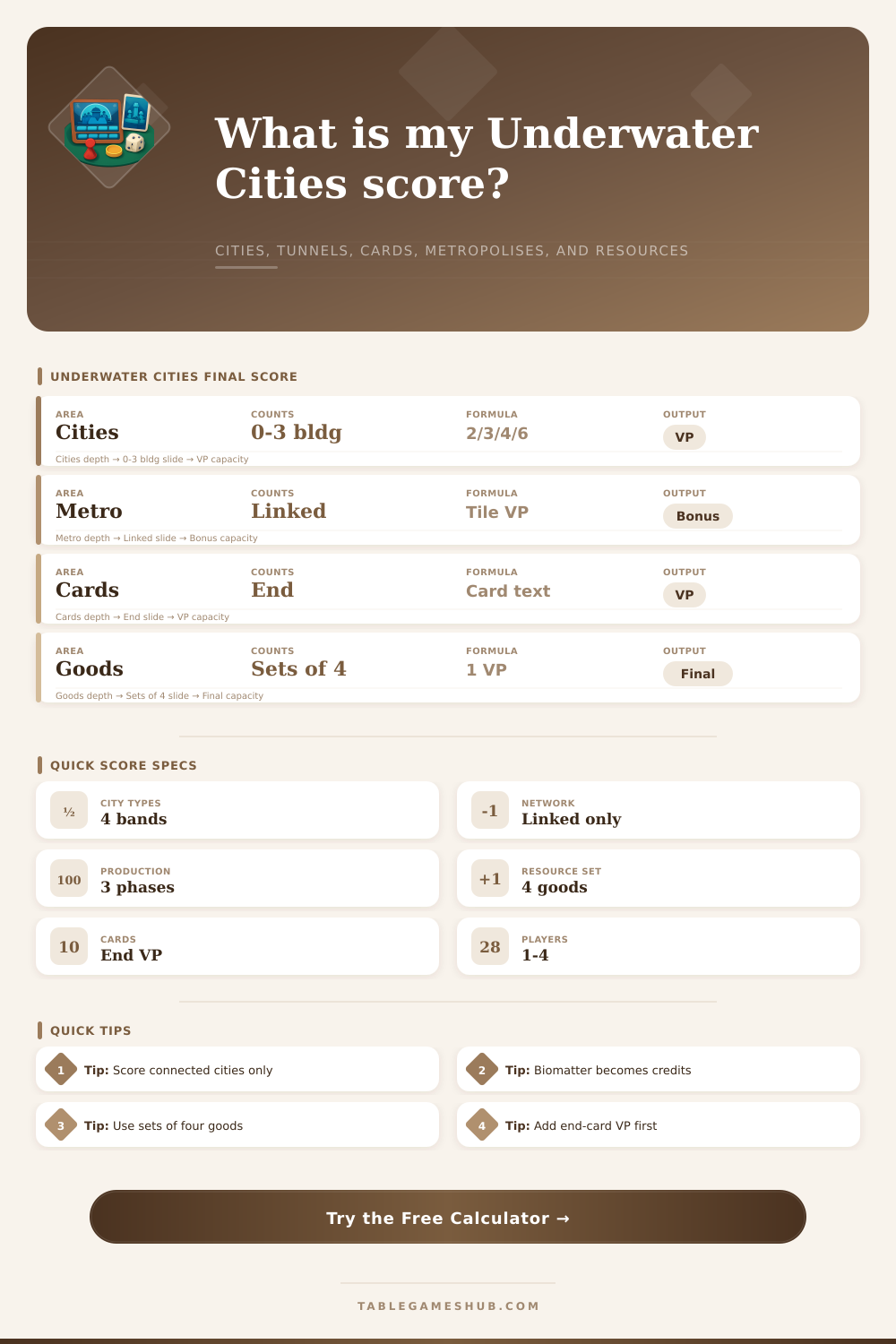
Score connected domes, tunnel links, city-adjacent buildings, metropolises, end-scoring cards, production points, and leftover resource conversion.
| Connected City Category | Adjacent Building Variety | VP Each | Calculator Field |
|---|---|---|---|
| Bare connected city | No farm, lab, or desalination type | 2 | Connected Cities with No Adjacent Buildings |
| Single-support city | One of the three building types | 3 | Connected Cities with One Building Type |
| Dual-support city | Any two different building types | 4 | Connected Cities with Two Building Types |
| Complete-support city | Farm, laboratory, and desalination plant | 6 | Connected Cities with Farms, Labs, and Desalination |
| Resource Counter | Scoring Step | Conversion | Calculator Treatment |
|---|---|---|---|
| Biomatter | Convert before final goods | 2 credits each | Adds to credit pool first |
| Credits | Final resource pool | 1 item toward set of 4 | Credits plus biomatter credits |
| Kelp, science, steelplast | Final resource pool | 1 item toward set of 4 | Added with credit pool |
| Leftover remainder | After complete sets | No VP | Displayed in breakdown |
| Endgame Source | Typical Count | Rule Hook | Input Strategy |
|---|---|---|---|
| Final-scoring tile | One personal tile | Connected upper-left metropolis condition | Include in metropolis VP |
| Metropolises | Brown, blue, or gained tiles | Only linked metropolises score | Use printed or awarded VP |
| End-scoring cards | Variable | Card text can reward structures or resources | Enter total card VP after spending |
| Special card award | Optional card condition | Some cards reward paid Special cards | Use estimator or direct card VP |
| Board Profile | Strong Inputs | Risk Check | Expected Score Shape |
|---|---|---|---|
| Production-heavy | Final production, upgraded buildings | Enough kelp after feeding | High score-track VP before final |
| Metropolis route | Metropolis VP, tunnels, seven cities | Disconnected tile routes | Large endgame bonus bump |
| End-card focus | Card VP, special cards, resources | Resources spent before conversion | Spiky final scoring total |
| Resource finish | Credits, kelp, science, steelplast | Remainders below sets of four | Efficient conversion closure |
The final scoring phases for the game of Underwater Cities occur after the construction phase is over and when the scoring phase begin. During the scoring phase, the game board isnt being use to construct buildings, but becomes an ledger on which to calculate the game scores for that round. Each player must look at the game board to determine how many connected dome exist on the board, how many tunnels connects those domes, and how many of the player’s constructed buildings is located adjacent to those cities.
The final score for each player is not determined by the number of buildings that the player constructed during the game, but by that players score for how well those buildings worked together when the game ended. In order to calculate a player’s score for connected buildings, players must input the number of cities that exists within each band of building variety within the score calculator. Players’ scores will reflect the number of different type of buildings that are adjacent to each player’s cities.
How to Score at the End of Underwater Cities
Players earn the least amount of point for a bare city (one with no other buildings adjacent to it). Cities that have one type of supporting building earn more points than players with bare cities. Players that have cities with two types of supporting buildings earns more points than those with cities and one type of supporting building.
For instance, if a city is adjacent to a farm, a laboratory, and a desalination plant, that player will earn the most highest score for those cities because there are three different building varieties adjacent to those cities. The score calculator dont require a player to select the types of buildings adjacent to each player’s cities; it only require that the player selects the number of varieties of those buildings. The rules regarding the resource pool reflect certain logic when applied to the conversion of biomatter.
Any remaining biomatter within each player’s resource pool must first be converted into credits prior to counting how many set of resources a player has accumulated. After the player converts biomatter to credits, the player’s remaining credits, kelp, science and steelplast must be group into sets of four. Each set of four resource types earns the player one point in the scoring phase.
Any resources left over after the formation of complete sets of four do not earns the player any points. The score calculator performs this biomatter-to-credit conversion automatically. Additionally, the score calculator also reflect for each player whether they should of spent their biomatter on building cards during the game.
The placement of the metropolises and end-scoring cards within the score calculator are separate from the score calculator for several reason. Each player earns points for each connected metropolises within their network. Each connected metropolis provide printed points to the player, as well as provides any additional point bonus for each specific type of tile that the player has placed as part of that network.
Additionally, each player earns points with their end-scoring cards based on the number of their buildings are upgraded, the number of tunnels within the player’s network, or the number of each type of resource that the player has collected. By separating the value of metropolises and end-scoring cards from the base score calculator, the player can determine whether their score is the result of long-term planning of their cities, or the result of the conversion of their leftover biomatter into credits. Each player must score their cities for the number of food units that each player has constructed within their cities.
Each city without food earn a player a point. Though each point is small, if a player has a large number of connected cities without enough food to feed each citys population, that player can earn a significant number of points. By placing a field within the score calculator for the number of cities without food, players can use the calculator to determine if they have enough food unit to supply each city with food.
Many players may focus on the game’s production phases and their reading of the text of the various types of building cards. However, players often forget that the player’s score also includes the resources that they have not spent on buildings. A player’s remaining resources are only valuable if they can earn complete sets of four of each type of resource.
Additionally, the player’s spending of their resources on building cards is only valuable if those cards score a player more points than if the player had created complete sets of four of each resource. Thus, the score calculator is useful for each player in that it makes the value of both spending and not spending player’s resources visible at the same time. Finally, another use of the score calculator is that it forces each player to view each of the categories of scores that are calculated for each player.
Each score calculator force players to view their network score, bonus score, credit score, and penalty score for cities without food. Each player’s ability to view each of these scores in one place allows each player to view which portion of their strategy earned them the most points in the game, and which portion of their strategy merely supported there high score.