Champions of Midgard Calculator
Total final Glory from defeated enemies, monster color sets, Destiny Cards, Rune cards, private ship journeys, coins, favor, and cumulative Blame.
▶Score Presets
Pick a scoring shape, then adjust your exact card Glory and endgame bonuses.
⚙Glory Inputs
▣Enemy Sets and Endgame Bonuses
▦Component Grid
☷Final Scoring Reference
| Score Area | Calculator Input | Scoring Rate | Important Note |
|---|---|---|---|
| Glory track | Current Glory track | Entered value | Use the track total before endgame scoring. |
| Trolls, Draugr, Monsters | Printed enemy Glory fields | Printed card values | Separate fields make battle sources easier to audit. |
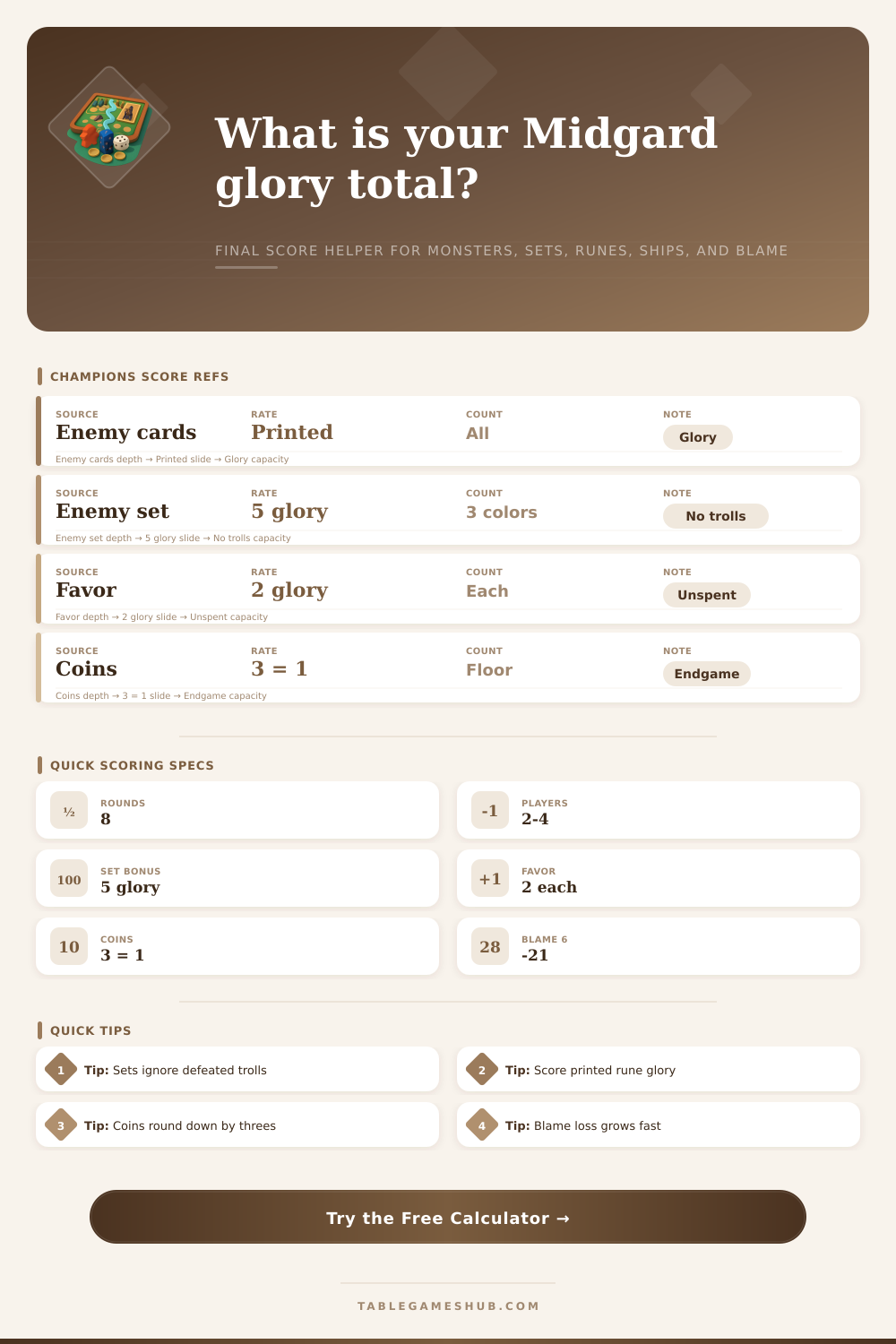
| Enemy color sets | Red, blue, yellow enemy cards | 5 Glory per complete set | Use the lowest of the three counts; Trolls do not complete these sets. |
| Destiny Cards | Full, tied, and full value | Full value or half value | Half value is rounded down for tied Destiny scoring. |
| Rune Cards | Printed Rune Glory | Entered value | Add only endgame Glory printed on Rune cards. |
| Private Longships | Private ship Glory | Entered value | Use card text or expansion scoring if a ship awards Glory. |
| Favor | Unspent Favor tokens | 2 Glory each | Spent Favor does not score. |
| Coins | Remaining coins | 3 coins = 1 Glory | Round down after dividing by three. |
| Blame | Blame tokens and mode | Cumulative loss | Standard loss is triangular: 1, 3, 6, 10, 15, 21. |
⚔Enemy and Journey Tables
| Category | Where It Scores | Use In Sets? | Calculator Handling |
|---|---|---|---|
| Trolls | Printed card Glory and Blame control | No | Enter their printed Glory separately from color set counts. |
| Draugr | Printed card Glory and rewards | Yes, if color matches | Add Glory to Draugr field and count color icons for sets. |
| Distant Monsters | Printed card Glory and ship rewards | Yes, if color matches | Add card Glory to Monster field and count color icons for sets. |
| Journey Cards | Before distant Monster combat | No | Use journey penalty only when your table scores a failed trip adjustment. |
| Private Longships | Endgame ship scoring | No | Enter the ship Glory directly in the private ship field. |
−Blame Ladder
| Blame Tokens | Standard Loss | Mistrust Variant Loss | Flat Audit Loss |
|---|---|---|---|
| 0 | 0 Glory | -1 Glory | 0 Glory |
| 1 | -1 Glory | -3 Glory | -1 Glory |
| 2 | -3 Glory | -6 Glory | -2 Glory |
| 3 | -6 Glory | -10 Glory | -3 Glory |
| 4 | -10 Glory | -15 Glory | -4 Glory |
| 5 | -15 Glory | -21 Glory | -5 Glory |
| 6 | -21 Glory | -28 Glory | -6 Glory |
⛵Ship Journey Preset Ranges
| Journey Profile | Completed Trips | Common Glory Range | Calculator Use |
|---|---|---|---|
| Single distant shore | 1 | 8 to 16 Glory | Add defeated Monster Glory and any private ship Glory. |
| Two-ship finish | 2 | 18 to 32 Glory | Use completed ship count to audit your final route. |
| Heavy sea strategy | 3 or more | 30+ Glory | Check Destiny, Rune, and set overlap carefully. |
| Failed voyage | 0 or partial | 0 card Glory | Only use journey penalty when your table records one. |
✦Calculation Tips
The final round in Champions of Midgard is calculated carefuly. After eight rounds of fighting draugr and trolls, it’s time to tally up your resources. Luckily, the calculator do this for you; but understanding what those numbers represent is key. Knowing them means the difference between winning by luck or strategy.
While most is concerned with instant combat gains (and rightfully so, after all, they must defend village wall), endgame combining is where true scoring depth occurs: various sources of glory meld together into a single number. In addition to tracking your total number of monsters killed, trolls defeated, and draugr felled, the battle glory fields request each measure individualy.
How to Count Your Score
Why? The way you earn that glory break down like this: Draugr tend to pay out consistent rewards in exchange for specific card effects, while killing trolls is a riskier move that comes with more punishment. Breaking this down allows you to audit your early-game risk-taking, and determine whether or not such methods yielded long-term dividends, or simply contributed to the spread of blame tokens.
Once total amount of glory gained from these battles are added up, the calculator doesn’t stop there. Where things get realy divided is in color sets. In order to get bonus glory, you must have three copies of an enemy card from each color, trolls don’t count towards this. Newer players tend to think that every enemy they defeat will add to their set; it won’t. Without having to go back through your discard pile, the tool lets you check your number of cards to ensure that you’re ready. Simply enter how many cards you have of each red, blue, and yellow, and it’ll let you know if you’ve got a full set (or just give you a five-glory bonus for each set). If you’re only missing one card from a third color, it immediately shows you that you’re out by that amount.
There’s also an added wrinkle of runes and destiny cards, which is valued not by a straight number but under certain circumstances. Destiny cards gives their printed glory when fulfilled; tied glory is equally divided with points rounded down. Flat glory from runes are given depending on the cards in your hand at game end. That gives you an input for those variable reward factors, and does it without making you do mental division for each of the tied objectives. It simplifies the math, so you can spend more time deciding if it was worth risking being exposed on your flank to grab that extra point on that destiny card. You should of thought about that.
Unused favor tokens turn straight into glory at 2 points per token. If you didn’t use them to buy yourself some help in battle or reduce your blame with other players, they’re surprisingly useful. Coins will also count toward glory but only three coins for every one point. It’s usually not worth it to save up little bits here and there because it just isn’t efficient. The calculator does these calculations for you in the background. You’ll know exactly what real price is of saving resources vs using them in-game.
It’s all scored against a shadow: Blame. In regular gameplay, it goes like this: six blame tokens cost twenty-one points. Accumulating them is bad. They speed up the loss curve and wipe out what might otherwise have been a large chunk of your battle rewards. Six blame tokens = 21 points. Accumulating them is bad. They accelerate the loss curve and wipe out what might otherwise have been a large chunk of your battle rewards.
If you’re playing variants or house rules, the app gives you the option of choosing a scoring mode that fits those rules so your score properly represents the table in front of you. You never want blameless gameplay, most of the time, that’s simply unrealistic. But by tracking exactly how many glory points that blame costs you, you’ll be able to make smart decisions about when it’s worth taking one on the chin.
But in the end, the calculator tames the frenzy that is the final round. It converts a bunch of tokens and cards to a straightforward story of success. Did your land battles trump your sea-faring journeys? Was it all the skillful blame management that did the trick? A look at the numbers reveals what matters to you in those nail-biting eight rounds. If you’re aware of the weight behind every decision, your next game becomes a little less frantic and a little more strategic campaign.