Trekking Through History Calculator
Total a Trekking Through History final score, audit trek-length victory points, check a clock landing, measure itinerary token pressure, and size the table space for a 2-4 player session.
Load a topic-specific scoring record, then replace the values with your table's score track, trek lengths, crystals, tokens, and clock position.
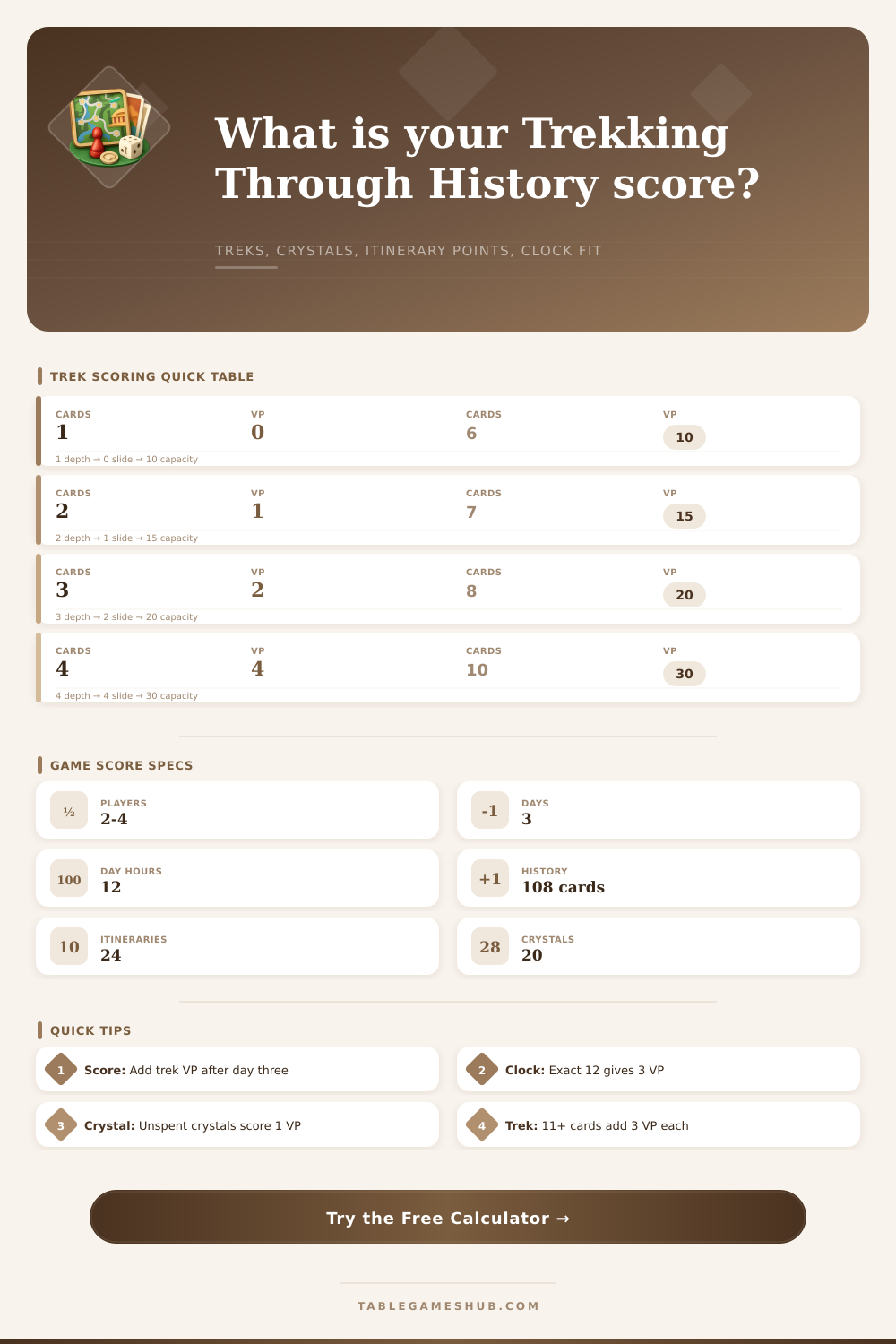
| Trek line | Cards | Formula | VP |
|---|
| Trek cards | Victory points | Calculator formula | Scoring note |
|---|---|---|---|
| 1 card | 0 VP | score = 0 | Single-card treks do not add final trek points. |
| 2 cards | 1 VP | score = 1 | Small chronological chain. |
| 3 cards | 2 VP | score = 2 | Common early-day reset total. |
| 4 cards | 4 VP | score = 4 | First meaningful run jump. |
| 5 cards | 7 VP | score = 7 | Used in the rulebook final-score example. |
| 6 cards | 10 VP | score = 10 | Mid-length trek scoring line. |
| 7 cards | 15 VP | score = 15 | Used in the rulebook final-score example. |
| 8 cards | 20 VP | score = 20 | Large chronological run. |
| 9 cards | 25 VP | score = 25 | Near top of the printed reference. |
| 10 cards | 30 VP | score = 30 | Printed cap before the extension rule. |
| 11+ cards | 30 + 3 each beyond 10 | 30 + (cards - 10) x 3 | Rulebook note for treks above 10 cards. |
| Component | Count | Per-player or setup use | Calculator use |
|---|---|---|---|
| History cards | 108 | 36 cards in each of Day I, Day II, and Day III decks. | Supports history cards taken and row-flow estimates. |
| Ancestor cards | 12 | Use 6 for 2 players, 9 for 3 players, 12 for 4 players. | Checks ancestor availability against player count. |
| Experience tokens | 84 | 20 Person, 18 Event, 16 Innovation, 16 Progress, 14 Wild. | Audits placed token mix and itinerary fill rate. |
| Time crystals | 20 | Players start with one and collect more from effects. | Adds 1 VP per unspent crystal and reduces clock moves. |
| Itineraries | 24 | Deal four to each player at setup; choose one each day. | Frames three-day itinerary point audit. |
| Time Warp cards | 24 | Optional module with three cards selected for the game. | Flags whether the optional module is in the audit. |
| Clock line | Rule value | Formula in calculator | Result impact |
|---|---|---|---|
| Day length | 12 hours | remaining = 12 - current hour | Determines whether the chosen card fits the day. |
| History card hours | 1-5 hours | net move = max(1, card hours - crystals spent) | Lower net movement can preserve clock space. |
| Ancestor visit | 3 hours | tracked through ancestor cards used and trek length | Consumes supply and can add a card to a trek. |
| Punctuality bonus | 3 VP | if net move = remaining hours, exact bonus = 3 | Calculator reports a +3 landing opportunity. |
| Overshoot | Stop at 12 | if net move > remaining hours, overshoot = net - remaining | No punctuality bonus is projected. |
| Final crystal scoring | 1 VP each | crystal VP = unspent crystals x 1 | Added after the third day with trek VP. |
| Players | Ancestor setup | Base clear rectangle | What the calculator adds |
|---|---|---|---|
| 2 players | 6 Ancestor cards | 36 x 30 in / 91 x 76 cm | Buffer factor for crystal tanks, itinerary sheets, and player score markers. |
| 3 players | 9 Ancestor cards | 42 x 32 in / 107 x 81 cm | Extra edge width for a third itinerary and token reach. |
| 4 players | 12 Ancestor cards | 48 x 34 in / 122 x 86 cm | Largest standard setup footprint plus selected buffer. |
Score audit: Keep the score track subtotal separate from final trek scoring. The final formula is score track + unspent crystals + trek VP + verified correction.
Clock audit: For an exact-12 check, subtract planned crystals from the chosen card's hour value, but never reduce the move below 1 hour.
Token audit: Count placed experience tokens by type before clearing an itinerary. Wild tokens are tracked separately so the fill rate stays honest.
Component audit: Ancestor supply changes by player count. Compare used ancestors against 6, 9, or 12 before blaming the tray count.
That is why an auditing calculator is so important. You might play a game of Trekking Through History, reach the end, and discover that you haven’t got a clue whether you’ve lost or won. There’s a certain type of terror that set in. I mean, sure, you put down some tokens. And yeah, you moved your clock. But math at the end seems more like solving a quadratic equation with the houselights rising.
With a proper audit tool, however, the haphazard finale turns into a neat accounting of which moves paid off (and which ones didn’t). No more staying up past bedtime arguing over how many points a seven-card trek is worth, either fifteen or sixteen, amirite? Once you input your own numbers into the calculator above, it does all the dirty work for you, so you don’t have to go back to rulebook to find the scoring table again.
Why Use an Audit Calculator?
Balance Speed vs. Maintain consistency. Consistency This is the core of the game. On one hand, you want to collect all those experience tokens on the board by filling out your itineraries as fast as possible; on the other hand, you need to stay within twelve ticks of your pocket watch. If you land at thirteen or beyond, you screech to a halt. You no longer have any turn order and, maybe more importantly, you can’t set up for the next day.
In theory, it seems easy enough, but in play, it’s a constant juggling match between taking that high-value History card and banking just enough Time Crystals so that you’ll land right on the hour. A lot of people don’t even consider crystals until deep into the game, thinking of them only as currency and not as strategic ways to slow down. Think of them instead as a form of insurance against yourself when you start getting aggressive.
Where most folks trip themselves up is on the scoring math: It’s not linear. Shorter treks don’t play as well when chained together. When they’re done, a single card give you zero victory points. So hoarding cards without playing them in chronological sequence are a losing strategy. To begin to see returns, you’ll want to put down at least a two-card run, if not three.
You can trust the calculator to apply the right (non-linear) formula for each trek length you input. You won’t have to remember “four cards equals four points but eight cards equals twenty.” Instead, it will highlight the value of longer chains, making it clear just how much more efficient a huge timeline is compared to multiple smaller timelines. This is typically the efficiency gap between casual players and competitors who actualy study their deck composition.
Then there’s another layer, the physical space in which the game plays out. On a normal dining table, with four players, do your itineraries cramp each other’s style? There’s also an option called footprint check. This takes into account size of token banks and player mats so you can see whether your hands can get to your own score track without bumping into somebody else’s crystals.
This matters more than you think. When the game flow degrades immediately due to this sort of thing, you’ll end up spending more time shuffling components around than making decisions. And nobody wants that, especially on the third day after everybody’s already tired and just want to be done with it.
Also note that it will calculate for you how many crystals is leftover at the end. Each crystal in your hand during the last scoring round becomes a direct victory point. This means there’s a strange second economy building up, where holding onto crystals could of been as strong as spending them on quick cards. Your leftovers go straight into your tally and show you your actual net result.
You have to ask yourself if you were merely lucky or overly conservative. And sometimes being lucky is good enough to win. But understanding when you’re doing well and why are better for improving next time.
At its core, Trekking Through History is all about making the most of limited time in an increasingly limited world. The math, when properly tabulated, doesn’t care whether you’re maximizing itinerary coverage or ticking things off with precise clockwork; it simply tells you what’s going to happen when it’s all said and done. A systematic auditing process will eliminate guessing games and allow you to concentrate on where it really matters: doing the best you can with the cards you’ve been dealt before time runs out.
Ultimately, it’s nothing more than a bunch of choices added up and put on display for judgement.