Trampoline Calorie Calculator
Estimate trampoline and rebounder calories from body weight, session time, bounce cadence, rest ratio, bed type, skill drills, and MET intensity.
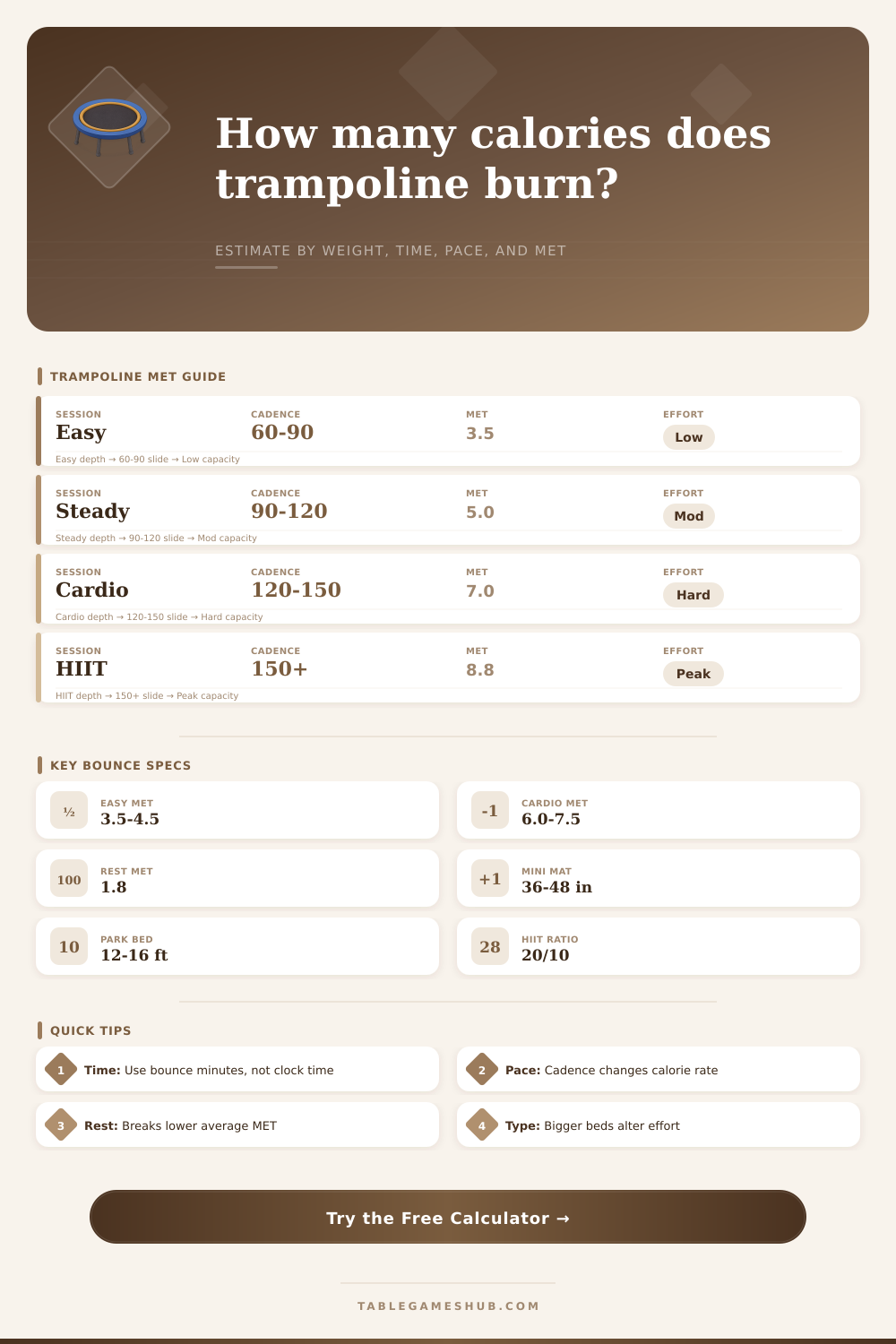
| Trampoline session | Typical cadence | MET range | Calculator use |
|---|---|---|---|
| Easy health bounce or warmup | 60-90 bounces/min | 3.5-4.0 | Low impact, light effort sessions |
| Light continuous rebound | 80-110 bounces/min | 4.0-5.0 | Beginner steady bouncing |
| Moderate fitness bounce | 100-130 bounces/min | 5.0-6.5 | Most general rebound workouts |
| Cardio rebound circuit | 120-150 bounces/min | 6.5-8.0 | Fast sequences with arm drive |
| Vigorous intervals or plyo drills | 145+ bounces/min | 8.0-10.0 | Short hard work bouts with rests |
| Workout pattern | Work block | Rest ratio | Best input approach |
|---|---|---|---|
| Continuous warmup | 4-8 minutes steady | 0-5% | Use easy intensity and actual clock time |
| Fitness rebound class | 3-6 minute songs | 8-18% | Use moderate or cardio intensity |
| Backyard play turns | 2-5 minute turns | 20-45% | Enter waiting time as rest ratio |
| Skill drill blocks | 30-90 second efforts | 15-35% | Select the closest drill modifier |
| HIIT rebounder intervals | 20-45 second efforts | 25-50% | Use vigorous intensity plus rest ratio |
| Trampoline type | Mat size cue | Factor | Why it changes the estimate |
|---|---|---|---|
| Soft bungee rebounder | 36-48 in | 0.95x | Smoother rebound can reduce peak push-off |
| Spring mini trampoline | 36-48 in | 1.00x | Baseline for compact rebound workouts |
| Round backyard trampoline | 8-15 ft | 1.04x | More travel and higher bounce potential |
| Rectangular backyard trampoline | 8 x 12 ft+ | 1.08x | Longer bed supports running patterns |
| Trampoline park bed | 12-16 ft lanes | 1.12x | Sessions often mix turns, travel, and skills |
| Performance training bed | Competition style | 1.16x | Higher rebound and drill intensity potential |
| Drill focus | Modifier | Common cadence | Calculator note |
|---|---|---|---|
| Basic bounce only | 1.00x | 70-120 bpm | Use when most jumps are vertical and simple |
| Arm drive and knee lifts | 1.04x | 90-130 bpm | Adds upper-body rhythm and leg lift effort |
| Twists and side-to-side travel | 1.08x | 90-135 bpm | Accounts for lateral movement and rotation |
| Seat drops and shape jumps | 1.12x | 70-115 bpm | Lower cadence, higher skill movement demand |
| Tuck jumps and plyo drills | 1.18x | 60-110 bpm | Higher effort despite lower repetition count |
| Mixed park skills | 1.24x | Variable | Use with a realistic rest or waiting ratio |
As difficult as it is to measure the energy expenditure associated with trampoline exercise, the effort that individuals feels when jumping on a trampoline doesnt necessarily reflect the amount of calories that is burned. Many individuals may begin to feel fatigued after jumping on a trampoline, but they may not know how many calories is burned during those periods of fatigue. The fatigue that individuals experience while jumping on a trampoline is due to the effort that they have to put in to fight gravity and the tension of the mat; the tension of the mat often leads to rhythmic exhaustion.
Due to this rhythmic form of exhaustion, it is difficult to fully quantify the energy that is use during trampoline exercise. Most individuals use estimates as to how many calories are burned using a watch to time there exercise or by feeling fatigued after exercise. The use of a simple timer to estimate the calories burned after jumping on a trampoline is often inaccurate due to the non-linear nature of trampoline exercise.
How Many Calories Do You Burn Jumping on a Trampoline?
Instead, the calculator included on this page use a method of separating the active jumping time from the total amount of time spent on the trampoline to account for the ratio at which individuals rest during exercise. By accounting for the ratio at which individuals rest during exercise, individuals can avoid underestimating the calories that they burn during exercise. Furthermore, the use of a calculator that accounts for the active jumping time as well as the resting time allow for individuals to gain an average number of calories burned during exercise.
The actual energy expenditure while jumping on a trampoline is dependent upon the individual’s cadence; cadence is the number of times an individual’s feet hit the mat per minute. Bouncing at a slow cadence is often used to allow for lymphatic drainage or to warm up prior to jumping at a faster cadence. However, slow cadences do not burn as many calories as faster cadences; increasing the cadence to a cardio range increases the number of calories that is burned.
Furthermore, increasing the cadence also increases the energy expenditure for the same reasons that an increased cadence increases the number of calories burned; the individual’s muscles have to work harder at a faster cadence. Therefore, measuring the cadence of an individual while using the trampoline is one of the most important measurements to determine energy expenditure. Additionally, the type of trampoline that is used also affects the energy expenditure for those jumping on the trampoline.
Small bungee cord jumpers are typically softer on the joints than massive backyard jumpers or those that is located in parks. However, the jumps required of the bungee jumpers are not the same as those required of individuals jumping on massive trampolines. Furthermore, the massive trampolines require individuals to jump higher and travel lateral on the mat; this increased jumping and movement increases the energy expenditure of those jumping on these mats.
In addition to the individual’s energy expenditure, the skill with which an individual jumps on the mat also increases the energy expenditure of those jumping. Performing basic jumps only require the use of a certain set of muscles; however, jumping with skills like knee lifts, twists or tuck jumps also requires additional sets of muscles to become active. As a result, the energy expenditure of jumping on a trampoline increases with the increase of the complex movements of jumping; increased use of muscles increases the MET value of jumping; MET values are a measurement of how hard the heart must work to provide oxygen to the extra muscles.
Furthermore, the calculator included on this page can also account for the MET value. The trampoline is a tool that can be used to increase cardiovascular health; however, the trampoline is also potentially deceptive of the health of those jumping on the trampoline. Because the mat is low impact, individuals can push their heart rates to be higher while on the mat than on pavement; however, the mat also helps the individual to jump.
Therefore, individuals may feel like they are either working harder than they actualy are, or they may feel like they are working less than they actualy are. The use of a weighted MET estimate can help to account for this potential deception of the cardiovascular health of individuals jumping on the mat. An accurate measurement of calories burned can be obtained by being honest in the input of the amount of time that an individual rested while jumping on the trampoline.
While the work-to-rest ratios for classes on the mat may be much more strict than those for backyard jumps, individuals that count calories burned during jumping on a trampoline must account for the percentage of time that they rested during jumping. For instance, if an individual jumped on a trampoline for twenty minutes but rested for forty minutes, the individual cannot claim that they were burning calories during the sixty minute time frame. Furthermore, the percentage of time that an individual rested accounts for the percentage of time the individual’s body was not burning calories.
Therefore, honest reporting of the percentage of time that an individual rested will allow individuals to more accurately calculate their energy expenditure while jumping on the trampoline. An understanding of these variables related to jumping on a trampoline will allow individuals to turn jumping on a trampoline into an exercise that can be planned according to the goals of those individuals. Once individuals understand the relationship between each of these variables, they can begin to manipulate each of those variables in order to achieve their goal.
For instance, individuals that wish to burn more calories but who wish to spend less time jumping on a trampoline can increase their jumping cadence or use skills with the trampoline that also increase the MET value. Furthermore, increasing jumping cadence or using skills on a trampoline will allow those individuals to work with the physics of the jump in order to achieve their goals for jumping on that mat. Thus, the goal is not to find the perfect number of calories that can be burned in a given time period, but to find the baseline for jumping on a trampoline.