Pitch Card Game Score Calculator
Total a Pitch hand from the bid, point cards, game value, optional jokers, last trick, setbacks, running score, and exact race to the target.
1Preset Pitch Hands
Pick a realistic table state, then adjust the point owners or score settings to match your house variant.
2Game Setup and Bid
3Point Owners and Game Count
Low is usually awarded to the side that captures the low trump, while game is awarded by card-count value.
4Custom Point Switches
5Pitch Component and Spec Grid
6Reference Tables
| Point Name | Classic Use | Who Scores It | Calculator Field |
|---|---|---|---|
| High | Always in classic Pitch | Side that wins or is dealt highest trump | High trump point |
| Low | Always in classic Pitch | Often the side that captures low trump | Low trump point |
| Jack | Always if jack appears | Side that captures jack of trump | Jack of trump point |
| Game | Always in classic Pitch | Side with higher game-card value | Game point winner |
| Variant | Total Points | Added Items | Typical Target |
|---|---|---|---|
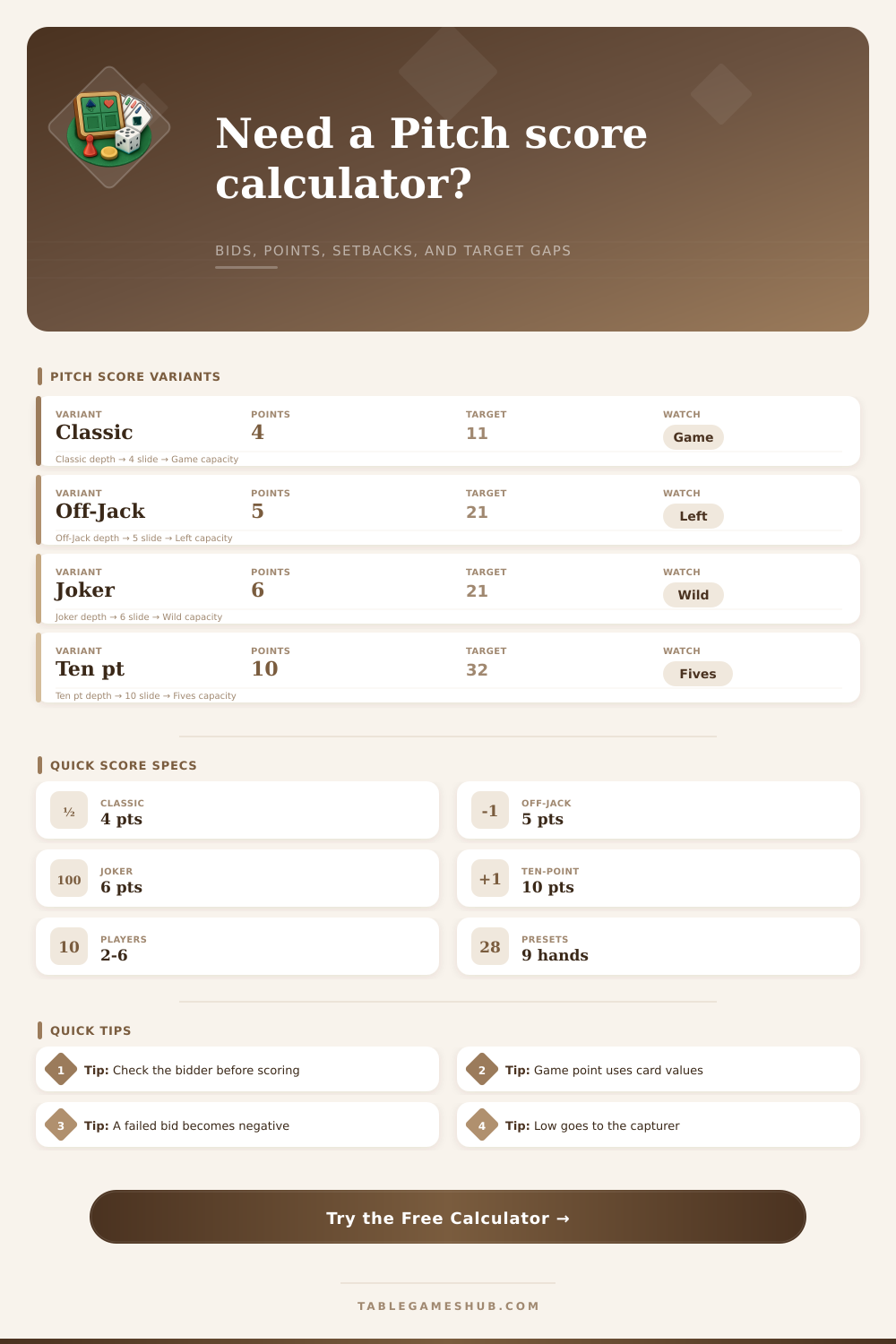
| Classic 4-point | 4 | High, low, jack, game | 11 or 21 |
| 5-point Pitch | 5 | Off-jack added | 21 |
| 6-point Pitch | 6 | Off-jack and joker added | 21 |
| 7-point Pitch | 7 | Last trick added to six-point set | 21 or 31 |
| 10-point Pitch | 10 | Five of trump and low joker options | 32 or 52 |
| Game Count Card | Count Value | When Counted | Score Note |
|---|---|---|---|
| Ten | 10 | Captured in tricks | Large swing in game point totals |
| Ace | 4 | Captured in tricks | Useful when auditing close game ties |
| King | 3 | Captured in tricks | Add to the side that took the trick |
| Queen | 2 | Captured in tricks | Part of the game-card count only |
| Jack | 1 | Captured in tricks | Can count both as jack point and game value |
| Scoring Situation | Bidder Points | Opponent Points | Running Score Effect |
|---|---|---|---|
| Bid made | Scores captured Pitch points | Scores captured Pitch points | Both sides add their hand points |
| Bid failed | Subtracts bid by common setback rule | Scores captured Pitch points | Bidder may fall below zero |
| Game point tie | No game point unless house rule differs | No game point unless house rule differs | Use tie option in game owner field |
| Missing jack | No jack point if not dealt or not in play | No jack point if not dealt or not in play | Set jack owner to no jack appeared |
7Pitch Scoring Tips
Bid audit: Score the bidder's captured Pitch points first, then compare that total to the bid before adding it to the running score.
Game point check: Count game-card value separately from Pitch points; the side with the higher count earns one game point.
Most people remember a round of pitch as an argument around the kitchen table about scores and whose card was trump. How does one keep score? Pitch balances between chaotic family fun and structure of contract bridge. The bidding feels serious for thirty seconds until someone forget whether they bid three or four. And by the point where anyone starts trying to count up game cards, whatever logic got us this far has melted away into white noise.
It’s too late. This calculator step in to prevent that downward spiral from destroying your evening. Most home games comes undone here. A tool should track the bids against captured points so you don’t have to do all the math yourself. There’s no need to hunt down some strange rulebook every time someone switches players; the presets will handle it for you.
How This Score Calculator Helps Your Game
After locking in the variant. Either the lighter four-point Pitch or something beefier like ten-points, you input who won the bid. This is more important than it appears because typically when you fail to make a bid you take a setback penalty. The calculator gives you an option to select how punishing that penalty are. That reflects your table’s house rule; some groups simply drop the hand, while others take away the entire amount of the bid from game total, burying a team in short order.
After that you get into assigning who gets what for high trump, low trump, jack, and game value. What’s nice about this piece is the game point portion, which force you to actually count cards (not just win tricks) in order to determine how many game points are earned. Capturing the 10 of trump earns ten points toward your game count, but an ace earns you four points. That can make all the difference in a tight hand when you’re tied in trick counts.
The app calculates that for you so you do not have to do any mental math and it keeps the conversation flowing. Want to add off-jacks? Jokers? Toggles flip on automatically. It’s not about learning all the variants: It’s about knowing exactly which game you’re playing.
And this is where beauty lies: Pitch scoring isn’t just additive; it’s positional. There’s some amount of risk in every bid proportional to how high it scores (the higher the target, the more you have riding on it). How does your team know when to go for broke and when to play safe? With the calculator, they’ll see exactly what gap remains after each hand. And seeing the running total updated instantly keeps them from second-guessing earlier rounds.
Want to adjust how much each card is worth? Need to tweak the value of the five of trump? You can do that too, whenever local traditions differ from standard rulebooks. The obvious math is one thing, but proper scoring also alters your play of next hand: not having to guess at momentum can be as important than having an exact score behind you.
In traditional Pitch, for example, a small lead doesn’t mean much until it is seven or eight. In ten-point Pitch, however, losing any number of points make the game feel even more lopsided because every hand moves the score faster. To explain all this structure, without burdening players with a book of rules, the page features reference tables that spell out who’s contributing what to what total, and when those points realy start coming into play.
In the end though it’s not about preventing fights because someone can’t do subtraction; it’s about giving the game breathing room by bringing us back to partner communication and bidding strategy when we have clean scorekeeping. Once you stop worrying about whether you added the jack points from the previous round, you can pay closer attention to your partner’s lead. That change in attention makes the game become real play as opposed to a frenetic scramble for control.
Once you plug the variables into the calculator above, it does the math for you. This lets you get back to the banter and bluffing, which are actualy why people like to play this game at all. Toss the napkin aside for coffee stains and give the book-keeping back to the tool. You should of used this earlier!