Tragic Number Calculator
Estimate a trailing team's elimination number from cutoff wins, remaining games, tiebreak status, and live loss/win combinations.
Elimination Snapshot
| Item | Formula | Meaning | Common Check |
|---|---|---|---|
| Max trailing wins | Wins + remaining | Best possible finish if team wins out | Cannot exceed schedule cap |
| Cutoff target | Cutoff wins + tiebreak penalty | Line the trailing team must still reach | Penalty is 0 or 1 win |
| Cushion | Max wins - target | How many standings movements remain before danger | Negative means no path |
| Tragic number | Cushion + 1 | Combo count that clinches elimination | Clamp to zero if eliminated |
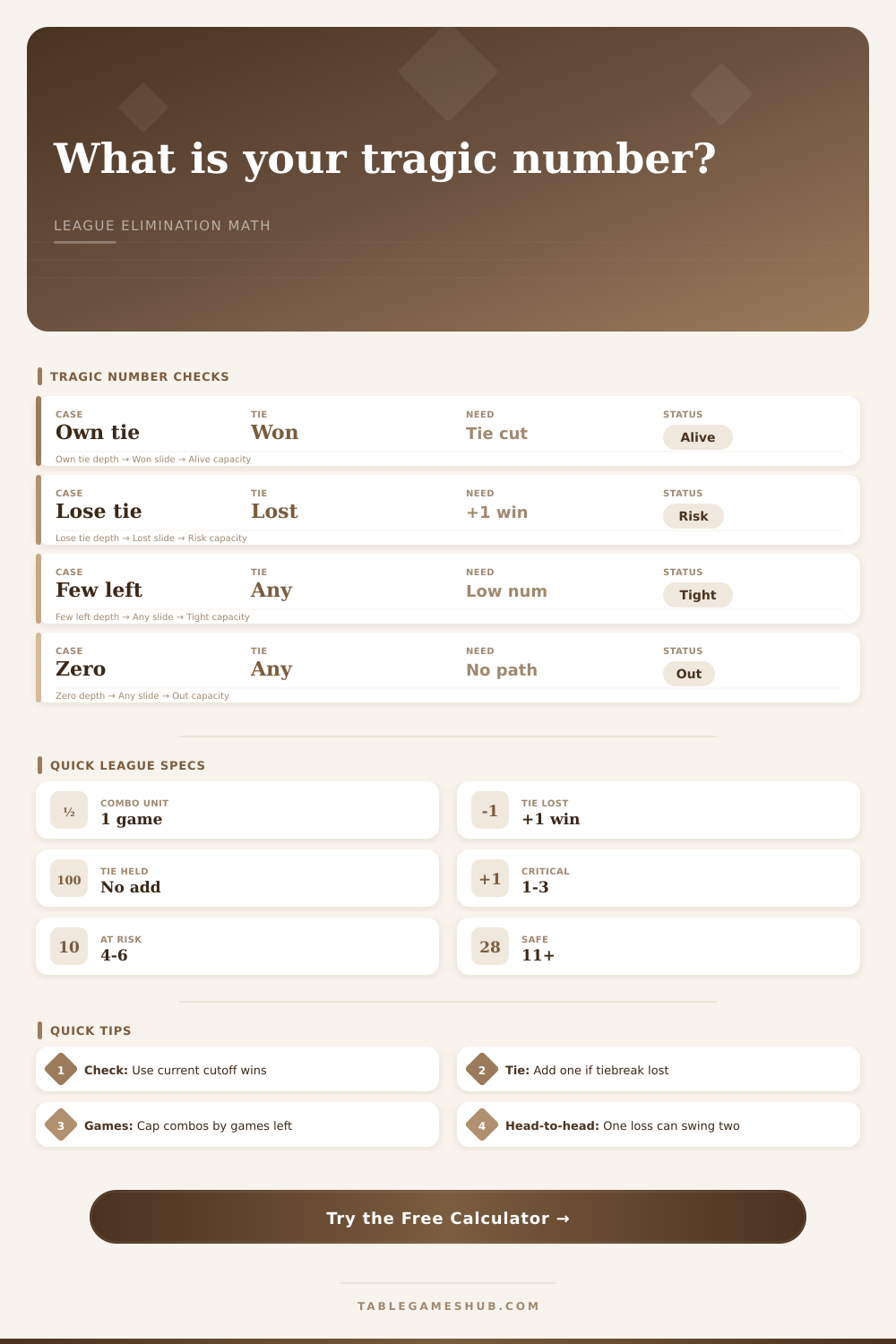
| Tragic Number | Status | What It Means | Watch Item |
|---|---|---|---|
| 0 | Eliminated | Best possible finish cannot reach cutoff line | Tiebreak and schedule already closed |
| 1 to 3 | Critical | One bad series or week can end the chase | Direct games and cutoff wins |
| 4 to 6 | At Risk | Still alive, but little error margin remains | Losses against non-cutoff teams |
| 7 to 10 | Tight | Alive with a visible but fragile cushion | Projected cutoff rise |
| 11 or more | Safe for now | Several combined results are still needed | Long losing streaks |
| Tiebreak Case | Penalty | Cutoff Tie Result | Calculator Use |
|---|---|---|---|
| Trailing team owns tiebreak | 0 wins | Tie can be enough | Target equals cutoff wins |
| Cutoff team owns tiebreak | 1 win | Trailing team must finish ahead | Add one to target |
| No tiebreak available | 1 win | Standings tie does not save team | Add one to target |
| Tiebreak undecided | Use 1 win | Conservative estimate | Recalculate when settled |
| Scenario | Trailing Result | Cutoff Result | Tragic Number Movement |
|---|---|---|---|
| Trailing win, cutoff loss | Improves maximum path | Cutoff line stays flat | No tragic number decrease |
| Trailing loss, cutoff idle | One remaining win removed | No cutoff movement | Minus 1 |
| Trailing idle, cutoff win | Path unchanged | Cutoff target rises by one | Minus 1 |
| Direct trailing loss | Loses one remaining path | Cutoff gains one win | Usually minus 2 |
It never feels like race at the end. It’s more like a waiting room. Every couple of hours, you pull out your phone, cross your fingers and wait for a result that’ll turn the standings in your direction. In sports, though, feelings isn’t reliable. All that remains is an honest metric: the tragic number.
This single number tell you precisely how many more games your team must lose and how many the team in front of yours must win before your hopes die. It removes all noise and leaves only math.
Understanding the Tragic Number
This is what most fans think of when they hear term “magic number.” It’s not. A tragic number is what they call dark mirror. When does it happen? It happens when elimination becomes mathematicaly certain.
Use the calculator up top to crunch numbers for you. But also understand how it arrive at those numbers. Why does it asks for head-to-head records and tiebreak status? Those are more than just box to check. They’re the rules by which an even record determines survival.
Tiebreak position is key input here. You can theoretically have an equal amount of wins as cutoff team and still get into playoffs if you hold tiebreak advantage over them. In other words, it’s like having a save under your belt. Tiebreak loss means needing to have more wins than that team. One point makes all the difference there. That alters the tragic number by a point.
Maybe not big deal, but when you’re fighting for every inch, one game makes all the difference between celebration time and year end review. That’s pretty clear from looking at reference table on the page. How that penalty move everything around.
But there is another hard cap: games remaining. You can’t lose games you don’t have to play. So if you’ve got three games left, then your tragically bad luck cannot include losses that will never occur. That’s why the tool limits number of potential combinations to actual game schedule. It doesn’t let your mind run away with idea that you’re in jeopardy from an infinite number of possibilities. Your schedule brings the math back to Earth, just the games on calendar expose you. It is not the imaginary ones that haunt you.
Things are complicated by direct matchups. Losing to the team that holds cutoff spot counts twice. It lowers your maximum possible wins and raises cutoff team’s count. This doubles effect, which lowers tragic number more quicker than anything else. That’s what makes head-to-head matchup so much more important than regular ones. You could lose one game there and flip two sides of the ledger.
But it’s not just spreadsheet. You need context there as well. Baseball has a long season with daily changes that add up slowley and create tension that burns like a candle. Soccer and football have fewer games, so each one carry more weight. Losing one game can ruin a team’s chances in a short season. Losing a stretch of games during a long one is just a blip on the radar. Know the rhythm of the league you play; adjust the tool accordingly. Five may seem like a tragic number in an eighty-game grind but feel like nothing but safety in a twenty-game league.
At the end of the day, that’s what the tragic number is: a marker of vulnerability. It measures the range of possibilities by telling you how many move your opponent has left until they get you. It never predicts the future; it only sets its limits on what might happen. With the number in hand, you’re no longer in the dark. You don’t need to guess anymore; you simply watch. You know exactly when something matters and when nothing does. The wait is still painful, but not blindly so. You know the precise price of the dream, one game at a time.