Tournament Time Estimate Calculator
Estimate total duration, waves, breaks, playoff blocks, table pressure, and a realistic finish time for Swiss, round-robin, bracket, and pool-cut events.
Estimated Tournament Schedule
| Block | Rounds | Waves | Time |
|---|---|---|---|
| Main event | Calculate | Calculate | Calculate |
| Tables | Main waves | Main time | Finish |
|---|---|---|---|
| Current | Calculate | Calculate | Calculate |
| Format | Round Formula | Match Load | Use When |
|---|---|---|---|
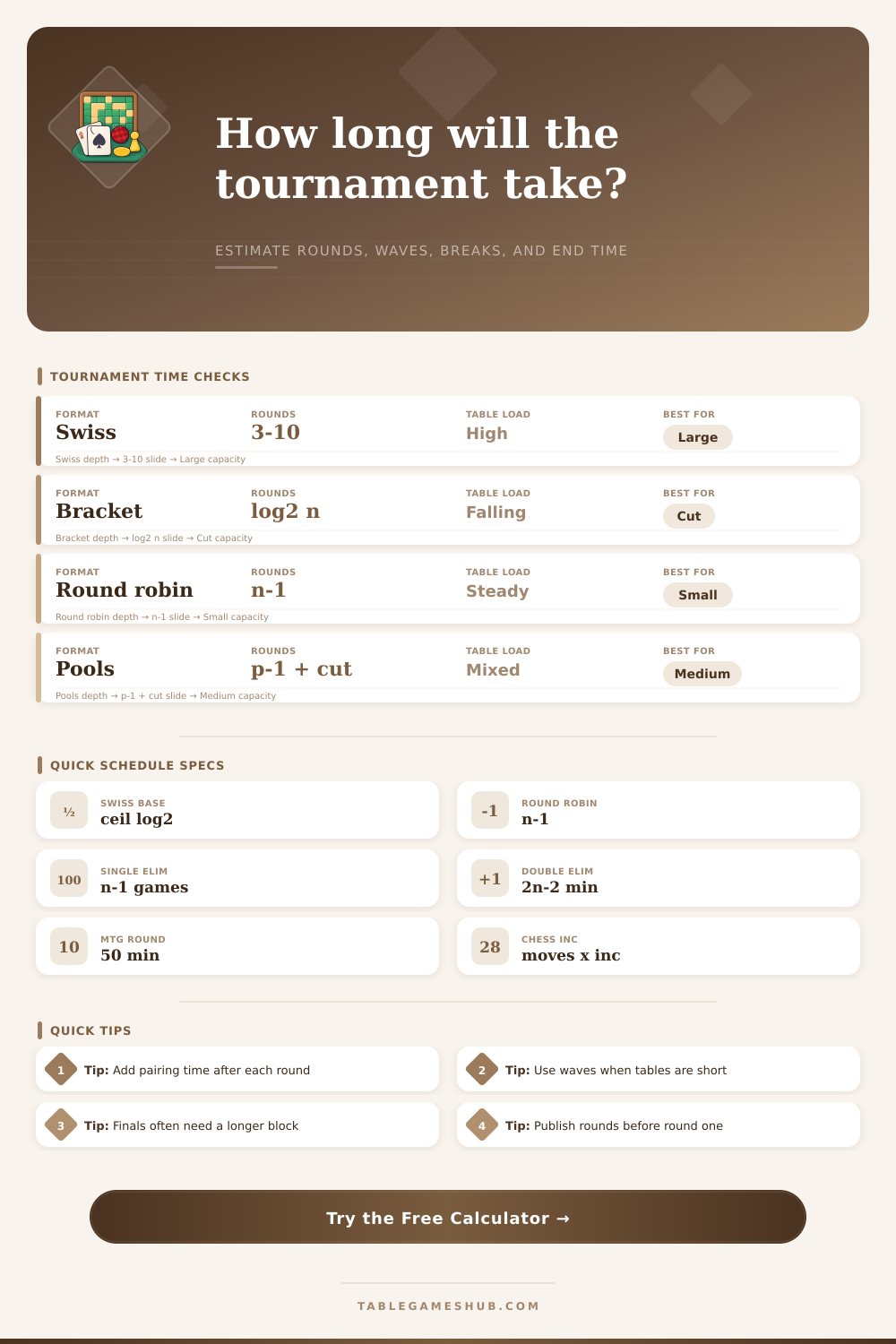
| Swiss | Declared, often log2-like | Rounds x floor(n/2) | Large fields, everyone keeps playing |
| Round robin | n - 1 if even, n if odd | n(n-1)/2 | Small fields needing full comparison |
| Single elimination | ceil(log2 n) | n - 1 played matches | Fast cut with rising stakes |
| Double elimination | About 2 x bracket rounds | 2n - 2 minimum | Second chance brackets |
| Pools plus cut | Pool robin + playoff | Pool matches plus cut | Medium fields and group winners |
| Item | Typical Range | Why It Matters | Calculator Input |
|---|---|---|---|
| Round limit | 25-120 minutes | Largest driver of day length | Base round length |
| Posting time | 5-15 minutes | Pairings, appeals, seat moves | Pairing and posting |
| Turnover | 3-10 minutes | Slip collection and table reset | Table turnover |
| Breaks | 15-90 minutes | Prevents cascading late rounds | Scheduled breaks |
| Buffer | 5-20 percent | Absorbs slow tables and rulings | Schedule buffer |
Fifteen minutes can be the difference between an unforgettable tournament and a crazy, disorganized Friday night. Games is set up, tables are waiting, and players are in place, but there is no schedule. When do we post the standings? Do they eat lunch before or after? Who’s finished with their last round when it’s time to serve dinner? It’s stressful for everyone involved. Anyone who wants to know how long it’ll realy take knows there’s no way to tell.
A solid schedule takes away that tension and converts vague optimism into cold hard facts so you can say “We’re going to be done at ____” and deliver on that pledge.
Why Good Schedules Matter for Tournaments
The second mistake: most planners are underestimating how much people’s behavior slow things down in exchange for game length. “Oh yeah, a card duel will take about half an hour,” they think, “and chess matches comes out to about an hour.” What they forget is that there’s always some time taken between matches: pairing announcements, score sheet collection, seat adjustments, shuffles. Those little breaks add up fast over several rounds and end up being delays that was not obvious at the start but became noticeable around round four. To avoid this, the tool above lets you specify not just amount of time the game itself takes, but also how long it take between games and when players need to be ready. This way, the estimate you produce matches what happens in the room and not necessarily what the rules say.
The first big choice, one that informs all following decisions… Is format. Do you use a bracket (elimination) tournament? Or do you use a Swiss (everyone keeps playing no matter their record)? If you have more players and want to keep them engaged all day, Swiss works best; you can have as many rounds as needed to accommodate the participants, but every round will take longer because tables is squeezed together. On the other hand, if you go with a bracket, you drastically reduce number of rounds because players who lose drop out; but now, you run the risk of idling spectators while you wait for the next round. Know the trade-off, and you’ll know what’s most important: keeping players happy versus timekeeping.
Your next decision depends on the particular event you’re planning. For almost all tournaments, there is one limiting factor: availability of tables. If you have fewer tables than rounds (even just theoretically), then you can’t run multiple rounds at once. When you don’t have enough physical surfaces, the calculator above will tell you number of waves necessary to divide up any round into successive blocks so that everyone gets their chance. This is helpful because it avoids the trap of assuming more participants always means proportionally longer days. That isn’t true. Sometimes not having enough tables can stretch out a day much more than any additional rounds ever would. It makes you face limitations of hardware first and invite people later.
The psychological effect of breaks/buffers is another thing you should of take into account. While a no-padding-zero-efficiency schedule sounds great on paper, in the real world, things happen. Someone forgets something, someone requests a call for the judge, or someone just wants a sip of water. Suddenly, a tightly scheduled day falls apart. Putting a ten percent buffer onto your overall estimate time gives you a safety net, allowing those little hiccups to be absorbed without delaying the closing ceremony. It is just an investment of perceived downtime that will pay huge dividends for the organizer’s sanity. Plus, having the break policy and round count posted prior to the event establishes the expectation, so when people show up and see the clock doing what it’s doing, they know why.
So all things considered, real challenge of running a tournament is mastering time management. You must juggle limited resources like equipment and talent with another scarce commodity: time itself. If you can calculate precisely how many hours will be spent on awards, breaks, pairings, and play, then you can turn a bunch of loosely connected games into a well-structured experience that’s not only over sooner then later, it’ll also end at a predictable point where everyone present can say “Oh yeah, I know exactly how long this took.”