Brass Birmingham Beer Calculator
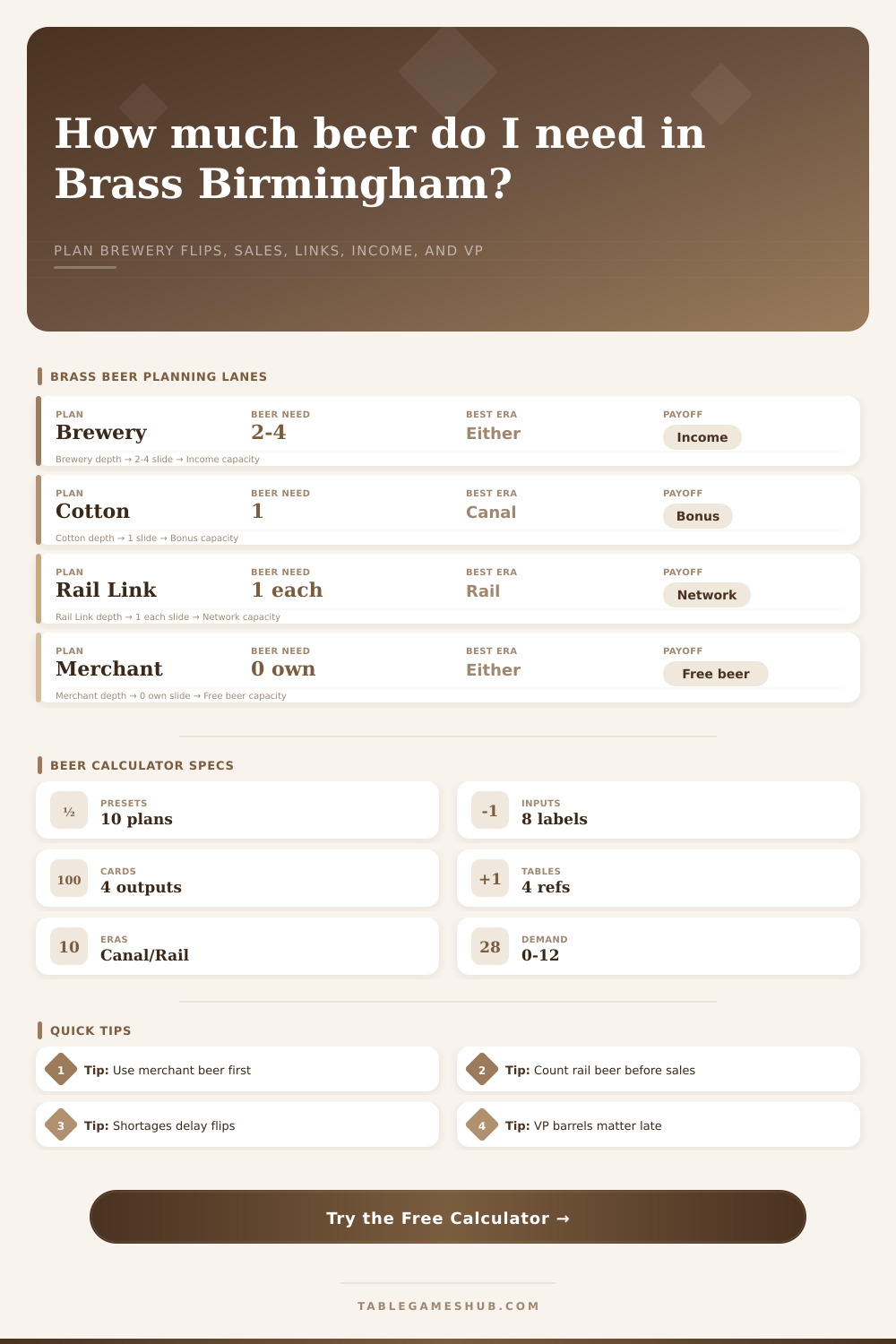
Estimate how many barrels your plan consumes, whether breweries flip cleanly, and how beer changes income, victory points, merchant bonuses, and link tempo.
1Presets
2Beer Plan Inputs
3Reference Tables
| Action | Beer Need | Planning Note |
|---|---|---|
| Sell cotton | Usually 1 | Merchant beer can cover isolated sales. |
| Sell goods | Usually 1 | Manufactured goods compete with cotton for timing. |
| Pottery sale | Often 1 | High VP makes beer shortages painful. |
| Rail link | 1 per link | Rail era can spend beer faster than sales. |
| Era | Beer Pattern | Best Use |
|---|---|---|
| Canal | Sales-focused | Use merchant beer to avoid overbuilding. |
| Early rail | Link spike | Reserve own barrels for network bursts. |
| Late rail | VP conversion | Prioritize high point flips and links. |
| Endgame | Scarcity | Count each barrel against exact demand. |
| Industry | Beer Impact | Score Bias |
|---|---|---|
| Brewery | Adds supply | Income plus tile VP. |
| Cotton | Consumes supply | Merchant timing and income. |
| Manufactured | Consumes supply | Flexible sale tempo. |
| Pottery | Consumes supply | High VP payoff. |
| Bonus | Calculator Effect | When It Shines |
|---|---|---|
| Coin | +3 value | Cash-starved canal turns. |
| Income | +2 income | Early engine tempo. |
| VP | +4 VP | Late rail or pottery sales. |
| Beer | +1 accessible barrel | Sales outside your network. |
4Spec Grid
5Tips
Sure, you’ve got a brewery tile and some possible connections. That’s great! But there’s no way to get those connections if you don’t have any beer. If you have coin to purchase a connection, that doesn’t mean anything; you still require barrels to fuel that connection. And so Brass: Birmingham goes beyond being a game about building engines to something more like a logistical puzzle. Each turn feel like a supply chain crisis. You could theoreticaly construct the greatest network of all time, but what good are those factories if they sits idle waiting for a delivery that never arrives?
To see that tug of war in advance, without spending action points… Use the calculator above. It won’t guide your decision. Instead it reveals if your plan would work in real life. You enter in the amount of barrels available (including courtesy beer from the merchant) and the number of breweries under your control. The tool then matches that supply against industrial connection, sales, and rail link demand. That’s when the coverage percentage appears.
Why Beer is Important in Brass: Birmingham
If the coverage percentage drop too low, a flip isn’t likely. A sale will grind to a halt. That figure will alert you of a bottleneck in advance. Until your network is locked, most players consider beer an afterthought. By that time, it’s often too late. That’s the mistake: thinking that just having a brewery means you have beer. You don’t. Having a brewery mean you have the potential to brew if you can get it connected.
And in the Canal Era, things happen more slowly, there is less pressure and sales are more predictable. Take your time with those merchant bonuses; be casual. Go for coin or income tracks without concern over the free barrel. Then, when you enters the Rail Era, the game speeds up viciously. Each rail link require a beer per link. And each of those beers depletes your supply quicker then any cotton mill.
This is where it gets important: the difference between endgame value and income tempo. In the early game you may want to flip breweries as quickly as possible to get up the income ladder. So you accept lower numbers of beer in-hand knowing you can invest all of them into increasing your network. But later, when points are valuable, cash flow isn’t king. Each barrel represent pure points potential, no longer an indirect sign but a direct one. A lost sale in the last few rounds is not only a loss of income, but a waste of points that will be used by your competitors. The table of reference values at the bottom of the calculator demonstrates how canal era flexibility lets you sell when convenient, whereas rail era demands increases the pressure.
Finally, think about your competition. Does anyone else on the board play? Maybe they’ll clog up the most profitable routes, stockpile barrels, or flood the market with booze in order to depress prices. This board is not a static supply-and-demand world. Read your opponents’ network just as much as your own. If there’s a chance that another player wants that third brewery spot, then you better of get yourself some beer ASAP. Don’t sit around hoping for an easier flip later.
Isolated from your primary engine? Merchant bonuses provide a lifeline. By selling items off the network with merchant beer, you keep your own barrels free for big-money flips. In fact, it preserves your strategic options for high-value flips that build your score. That’s a little move that helps you keep your strategic options open. When you’re after small gains, don’t waste precious personal resources. Let the merchant slot pick up the tab.
Rhythm’s the name of the game with Brass: Birmingham. Connect → Sell → Brew: this is the smooth loop you want. It rakes in the points and money hand over fist. That’s what powers the engine. And beer fuels that engine. When you’re running low, everything grinds to a halt.
Before it fully shuts down your machine, let the tool show you the friction. Stay tuned into that coverage percentage. Pay attention to the increase in usage during the rail period. Recall that a barrel today may save you from last to first place tomorrow. Always plan for the shortage, it’s always coming.