Ticket to Ride Rails and Sails Calculator
Score train routes, ship routes, destination tickets, tour tickets, harbors, unused pieces, and World or Great Lakes map bonuses in one final audit.
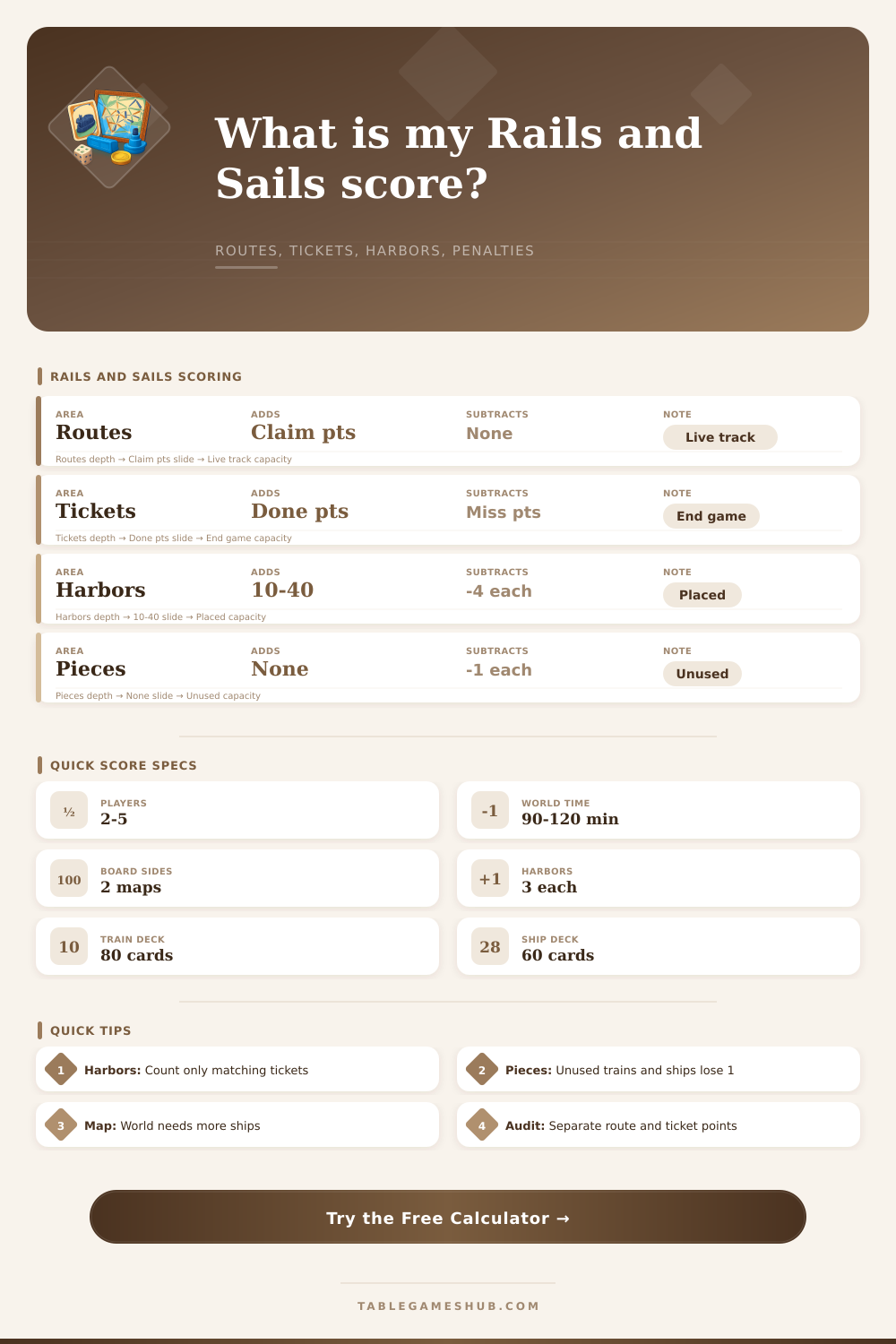
Enter the route points already scored during play, then add hidden end game scoring: completed tickets, missed tickets, harbor tiers, map bonus, and unused train or ship piece penalties.
| Route Length | Route Points | Typical Use | Score Note |
|---|---|---|---|
| 1 segment | 1 point | Short connector | Often closes ticket gaps |
| 2 segments | 2 points | Local rail or ship link | Low risk, low score |
| 3 segments | 4 points | Efficient mid route | Solid value per piece |
| 4 segments | 7 points | Core network route | Strong route tempo |
| 5 segments | 10 points | Major crossing | High route score |
| 6 segments | 15 points | Long rail or sea route | Best common scoring jump |
| 7 segments | 18 points | Extended water line | Useful in ship heavy games |
| 8 segments | 21 points | Large ocean route | Big route score, big piece use |
| Harbor Result | Final Points | Calculator Field | Audit Detail |
|---|---|---|---|
| Placed harbor with no matching completed ticket | 0 | Do not enter | Placed but scores no bonus |
| Placed harbor with 1 matching completed ticket | 10 | Harbors scoring 1 ticket | Ticket must include harbor city |
| Placed harbor with 2 matching completed tickets | 20 | Harbors scoring 2 tickets | Two completed cards count |
| Placed harbor with 3 or more matching completed tickets | 30 | Harbors scoring 3+ tickets | Cap this tier at 30 per harbor |
| Unbuilt harbor piece | -4 | Unbuilt harbors | Subtract for each piece not placed |
| Map Side | Piece Mix | Ticket Deck | Scoring Pressure |
|---|---|---|---|
| World | 25 trains and 50 ships available before selecting 60 pieces | 65 World tickets | More ocean routes and higher ship commitment |
| Great Lakes | 33 trains and 32 ships available before selecting 50 pieces | 55 Great Lakes tickets | Tighter board with sharper route blocking |
| World first play | 20 trains and 40 ships suggested mix | Longer routes | Good baseline for the calculator presets |
| Great Lakes first play | 27 trains and 23 ships suggested mix | Regional routes | Balanced rail and ship route scoring |
| Audit Step | Where It Goes | Formula Use | Common Miss |
|---|---|---|---|
| Score track route points | Train and ship route fields | Train + ship | Mixing route points with ticket points |
| Completed tickets | Destination and tour fields | Add positive ticket values | Forgetting multi-city tour cards |
| Missed tickets | Uncompleted ticket penalty | Subtract absolute card values | Entering a negative number |
| Harbor cities | Harbor tier fields | 10, 20, or 30 per harbor | Counting tickets that do not touch the harbor |
| Unused pieces | Unused train and ship fields | Subtract 1 per piece | Skipping ships left beside the board |
| Unbuilt harbors | Unbuilt harbors field | Subtract 4 each | Only counting placed harbors |
| Spec Item | World Map | Great Lakes Map | Calculator Use |
|---|---|---|---|
| Player range | 2 to 5 | 2 to 5 | Player field and table context |
| Game length | 90 to 120 minutes | 90 to 120 minutes | Preset naming and final audit pace |
| Travel cards | 80 train, 60 ship | 80 train, 60 ship | Route mix notes |
| Harbors | 3 per player | 3 per player | Harbor cap and penalty fields |
| End scoring | Tickets, harbors, unused pieces | Tickets, harbors, unused pieces | Final score formula |
Scoring for the game Ticket to Ride Rails and Sails involve two different types of scoring. Each of these types of scoring happens at a different time during the game. For instance, a player earn points for each of the routes that they place on the game board during the game; however, other types of points is only calculated after the game is over.
For example, each player earns points from the trains and ships that are already placed on the game board, but the player only add points from the destination ticket, harbors, and unused pieces to their total score at the end of the game. A player can use a calculator to keep track of each of these score and to prevent making mistakes with the math required to calculate each category of points for each player. The scoring system related to the harbors on the board can be difficult for many player to understand.
How to Count Points in Ticket to Ride Rails and Sails
Each player places three harbors on the game board during the game. However, the harbors only provide points for each game if the cities represented on the harbors match the cities on the destination tickets that are completed by each player. Specifically, if a player has one destination ticket that match the location of a harbor, the player earns ten points for that destination ticket and harbor; if the player has two destination tickets that match the location of the same harbor, the player earns twenty points for those two destination tickets; if the player has three or more destination tickets that match the location of the same harbor, the player earns thirty points for those destination tickets.
However, if none of the destination tickets matched the harbor where the player placed their harbor tokens, the player lose four points for that harbor. Each player also earns points from the destination tickets and the unused game pieces that they have left in their supply at the end of the game. Each player earns a point for each train car that they have left in their supply for the game; each ship that they have left in their supply for the game also earns a point for each player.
The number of points that are earned for each of these categories can vary depending on which map that the players select for the game. For instance, the World map for Ticket to Ride includes more ships than the Great Lakes map, and the Great Lakes map include more train cars than the World map. Thus, the more unused piece that a player has left in their supply at the end of the game, the lower that players score will be for that game.
The points that are earned from the destination tickets can significantly impact a player total score for the game. Each destination ticket provides points to the player who completes the route that is indicated by the destination ticket; the player adds the value of the ticket to their score for the game. However, if the player does not successfully complete that destination ticket, they lose points equal to the value of that ticket.
Thus, each player can gain a significant number of points from their completed destination tickets, but also can lose a significant number of points if they do not succeed in their attempt to complete those same tickets. It is important for each player to keep the values of their destination tickets separate from their route points; otherwise, players may not be able to fully understand how many points that their destination tickets provide to their total score. Some groups of players may wish to use the map bonus and table awards for the game, but these awards are not included in the standard rules for the game.
For example, one map bonus may be awarded to the player who create the longest route for that game, and one table award may be given to the player who completes the most destination tickets. These bonuses and awards can change depending on the group of players that are using the game; thus, prior to the start of the game, the group of players must decide whether they wish to use these bonuses and awards. The rules regarding these bonuses and awards should not be changed during the game, as any changes to the game rules during play may lead to argument among those players.
By tracking each category of scoring for the game separately, each player can understand how well their strategy for the game was successful. For example, a player with a high score for the route category may have a low final score for the game if they have many unused pieces. Additionally, a player with a high score for the route category may have a low final score if the number of harbors that they control do not match the number of completed destination tickets.
Thus, by reviewing each of these separate scoring categories, each player understand the success of their route and harbor selections for that game, and can use that information to create better routes and select better destination tickets for future games of Ticket to Ride Rails and Sails. It’s also helpful to look at the score based off of how many pieces you have left. You should of checked the rules carefully so you dont make a mistake with the math.
Youll need to be more careful with your scores next time.